

Minister CL John calls for an end tribalism, clanism, factionalism and division in Naga society.
Share


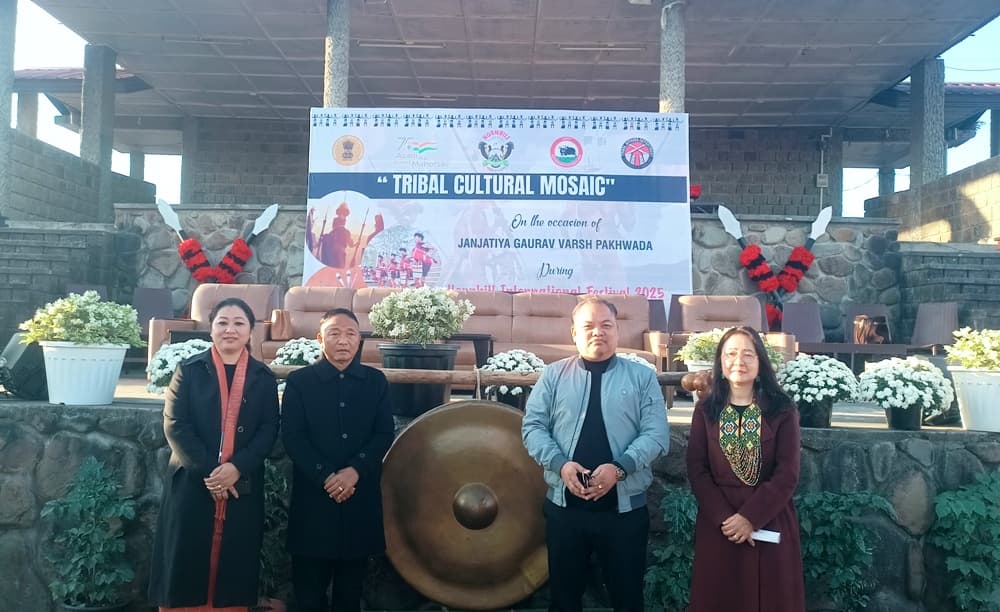
KOHIMA — Minister for Forest, Environment and Climate Change, and Village Guard, CL John, on Saturday made a clarion call to Naga society to end tribalism, clanism, factionalism and division for the society to progress and advance.
The minister was addressing the ‘Tribal Cultural Mosaic,’ organised by the Department of Tribal Affairs, Government of Nagaland, at Naga Solidarity Park, Kohima.
Referring to the past, John said that the Nagas were once headhunters, where heads hunted were considered trophies, and that amidst such practices, Christianity came to the Naga Hills and put an end to them through the Gospel.
He maintained that Christianity, the Naga political issue and Nagamese dialect are unifying factors of Naga society and form part of the people’s identity.
Observing that Nagamese is a dialect commonly used and understood by people from all sections amid various dialects, while English cannot be understood by all, he called for efforts to further develop the language to strengthen the fabric of Naga society
The minister stated that tribalism stems from government offices and churches, not villages, often rooted in clanism. He emphasised the need to overcome this mindset for progress.
Also read: Tribal heritage unfolds at ‘Cultural Show’ on day-6 of Hornbill Festival 2025
Hornbill Festival 2025: ‘Mithun Show’ emphasises need for conservation
He also noted Nagaland's unique opposition-less government, despite multiple parties, and urged Naga society to set aside differences, promoting unity and strengthening it further.
Additionally, he expressed concern over divisions among Christians across denominations, despite sharing the same Bible and hymnals.
He highlighted that each Naga tribe has its own festival, but there's no common festival, and some people consider attending the Hornbill Festival a sin.
He urged understanding of the festival's purpose, calling it a platform for tribes to showcase Naga unity, making it a "unity festival."
Asserting that the Hornbill Festival has put Nagaland on the international stage, boosted the economy, and showcased the state's culture, John emphasised that the festival aims to unify people, not go against religion or God.
Chief host of the event, Advisor for Tribal Affairs and Election, H Tovihoto Ayemi, said the Tribal Cultural Mosaic was envisioned as a platform where the colours, voices and traditions of Naga tribes come together—each distinct yet integral to a shared identity.
He said the event celebrates not only cultural diversity but also the unity that binds communities, noting that the Hornbill Festival has long symbolised pride, harmony and continuity between the past and the present. Through the Mosaic, he said, this spirit is renewed by honouring ancestors who preserved these traditions while encouraging youth to cherish and sustain them.
Ayemi highlighted that Nagaland is home to diverse tribes, each contributing uniquely to the state’s cultural landscape, together forming a living mosaic of unity in diversity.
Angelina Tajen, Secretary, Department of Tribal Affairs, delivered the welcome address, while TL Kiusumong Tikhir, Joint Secretary of Tribal Affairs, proposed the vote of thanks.
Earlier in the day, competitions were held. In the rice husking competition (female), the Rengma tribe won first position, followed by Zeliangrong in second and Konyak in third. In the catapult target-hitting competition, first position was won by Shangtok Phom of the Phom tribe, second by Jill Sangam of Garo, and third by Zulutoshi of the Ao tribe.
In the spear throw competition, S Bhȕktok Phom of the Phom tribe secured first place, followed by Khiti Kath of the Rengma tribe in second and Zulutoshi of the Ao tribe in third.