


Nagaland launched ELIONA, an AI-enabled supercomputing platform for disaster forecasting and climate intelligence.
Share


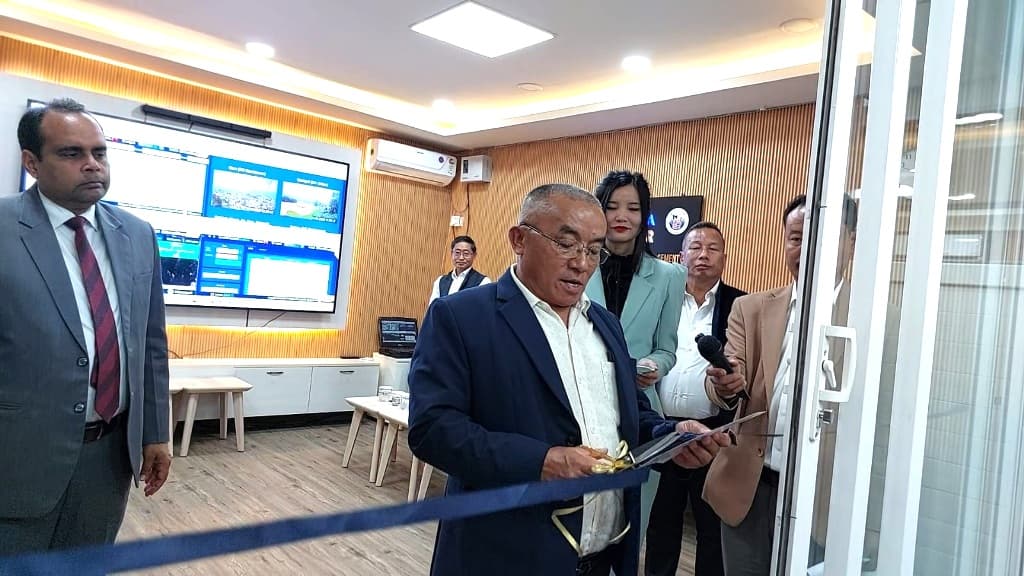
KOHIMA — Positioning technology as a shift from disaster response to prediction and mitigation, the Nagaland State Disaster Management Authority (NSDMA) on Thursday launched ELIONA, an artificial intelligence-enabled supercomputing platform aimed at strengthening disaster forecasting, climate intelligence and decision-making in the state.
The platform was launched by Advisor for NSDMA and New and Renewable Energy Resources (NRE), Z Nyusietho Nyuthe, at the Nagaland Centre for Disaster Management and Atmospheric Research (NaCDAR) in Kohima.
Speaking at the launch, Nyuthe said ELIONA marks a significant step towards improving disaster preparedness, climate resilience, scientific research and technology-driven governance in Nagaland.
Referring to the state’s vulnerability to hazards, he said Nagaland’s terrain, rainfall patterns, seismic sensitivity and exposure to landslides, flash floods and thunderstorms require stronger systems for monitoring, analysis, early warning and timely response.
Also read: Nagaland launches statewide anti-dengue, malaria drive before monsoon
Ahead of monsoon, chief secretary reviews flood-prone areas in Dimapur
According to him, ELIONA has been developed with high-performance computing capabilities to process large volumes of meteorological, satellite, terrain, climate and disaster-related data.
He said the system would support advanced weather modelling, rainfall prediction, landslide and flood analysis, geospatial hazard mapping, climate risk assessment and artificial intelligence-based applications.
WATCH MORE:
Nyuthe added that the platform is expected to strengthen ongoing NSDMA initiatives, including the Nagaland State Disaster Management Information System, disaster risk financing, parametric insurance, damage and loss assessment, urban resilience planning and community-based preparedness.
“In the coming years, ELIONA can become a major decision-support platform for the state, helping departments and district administrations plan better, respond faster and reduce disaster risks more effectively,” he said.
At the same time, he cautioned that technology alone was not the end goal and said the value of ELIONA would depend on whether its outputs translate into field-level action, support district administrations and help protect lives, livelihoods and infrastructure.
Chief Secretary of Nagaland, Sentiyanger Imchen, framed the launch as part of a broader shift in disaster management priorities.
“I have been telling the NSDMA and departments related to disaster management that while humanitarian assistance and relief after disasters are important, the more crucial aspect is to predict and mitigate disasters before they happen,” he said.
Imchen said ELIONA’s computing capacity would allow the state to process large volumes of weather, terrain, climate and disaster-related information for weather modelling, hazard mapping and predictive analysis.
He further stressed that data generated through the platform should not remain unused but should guide resource allocation and proactive disaster prevention measures.
Home Commissioner Abhijit Sinha described the launch as an important milestone in strengthening disaster preparedness, early warning systems, scientific analysis and evidence-based action.
Noting that disasters globally have become increasingly complex and unpredictable, he said advanced technological tools are increasingly necessary for timely and informed intervention.
Sinha said ELIONA, established under NaCDAR, would function as a computational platform for weather modelling, climate risk analysis, satellite data processing and artificial intelligence applications, generating weather indicators, hazard maps and predictive assessments.
Earlier, Dr. Johnny Ruangmei, Joint Chief Executive Officer of NSDMA, presented an overview of the platform.
He described ELIONA as an AI-native climate and disaster intelligence supercomputing platform under the Home Department and said the system is designed for climate intelligence, atmospheric modelling, real-time disaster analytics, geospatial risk computation and predictive disaster governance.
According to Ruangmei, ELIONA is intended to serve as the computational backbone for weather and climate modelling, earth observation analytics, disaster simulation, scientific research and decision intelligence systems.
He said the long-term vision is to establish ELIONA as one of India’s leading AI-powered climate and disaster intelligence supercomputing platforms focused on predictive governance and resilience.
The programme was chaired by Jonjibemo Odyuo, Assistant Manager (Relief, Recovery and Mitigation), NSDMA. Rev. Dr. K Benry Lotha, Senior Pastor of Kohima Lotha Baptist Church, offered the invocation, while the vote of thanks was delivered by Dr. Noyingbeni Kikon, Project Coordinator (GIS and Remote Sensing), NSDMA.