


Ikato Chishi Swu calls for unified Naga government, criticises Hebron leadership, warns of armed resistance amid political differences
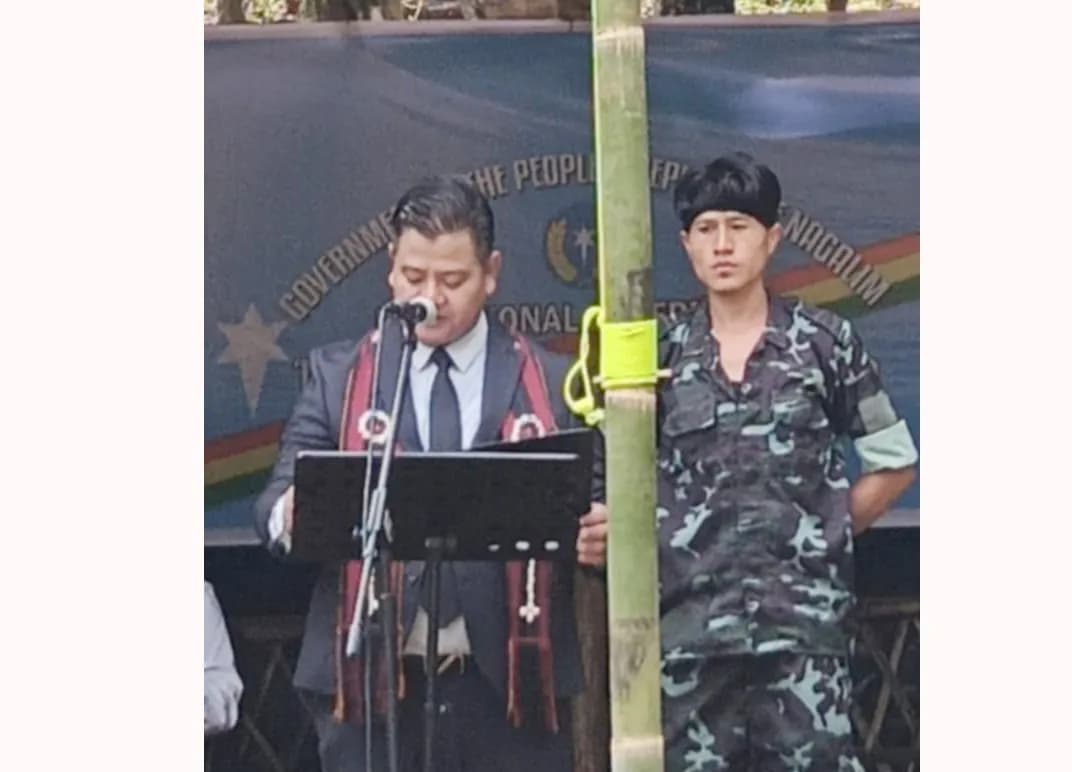
DIMAPUR — A fresh fault line has emerged within the Naga political movement, with NSCN Provisional Government Chairman Ikato Chishi Swu calling for a unified Naga national government and warning that any further breach of the Naga political cause could invite a “strong united and organised response through political as well as armed resistance”.
In his first address as chairman of the Provisional Government on Friday, Swu said that an extraordinary joint meeting of Civil National Workers and Naga Army officers held at Mt Horeb Camp on July 21 had declared the establishment of a Provisional Government until a full-fledged government is formed.
The address was issued from Mt Horeb Camp on the occasion of the 80th Naga Independence Day celebration. He appealed to Naga national workers, Nagas residing across what he described as the 120,000 sq km Naga homeland and the Naga diaspora to join the formation of a unified national government.
The appeal came amid his sharp criticism of the NSCN (IM) Hebron leadership over the Indo-Naga political talks and the competencies submitted to the government of India.
According to Swu, the Hebron leadership’s submission of competencies that fall within the jurisdiction of the Indian Constitution amounted to a compromise of the Naga nation’s sovereign existence and contradicted the principles of the Framework Agreement signed between the government of India and NSCN (IM) on August 3, 2015.
He claimed that the spirit of the Framework Agreement was undermined after the government of India imposed a three-month ultimatum in 2019, insisting that further negotiations would cease unless the Nagas agreed to a separate flag and constitution.
Swu alleged that the Hebron leadership subsequently submitted competencies under pressure from the government of India, which he said contradicted the principles of the Framework Agreement as well as the Naga Independence declaration of August 14, 1947 and the 1951 Naga Plebiscite.
He accused the leadership of becoming increasingly preoccupied with celebrations and ceremonial occasions while failing to attend to its political responsibilities.
“It is in response to this perceived betrayal and political compromise and in view of the threat to the sovereign existence of the Naga nation,” Swu said, that the July 21 joint meeting declared the Provisional Government.
He said the objective was to “save the Naga nation” and rescue the Naga political movement from what he described as its predicament.
Calling on Nagas not to remain passive, Swu said that any further breach must be met with a strong and organised response, “through political as well as armed resistance”.
“We must be ready to defend our political rights with courage, unity and unwavering determination,” he added.
Swu also called for the political movement to remain united, saying differences should not overshadow the common Naga identity or undermine the pursuit of a political settlement.
“My appeal today is not against any particular organisation, leaders or group. It is to the entire Naga nation,” he said.
He maintained that political disagreements should not dismantle Naga unity and that the pursuit of a settlement should not compromise the dignity and aspirations of the Naga people.
On the Framework Agreement, Swu asserted that a just and lasting settlement must have the confidence of the people whose future it shapes. He called for truth to prevail over convenience, public responsibility over personal ambition and accountability over secrecy.
The address also invoked the Naga political movement’s historical milestones, including the 1929 memorandum submitted by the Naga Club to the Simon Commission, the Naga National Council’s declaration of Naga independence on August 14, 1947, and the 1951 Naga Plebiscite.
Swu said these milestones constituted the political heritage left by previous generations and urged Nagas to learn from past conflicts, divisions and political setbacks.
He also acknowledged the people of Eastern Nagalim for their steadfast stand for the Naga cause.
Swu called on Nagas to write the next chapter of their history “in unity not in division; with courage not in fear; in truth not with hatred; in service not with selfish purposes”.