


Nagaland CM Neiphiu Rio says FNTA is no separation, assures Article 371A remains untouched and urges Naga unity.
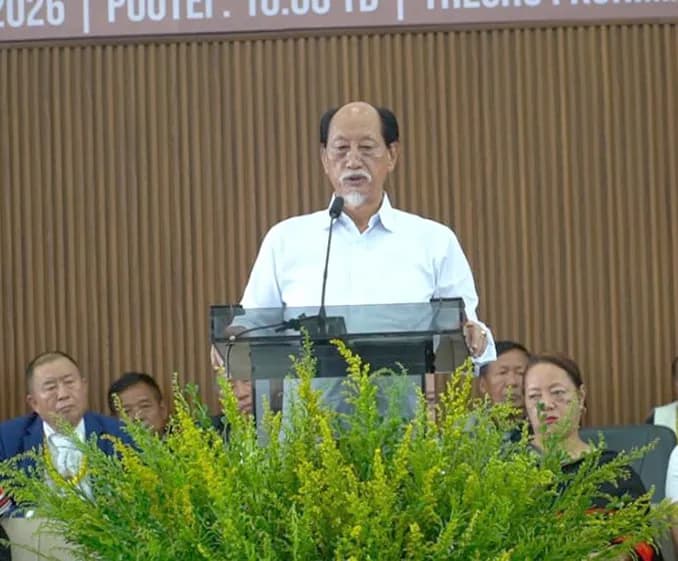
KOHIMA — Chief Minister Neiphiu Rio on Friday sought to allay concerns over the Frontier Nagaland Territorial Authority (FNTA), saying the arrangement should not be viewed as a separation from Nagaland and that there would be no amendment to Article 371A.
Addressing the Angami Public Organisation (APO) general conference at Kohima village multi-purpose building, Rio urged the Angami community to look beyond its own interests and support initiatives aimed at the welfare and development of Nagas as a whole.
Referring to the FNTA Bill, 2026, passed by the Nagaland Legislative Assembly on September 3, he said the focus should remain on the economic upliftment of the region.
He reminded that the state government had sought INR 10,000 crore for development in the region and stressed that the FNTA was an arrangement within Nagaland, rather than a separation from the state.
Rio reiterated that there would be no amendment to Article 371A in connection with the FNTA and urged the Angamis to support the people covered by the arrangement and work towards bringing development in the region on a par with other parts of Nagaland.
The chief minister also called for greater unity among the Naga people, saying fragmentation would not help the community achieve its political goals.
Also read: CAG flags INR 288 cr extra spending in Nagaland’s Jal Jeevan Mission
Expressing concern over the proliferation of Naga GROUPS, he said there were currently 32 officially recognised political groups and lamented that repeated calls for unity had failed to yield the desired results.
On the Naga political negotiations, Rio reiterated the state government’s demand for a ministerial-level interlocutor, saying the demand had been endorsed by 60 organisations in Nagaland.
He referred to growing frustration among groups including the Concerned Naga Forum of Nagaland (CNFN) and the Naga Youth Movement (NYM), which have submitted a memorandum to the president, prime minister and governor seeking a resolution within three months.
Against this backdrop, he said the Nagaland Political Affairs Committee (PAC) met Governor Nand Kishore Yadav on September 2 to apprise him of the matter.
Rio said the Framework Agreement and Agreed Position already exist, but maintained that the negotiations now require ministerial-level engagement to reach a resolution.
He also urged the APO to uphold its resolution on the Inner Line Permit (ILP) and stressed the need for effective enforcement.
On the Register of Indigenous Inhabitants of Nagaland (RIIN), Rio said village councils would be the appropriate authorities to certify indigenous inhabitants, while administrative officers would be responsible for verification. He warned that false certification would invite criminal action.
He called upon village councils to enumerate non-locals requiring ILPs and urged house owners, business owners, contractors and employers to take responsibility for effective implementation of the ILP regime. He added that the ILP system had been digitised.
Rio also urged the Angami community to uphold its traditional institutions and customary practices, particularly as Angamis occupy prominent positions in Kohima and Dimapur.
He said Angamis had been known for visionary leadership and pioneering contributions, adding that leadership came with responsibility. He stressed the need for the present generation to pass on the community’s legacy, traditions and culture to younger generations.
He cautioned that failure to guide the younger generation could result in them adopting values and practices from elsewhere.
Meanwhile, APO president Thejao Vihienuo stressed the importance of preserving traditional and customary practices handed down by elders, adding that collective decision-making and the welfare of the people had long been central to Angami society.
Former APO president Abi Yalie also expressed concern over the proliferation of Naga political groups and called unity the strength of Naga society. He urged Angami legislators to extend their support to other communities as much as possible.