


White Owl Literature Festival examines AI’s impact on humanity and explores why Korean popular culture deeply resonates with Indian audiences.
Share


DIMAPUR — From artificial intelligence reshaping human work and relationships to Korean popular culture redefining global storytelling and fandom, the final day of the 3rd White Owl Literature Festival and Book Fair unfolded as a wide-ranging exploration of how technology, culture and creativity are transforming what it means to be human in the contemporary world.
Across two engaging panel discussions, speakers examined both the anxieties and opportunities of living in an age defined by algorithms, automation and transnational cultural flows—probing questions of identity, authenticity, bias, labour and emotional connection.
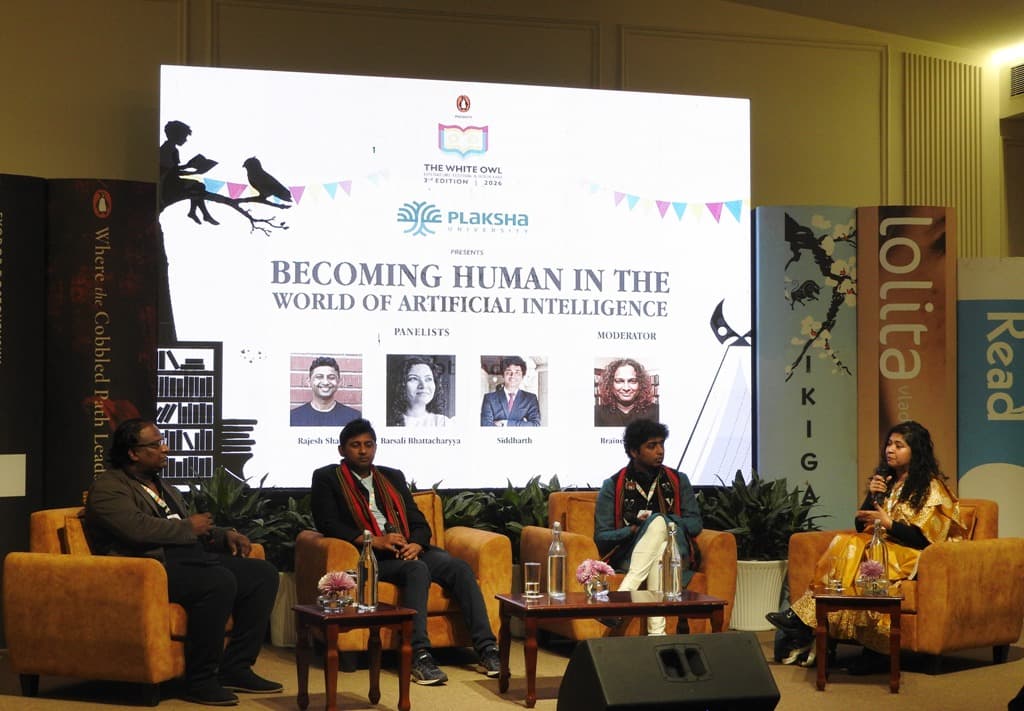
A thought-provoking session titled ‘Becoming Human in the World of Artificial Intelligence’ examined the promises, perils and paradoxes of AI in everyday life, with particular focus on employment, education, creativity, bias and human relationships.
Moderated by Brainerd Prince, Associate Professor and Director at Plaksha University, the panel featured Dr. Sidharth, Assistant Professor at Plaksha University; Barsali Bhattacharyya, Deputy Director at the Economist Intelligence Unit; and Rajesh Sharma, Professor of Computer Science and Artificial Intelligence.
Also read: White Owl Literature Festival 2026: Podcasting takes centre stage
From books to bytes: White Owl LitFest on the creator economy
Setting the tone, Prince outlined three objectives: deepening public understanding of AI, critically examining its benefits and risks, and exploring how humans can continue to flourish alongside intelligent machines.
Bhattacharyya described AI as a general-purpose technology—an umbrella term for tools designed to replicate human tasks. She observed that once such technologies become familiar and widely adopted, they often cease to be perceived as AI and blend invisibly into everyday life.
Tracing AI’s intellectual lineage, Dr. Sidharth referenced Alan Turing’s post-World War II ideas and the famous Turing Test, noting that recent breakthroughs—particularly large language models like ChatGPT—have intensified both fascination and fear because they operate in language, a domain long considered uniquely human.
Sharma offered a technical perspective, explaining that AI systems learn through pattern recognition across massive datasets, relying on repetition and reinforcement rather than consciousness or intent.
Employment emerged as a central concern. Acknowledging fears of job displacement, Dr. Sidharth cited global figures showing tens of thousands of jobs lost to automation, urging a shift toward human–AI collaboration rather than competition.
Bhattacharyya added that while new jobs are emerging, replacements are not always equitable, raising questions about whether displaced workers are genuinely better off.
The panel also examined AI’s role in education and creativity. While AI tools can enhance individual productivity, research suggests collective originality may decline as outputs become increasingly homogenized.
On bias and representation, Sharma agreed that AI systems often reflect social prejudices embedded in their training data—ranging from gender stereotypes to limited cultural diversity. Bhattacharyya warned that uncritical reliance on such systems risks reinforcing outdated norms, underscoring the need for inclusive datasets and ethical oversight.
Concerns were also raised about AI companions and chatbots, particularly their potential to foster emotional dependency and distort human relationships. Reflecting on preserving humanity in an AI age, Dr. Sidharth highlighted the importance of physical community spaces—parks, sports fields and shared activities—in nurturing empathy and social skills.
Bhattacharyya asserted that human imperfection is a strength, suggesting that authenticity and vulnerability will grow more valuable in a world saturated with polished AI-generated content.
The Hallyu wave
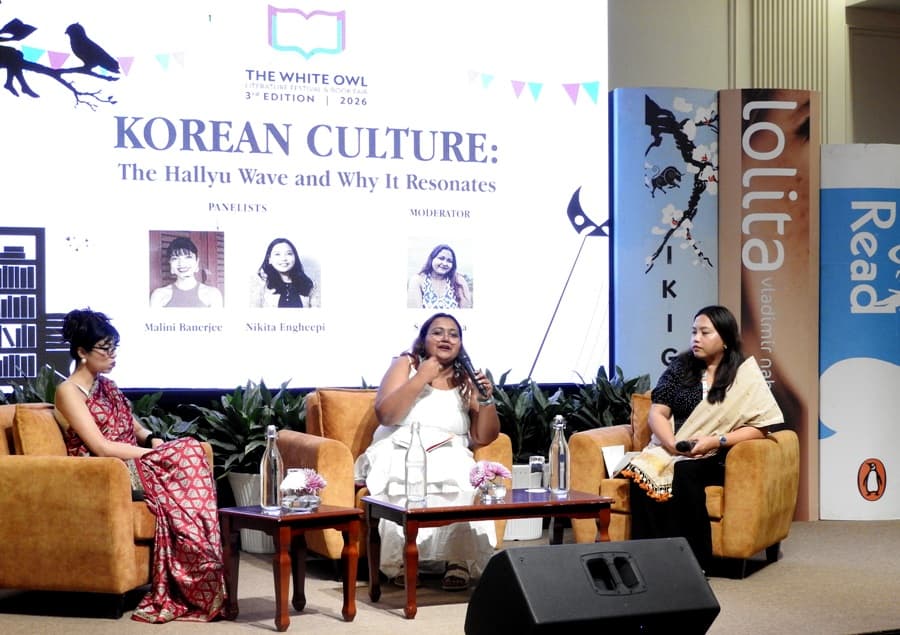
In another session titled ‘Korean Culture: The Hallyu Wave and Why It Resonates,’ speakers explored the growing global influence of Korean popular culture and its deep resonance with Indian audiences.
Moderated by Saumya Jha, a brand and communication professional at Penguin Random House, the panel featured Malini Banerjee, a media professional turned singer-songwriter, and Nikita Engheepi, entrepreneur and co-founder of Pink Box Entertainment and Namaste Hallyu.
Banerjee shared her personal entry into Korean culture, recalling that she grew up immersed in Bollywood and was far removed from K-culture until 2016, when a friend showed her a black-and-white wedding photograph of actors Song Joong-ki and Song Hye-kyo. Intrigued, she watched Descendants of the Sun, marking the beginning of her journey into Korean dramas.
She soon explored classics such as Full House, Coffee Prince and Boys over Flowers, stating that beyond romance, it was the honesty, emotional depth and craftsmanship of Korean storytelling across genres that captivated her.
Engheepi offered a contrasting perspective, explaining that Korean culture was never niche in Northeast India. Growing up in the early 2000s, she recalled watching Arirang TV on local cable networks and accessing Korean films through CDs and DVDs.
While K-culture had long been familiar in the region, she said its mainstream acceptance in India became evident when admiration shifted from being “unusual” to fashionable.
Tracing the rise of fandom through her company Pink Box Events, Engheepi said that what began as small fan gatherings in 2015 expanded significantly by 2019—a peak year for K-pop concerts in India. The pandemic further accelerated digital consumption, though the Northeast had embraced Hallyu long before.
The panel also addressed criticism around rigid beauty standards in K-pop and K-dramas. Engheepi acknowledged the industry’s perfectionism but observed a gradual shift toward authenticity, with newer idols being more open about their struggles.
Banerjee agreed, adding that such pressures are not unique to Korea and reflect broader societal insecurities, including those in India.
On intense fan–artist relationships, Engheepi remarked that while fandom culture can be controlling, perceptions are evolving as fans increasingly recognize artists as individuals with personal lives.
Responding to questions on cultural borrowing, Banerjee described her engagement with Korean culture as a confluence rather than appropriation, underlining shared values between Indian and Korean societies.
Engheepi pointed out that the Hallyu wave has expanded beyond entertainment into language, education and trade, evolving into a lasting and institutionalised cultural exchange.
Closing reflections
The festival concluded with a closing ceremony hosted by Easterine Kire, noted Naga poet and author, and Vizovono Elizabeth, independent researcher and editor from Nagaland. This was followed by the final session, ‘Stories by the Sacred Fire,’ narrated by Ariba Anar, Pinglang and Tingyineu Haibwang, bringing the literary gathering to a reflective end.