


ICAR-Central Citrus Research Institute trains farmers on Khasi Mandarin production and rejuvenation in Tseminyu district.
Share


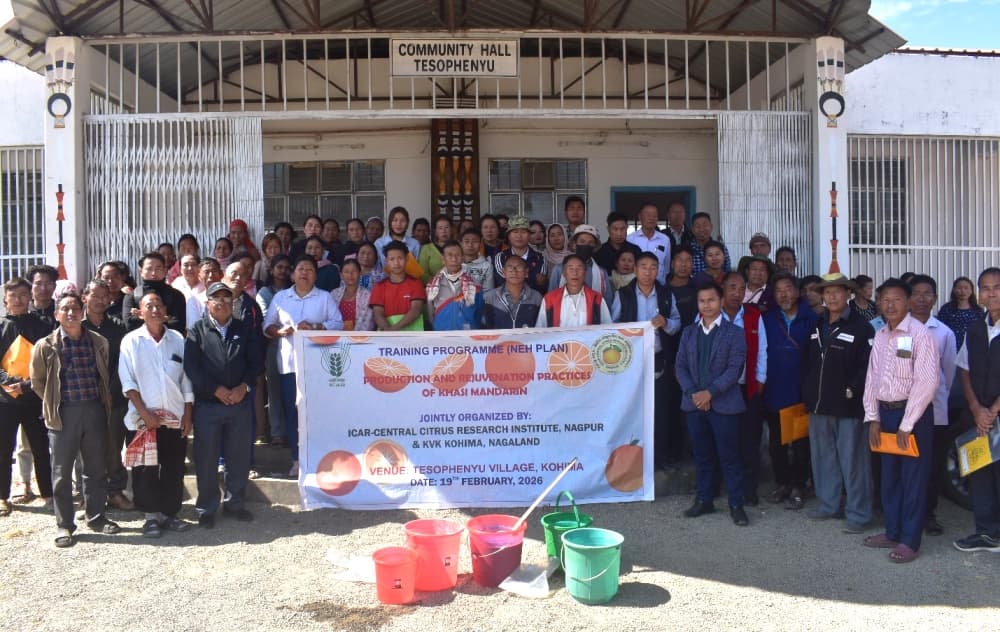
DIMAPUR — A one-day intensive training programme on “Production and Rejuvenation Practices of Khasi Mandarin” was organised under the NEH Plan by ICAR-Central Citrus Research Institute (ICAR-CCRI), Nagpur, in collaboration with Krishi Vigyan Kendra Kohima (KVK) Kohima on Thursday at Tesophenyu village in Tseminyu district.
The programme, conducted under the guidance of Dr. Dilip Ghosh, Director of ICAR-CCRI, was attended by 60 farmers and local community leaders who are major citrus growers in the region, KVK Kohima stated in a press release.
The event began with a welcome address by Dr. Martina Shitiri, ACTO (GPB), KVK Kohima.
In her address, she underscored the critical need for capacity-building initiatives to revitalise Khasi Mandarin orchards and enhance productivity through scientific interventions.
Dr. Evening Stone Marboh, Senior Scientist at ICAR-CCRI, Regional Research Centre for Citrus (RRCC), Biswanath Chariali, Assam, delivered the introductory remarks.
Also read: 2 Nagaland colleges sign MoU to strengthen academic cooperation
He highlighted the immense potential of Khasi Mandarin as a commercially viable citrus crop in the North Eastern Hill (NEH) region and emphasised the importance of sustainable orchard management practices to combat orchard decline and improve fruit quality.
Shazukha Kath, Chairman of Tesophenyu Village Council, also addressed the gathering and assured the community’s commitment to adopting modern citrus production technologies to strengthen the local horticultural economy.
The technical session was led by Dr. Marboh, who delivered comprehensive lectures on nursery management and multiplication of true-to-type, disease-free planting materials; scientific production practices for enhanced yield and quality; and integrated management of major pests and diseases affecting Khasi Mandarin.
Participants were provided practical exposure through hands-on demonstrations on the preparation and application of Bordeaux paste and Bordeaux mixture.
An interactive session enabled farmers to discuss field-level constraints, share experiences and seek expert solutions tailored to local conditions.
The programme concluded with the distribution of essential organic inputs to participating farmers to support the effective adoption of improved citrus production and rejuvenation practices.
“The training initiative marked a significant step towards strengthening technical knowledge, promoting sustainable citrus farming, and enhancing livelihood opportunities for Khasi Mandarin growers in the region,” the release stated.
The event ended with a vote of thanks, expressing gratitude to the dignitaries, organisers and participants for their contributions in making the programme a success.