


Training on sustainable fish farming management in Wokha focused on scientific aquaculture and fish health practices.
Share


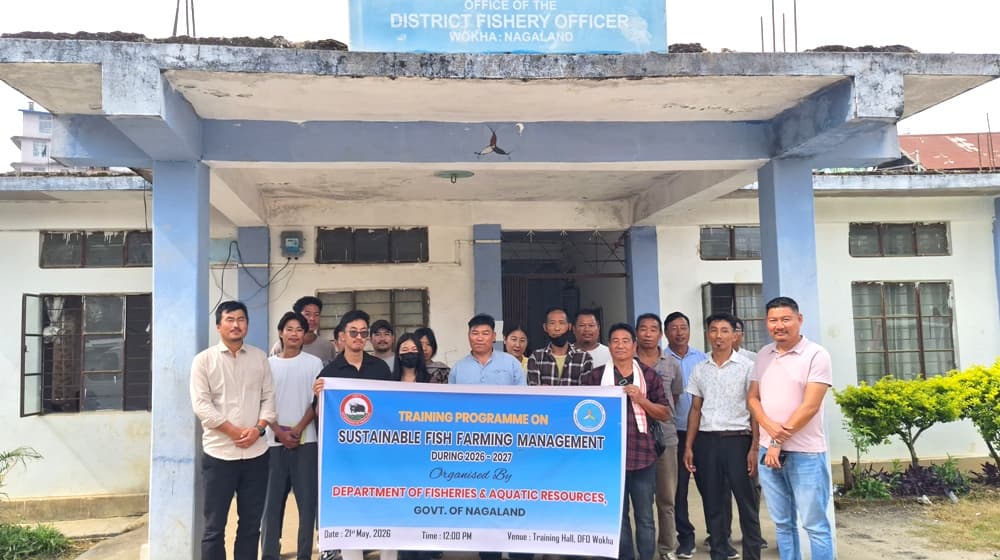
WOKHA — A training programme on sustainable fish farming management was conducted on Tuesday at the District Fisheries Office, Wokha, to promote scientific aquaculture practices among farmers.
Delivering the keynote address, District Fisheries Officer Rulanthung Ezung underscored the importance of adopting scientific methods for improved livelihood, economic benefits, and nutritional security while safeguarding aquatic ecosystems.
He also encouraged farmers to register under the National Fisheries Development Programme (NFDP) portal to ensure security and easy access to financial support.
In the first technical session, Assistant Fisheries Inspector (AFI) Riimachang Aier spoke on composite fish culture and pond management. He explained that different species can be reared together as they occupy distinct water levels and feeding zones—Catla as a surface feeder, Rohu and Grass Carp as mid-column feeders, and Mrigal along with Common Carp as bottom feeders.
Also read: New Fire Station South building in Kohima inaugurated, NFES-MS launched
RTA Wokha conducts riding tests for two-wheeler taxi permits
Aier stressed the need for balanced stocking, water quality maintenance, and proper pond management for optimum production, while also briefing farmers on integrated farming practices combining paddy, pigs, ducks, and poultry with fish culture.
The second session, conducted by Khriezeto Zatsu, AFI, focused on fish healthcare and post-stocking management. He advised farmers to adopt proper feeding practices, maintain pond hygiene, and monitor water conditions to reduce mortality and enhance growth. Zatsu also highlighted common fish diseases and recommended available measures in the market to safeguard fish health.
Officials informed participants that Nagaland currently produces only about 30 percent of its fish demand. A demonstration on testing water pH was also conducted, with trainees cautioned that levels above 9 are harmful for fish culture.
The programme concluded with an interactive session and a vote of thanks by Fisheries Inspector Konri Magh.
The department welcomed farmers to approach the office for assistance on issues related to fish farming, including disease management and water testing.