


Sümi leaders adopted key customary governance resolutions as Kaito cautioned village chiefs against joining underground factions
Share


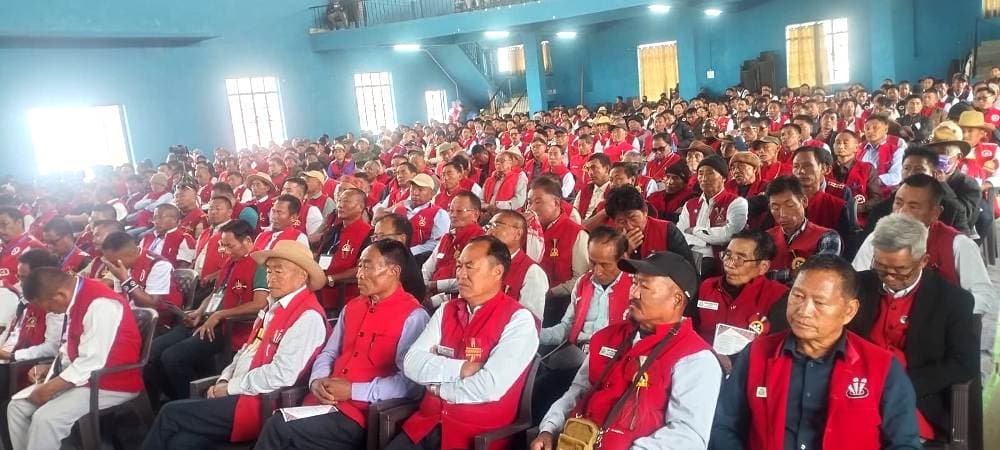
DIMAPUR — Concerns over customary leadership, ‘underground’ affiliations, electoral corruption and the growing fragmentation of community organisations dominated discussions at the Sümi Kükami Hoho (SKH) general conference in Zunheboto on Saturday, where tribal leaders adopted a series of resolutions aimed at strengthening traditional governance and social reforms within the Sümi community.
Addressing the gathering at Multi-Purpose Hall in Zunheboto, Minister for Roads and Bridges G Kaito Aye cautioned village chieftains against joining underground factions, warning that such involvement could complicate leadership and governance structures in villages.
According to a press release issued by the Naga People’s Front (NPF), Aye acknowledged the sacrifices made by Naga forefathers in shaping Nagaland’s democratic and political journey and said that tribal leaders, legislators, village chiefs and community members must adopt constructive approaches while preserving the distinct identity and traditions of the Sümi people.
Tracing the origins of the Inner Line Permit (ILP) system to the British era, he recalled that the British were among the first administrators to encounter the Sümi tribe before Indian administration took over.
Referring to Article 371A and the Nagaland Village and Tribal Councils Act, 1978, amended in 2022, the minister urged village leaders to maintain uniformity and strengthen customary governance institutions.
Also read: FNTA, Naga talks in focus as Rio-led delegation meets Amit Shah
He also appealed for collective efforts to curb electoral corruption and called upon Sümi Hoho and youth organisations to actively pursue social reforms.
Expressing concern over the growing number of organisations operating under the Sümi banner, Aye urged the community to adopt “reasonable approaches” and restructure institutions for better growth and development.
On the proposed ban on religious symbols and stickers on vehicles, the minister defended churches and NGOs, describing them as first responders to social issues.
“Such symbols represent identity and service to society. If they are banned, then government and departmental insignias should be treated similarly,” he said.
Speaking at the programme, S Toiho Yeptho, Deputy Speaker of Nagaland Legislative Assembly, observed that the Sümi community has gradually moved away from its traditional hereditary kingship system.
Read more: NSF marks 76th Naga Plebiscite Day in Kohima
He distinguished between hereditary kingship and the government-appointed Gaon Bura (GB) system, stating that GBs are selected periodically in urban areas while kingship remains hereditary by tradition.
Yeptho also elaborated on the customary practice of regency, where a wife may temporarily assume leadership responsibilities after her husband’s death until the rightful male heir matures.
“There is no provision in Sümi customary law for women to permanently assume kingship roles. Leadership is a responsibility, not an opportunity,” he said.
Meanwhile, Picto Shohe said the Sümi community possesses a distinct identity dating back to the British era and urged the people to revive and preserve traditional practices.
He added that the traditional attire worn by GBs today evolved from historical recognition associated with the Sümi tribe.
During the meeting, the house adopted four key resolutions, including replacing the term “GB” with the traditional honorific titles “Akükau” and “Akükatou” across Sümi villages.
The resolutions also stated that women would not be permitted to permanently hold village kingship titles, while allowing temporary leadership responsibilities after the death of a husband until the male heir matures.
Further, the gathering resolved that consent from village and area kingship authorities must be obtained before filing RTI applications to prevent alleged misuse for personal motives.
It also resolved that disputes within Sümi-inhabited villages and areas should be settled through customary courts instead of legal courts.