
Vatsal Soin's two new filings place a checkpoint at each end of an AI system: BBAT, where data leaves the vault as a safe band, not raw files, and the 0→1 Doctrine.
A metainvention wraps other inventions into one governing layer. Vatsal Soin's two new filings place a checkpoint at each end of an AI system: BBAT, where data leaves the vault as a safe band, not raw files, and the 0→1 Doctrine, where an AI action reaches the real world. Each works alone, together they work as one chain, and every outcome leaves a sealed receipt.
LIVE www.0to1doctrine.com
THE STACK TODAY
Picture an AI system as a river with four stretches. Data rests in storage. It feeds training, training builds a model, and the model proposes actions that machines carry out. Checks often guard single stretches. The new filings add two gates and one shared trail of receipts that follows the water from source to sea.
TWO GATES, ONE SCALE
Two separate inventions add the gates. BBAT, Band-Based Archive Triage, guards the exit of the data vault. The 0→1 Doctrine guards the exit of the action. Both use one scale, from zero to one. A band is a range on that scale, such as low, medium or high, so the gates share one simple language.
GATE ONE: THE VAULT
Unused old files rest in a vault. This is called dark data. BBAT sorts each file into one of three outcomes: retain, purge or promote. It reads only the labels, called metadata, and never opens the file. MICA, the Metadata Inconsistency Check Module, holds back any file whose labels look wrong or do not match.
THE HUMAN EXIT
Some cases need a person. HOP, the Human Override Pathway, sends them to a reviewer. Low confidence goes there, and so does every legal hold. The reviewer sees the details of the decision but never the stored content. The machine enforces the line, and people decide the exceptions. Every choice is recorded for checks.
INSIDE THE SEALED ROOM
Promoted files move into a Trusted Execution Environment, or TEE, a hardware-protected environment designed to keep the protected data inaccessible to the host system. A derivation engine builds a band there. IVDA, the In-Vault Derivation Axiom, then checks group size, band width and outside risk through several conditions. If any check fails, the exit stays shut.
DELETE, PROVE, RELEASE
DBS, Delete-Before-Share, destroys the source files inside that room. Where the risk is high, the hardware also proves it with a Hardware Attestation Certificate, or HAC. Only then does the exit open. The level of proof grows with the risk class, from simple procedure to hardware-backed evidence, so low-risk work stays light.
THE BAND IS THE HANDOFF
What leaves the vault is a band, the same kind of object the decision gate later compares. BDTS, Band-Derived Training Signals, uses bands only, never raw files. Its intake can turn back any band that arrives without a HAC, and it keeps no link back to the source files. One format connects both gates.
GATE TWO: MULTIPLE TOKENS
Multiple signed tokens carry a request, step by step. USP, User System Parameters, state the need. UCC, User Compliance Code, holds the rules. PDT, Product Design Token, and ACT, Asset Capability Token, describe design and ability. MAT, Manufacturing Authorization Token, permits. OCT, Orchestration and Compliance Token, watches. ACR, Actuation Compliance Receipt, seals.
THE DECISION GATE
The need and the machine's ability meet as two bands on one scale. A fit index and set limits give one of three answers: permit, permit with conditions, or prevent. Only a permit reaches the actuator, the part that carries out the action. The ACR is sealed when the action ends, so every decision leaves proof.
WATCHING THE RECEIPTS
Watchers read receipts, never content, so privacy holds. CAAD, the Cross-Agent Aggregation Detector, notices many agents acting in step. SIGHT, Signal-based Insight Generated from Historical Trajectory, notices slow drift in one agent. SPAR, Systemic Pattern Analysis from Receipts, notices wider patterns. They raise warnings, and people review each one before anything changes.
EARLY WARNING AND REPAIR
PRAT, the Predictive Risk Advisory Token, warns of risk before it grows. EMERGE, the Emergent Meta-Environmental Response and Governance Envelope, watches wider conditions. Both advise, and people decide. If trouble appears later, PARR, the Post-ACR Remediation and Resolution Framework, starts from the receipt and helps repair the damage and learn from it.
ONE LEDGER OF RECEIPTS
Every outcome leaves a receipt: keep, destroy, promote, release, and each action. Together they form one connected ledger. An authorised verifier can follow it from start to finish through a privacy-preserving interface, seeing proof of what happened without ever seeing any content. Engineers get a clear trail instead of scattered logs.
THE CHAIN, STEP BY STEP
Read the picture from left to right. The top row shows an AI chain as it often runs today, with checks at separate points. The bottom row adds the two gates, the band between them and one trail of receipts. The band is where the two inventions meet, and people review hard cases.
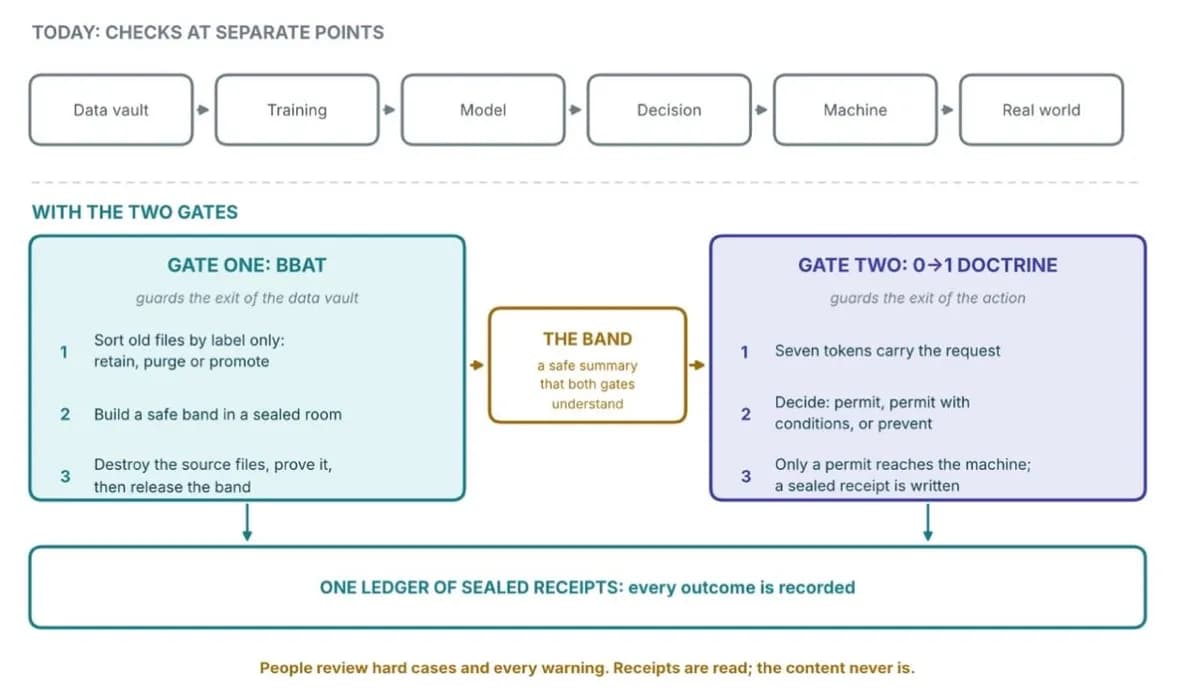
Across the chain: the stack as it runs today, and with both gates.
A DATASET, WITH AND WITHOUT
A buyer wants data to train a model. Without the vault gate, the buyer may receive copies. With it, the buyer receives a band and a receipt, and no file leaves the vault. The source files are destroyed first, so no raw copy remains to leak. The receipt shows exactly what happened and when.
ONE LAYER, TWO INVENTIONS
This is a governance layer, not another AI model. It could sit across existing models, data systems and machines. The two inventions are separate filings, so each can work alone, and together each could make the other more valuable, a multiplier effect. Together, the steps create a more continuous proof trail from data to action.
CLEARLY EXPLAINED
Does the gate sit inside every model call?
It sits at two boundaries only: the vault exit and the actuator. Everything between runs as before, with receipts alongside. A pilot can measure any added delay.
What leaves the vault?
One band and its sealed record. The source files are destroyed first, and hardware proves it before the exit opens. If any check fails, nothing leaves, and a person reviews the case.
Who sets the thresholds?
Humans write the rules, and the gates apply them. PRAT and EMERGE advise only. Hard cases go to a reviewer, and the choice is recorded.
CLOSING NOTE
A bridge is trusted for its joints, not its paint. Seal the two crossings, then let the load prove the rest.
LIVE www.0to1doctrine.com
This can be tested, live, via API, governed against ungoverned, side by side.
THE INVENTOR
Systems theorist, inventor, and serial entrepreneur Vatsal Soin holds grants in the US, Japan, India and more; filings span six continents; latest grant, AI footwear, August 2026. Inventions: footwear, apparel fit, Sharable Size Cards, digital twins, robotics, global governed data, archive triage, quantum-resilient cryptography, AI governance. SIM–RMIT and NTU alumnus. Every prior invention was a step; 0→1 is the destination.
SELECTED REFERENCES
Granted: US Patent 12,446,652 B2 • Japan Patent 7560909 • India Patents 454081 and 599317. Filed: PCT/IN2025/051943 • US 19/489,595 • India 202511115781 • Australia AU2022450649 • India 202611113867 (23 September 2026) • PCT/IN2026/052042 (1 October 2026).
DISCLAIMER
Informational only. Not certified. No endorsement implied. Not investment advice. Examples are illustrative, not field results. Vatsal Soin • © 2026 All Rights Reserved.
(The views and opinions expressed in this guest article are solely those of the author and do not necessarily reflect the views of Eastern Mirror)