


Nagaland University conducts scientific beekeeping training for farmers in the Noklak and Shamator districts.
Share


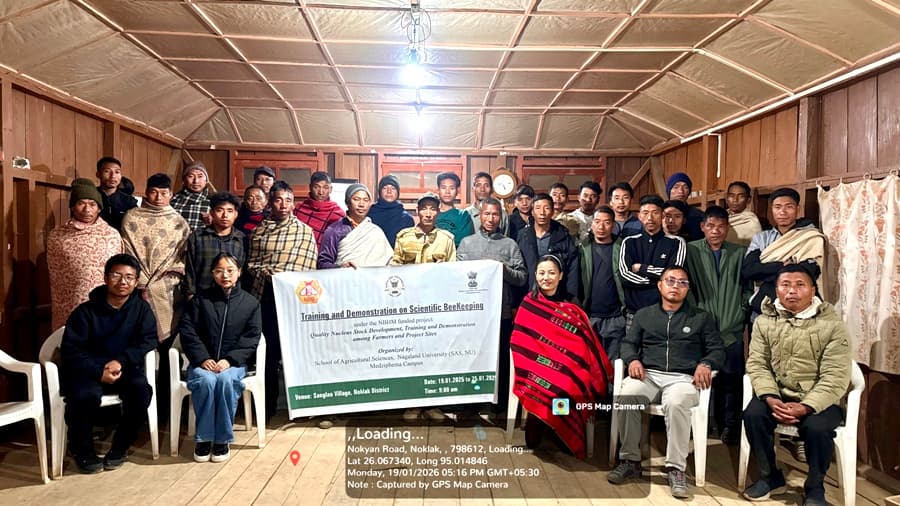
DIMAPUR — A series of intensive training and demonstration programmes on scientific beekeeping were conducted across districts in eastern Nagaland from January 19 to the 27th.
The initiative was held under the National Bee Board-National Beekeeping and Honey Mission (NBB-NBHM) with the objective of strengthening farmer capacities, promoting scientific apiculture practices, and enhancing livelihood opportunities.
The programme was funded by the National Bee Board (NBB), Ministry of Agriculture and Farmers Welfare, and implemented by the School of Agricultural Sciences (SAS), Nagaland University, Medziphema Campus.
The project was led by Dr. Mary N Odyuo, associate professor and principal investigator, and Dr. Avinash Chauhan, scientist, AICRP on Honey Bee and Pollinators, as co-principal investigator, who also served as the course directors of the training programme.
The training covered villages including Nokyan, Kusong, Sanglao, Pathso village and Panso headquarters in Noklak district, and Yakor village, Shamator headquarters, Sangphur village and Leankonger village in Shamator district.
Read more local news: NECTAR training on Annual Curriculum and Pedagogical Plan underway in Kohima
Nagaland GIS and Remote Sensing Centre begins FPV drone training
According to an update, this intervention marked the first scientific beekeeping training at the village level in these areas, except for Yakor village, known as the district’s "honey bee village".
Participants were primarily members of farmer producer organisations (FPOs) supported by the Small Farmers’ Agribusiness Consortium (SFAC). The sessions received technical support from the Nagaland Honey Bee Mission and were attended by officials from the District Agriculture Offices and District Horticulture Offices. At Leankonger village, Bodi Kapfo, SDO (civil), attended the training.
The programme emphasised hands-on demonstrations covering colony inspection, seasonal management, disease identification, swarm control, and value addition. Special emphasis was given to hygienic harvesting of quality honey and the role of bees in enhancing oilseed pollination.
Following the training, participants in several villages began constructing scientific bee boxes. In Kusong village, ten participants formed a group for joint scientific beekeeping, contributing funds to procure materials for box construction.