


Limawabang Jamir urged stronger action against trafficking and violence as Mission Shakti functionaries reviewed rising reporting of sexual offences and support services.
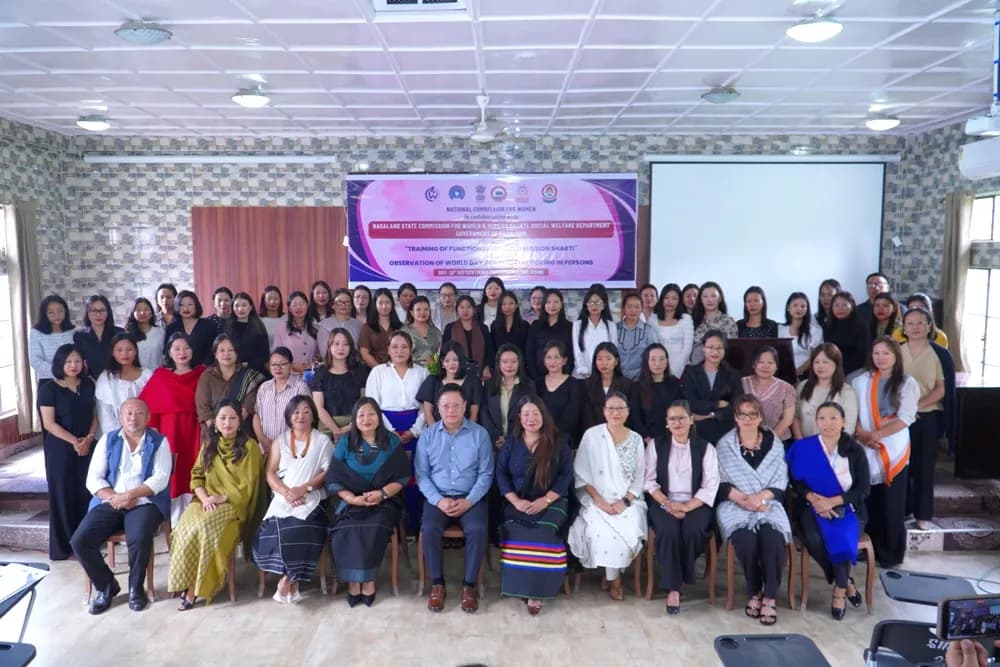
KOHIMA — Secretary and AHoD, Social Welfare department, Limawabang Jamir, on Thursday said the recent rise in reported cases of sexual offences against women in Nagaland reflected increasing awareness and confidence among survivors to come forward.
Speaking at the "Training of functionaries under Mission Shakti" and the observance of World Day Against Trafficking in Persons, organised by the National Commission for Women (NCW) in collaboration with the Nagaland State Commission for Women (NSCW) and Mission Shakti, Social Welfare Department, at the State Institute of Rural Development (SIRD), Kohima, Jamir said the trend was a positive outcome of sustained awareness campaigns conducted across the state.
He said human trafficking was evolving into new forms, including forced criminality linked to cybercrime, financial fraud, money laundering, commercial sexual exploitation and forced labour.
He noted that Nagaland and the Northeast have become important transit routes and destinations for trafficking.
According to Jamir, trafficking in the state has traditionally taken the form of child domestic labour, commercial sexual exploitation and fraudulent child adoptions under the guise of providing free education.
He urged all stakeholders to strengthen awareness campaigns and help vulnerable women and children take precautions against trafficking and abuse.
Addressing functionaries of Shakti Sadan, Women Helpline-181 and One Stop Centres (OSCs), Jamir reminded them of their responsibility to respond effectively to violence against women and children.
He said Women Helpline-181 has been established in Kohima, Sakhi One Stop Centres are operational in 17 districts, and Shakti Sadans have been set up in six districts.
He informed that during the first three months of the current financial year, One Stop Centres handled 125 cases of gender-based violence, while Women Helpline-181 attended 53 cases, including gender-based violence and information-seeking calls. He added that Shakti Sadans were providing shelter to survivors of domestic violence and other vulnerable women in distress.
Jamir appreciated the dedication of frontline workers despite delays in payment of their honorarium, saying the department was pursuing the Ministry of Women and Child Development for the early release of pending funds.
He also appealed to the media to report cases of sexual offences and human trafficking responsibly while protecting the identities of survivors as required by law.
NSCW chairperson W Nginyeih Konyak said the role of Mission Shakti functionaries demanded not only technical expertise but also empathy and mental resilience.
She said the training would equip participants with updated legal and medico-legal protocols, trauma-informed counselling approaches and knowledge of legal rights.
Urging participants to see their work as a frontline effort to protect human dignity, Konyak said those serving at One Stop Centres, Women Helpline-181 and Shakti Sadans become the bridge between vulnerability and safety for women seeking help.
She noted that service delivery in Nagaland required sensitivity to tribal community structures, geographical challenges and institutional realities.
She stressed that prompt and compassionate responses could determine whether survivors received timely protection and support.
Observing World Day Against Trafficking in Persons, Konyak described human trafficking as a modern form of slavery that disproportionately affects women and children.
"Our response cannot be passive. It must be proactive, comprehensive and relentless," she said.
She called for stronger collaboration with village councils and student organisations to improve community vigilance, adding that survivors needed not only rescue but also long-term legal, psychological and livelihood support to prevent re-trafficking.
311 cases handled by OSCs in 2025-26
Director of Social Welfare Tosheli Zhimomi said participants included staff from One Stop Centres in 16 districts (excluding Mon), Women Helpline-181 call operators and resident superintendents of Shakti Sadans from five districts.
Presenting data for the 2025-26 financial year, she said One Stop Centres handled 311 cases, while Women Helpline-181 received 2,090 calls, of which 144 required intervention and support.
The cases included domestic violence, cybercrime, sexual assault, offences under the POCSO Act, missing persons and other situations involving women in distress.
Zhimomi commended the commitment of staff working in One Stop Centres, Women Helpline and Shakti Sadans despite salary delays. She also encouraged closer coordination with other Social Welfare Department initiatives, particularly Mission Vatsalya, to strengthen support services for women and children.
Resource persons for the technical sessions included Dr. Rubert Peseyie, Joint Director, Health and Family Welfare; Themmungla Raman Longkumer, clinical psychologist; Gracy Ayee, State Mission Coordinator, Mission Shakti; and Apila Sangtam, legal consultant, NSCW.