

Chief Minister Neiphiu Rio said the Nagaland government is ready with an alternative political arrangement once the long-pending Naga political issue is settled.
Share


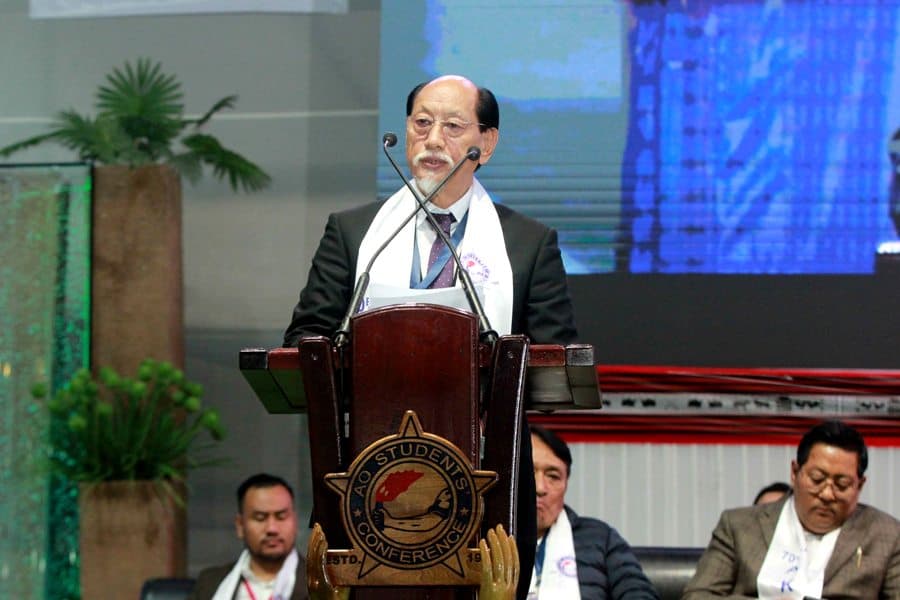
CHUNGTIA — Nagaland Chief Minister Neiphiu Rio on Wednesday said the state government was prepared to facilitate an alternative political arrangement once the long-pending Naga political issue reaches a settlement, underlining that the present opposition-less government was formed with that single objective.
Addressing the second day of the 70th General Conference of the Ao Kaketshir Mungdang (AKM) at Chungtia Village, Rio said the unity of all political parties in the state was aimed at bringing the issue to a conclusive end. “Should the Naga political problem find resolution, we are prepared to make way for an alternative arrangement,” he said.
Describing the Naga issue as fundamentally political in nature, the Chief Minister said it concerned not only political leaders but every Naga, as all had a stake in its outcome. He called for collective effort and support from all sections of society, stating that unity across organisations, big or small, was essential for a lasting solution.
Rio recalled a consultative meeting held on September 12, 2024, convened by the government of Nagaland, which brought together 61 organisations, including tribal hohos, civil society groups, students’ bodies, women’s organisations, senior citizens, youth representatives and church groups. The meeting, he said, adopted a document containing five resolutions, one of which he described as particularly significant.

The fourth resolution, he said, urged the government of India to elevate the peace talks by appointing an interlocutor at the political or ministerial level, vested with full authority and the confidence of the central government. “At present, there is no interlocutor in place with such authority,” he said, pointing to what he described as a gap in the ongoing process.
The Chief Minister said that while Nagas must show wisdom and resolve in addressing internal differences, the absence of a political settlement continued to affect development. Major developmental initiatives and large-scale projects continue to face disruptions, and we receive little leniency or support from any quarter, he said.
He also informed the gathering that a political affairs meeting had been scheduled for January 17, 2026, to take forward discussions related to the issue.
On the Inner Line Permit (ILP) regime, Rio admitted that enforcement remained weak in several areas. He said ILP provisions were not applied in the Dimapur belt until 1979, when a state government notification declared Dimapur a tribal belt with specific demarcations. Enforcing ILP effectively, he said, had proved challenging.
“At the same time, we are pursuing the matter seriously,” he said, calling on all stakeholders to act responsibly and support implementation. He stressed that illegal migrants must be identified and deported, while those who had arrived and settled before the cut-off year should be granted permanent residency rights. He cautioned, however, that genuine Indian citizens should not be harassed, while emphasising that ILP remains mandatory for entry into Nagaland.
Turning to education and employment, the Chief Minister said Nagaland had emerged as India’s third most literate state, with a literacy rate of 95.7 per cent, after Kerala and Mizoram. About 20 per cent of the literate population held graduate or higher qualifications, he added.
Despite this, Rio expressed concern that nearly 92 per cent of the population lacked technical or vocational skills, which he described as a serious gap in a competitive, merit-driven environment. He urged students and youth to acquire specialised skills, develop problem-solving abilities and adapt to changing demands.
He said government employment had reached saturation levels, with assessments indicating a requirement of more than 2,000 new posts annually.
The government, he added, planned to conduct competitive recruitment for over 2,000 positions each year. Formal education alone, he said, was no longer sufficient, and individuals needed to take responsibility for continuous learning and skill development.
Read more: Neiphiu Rio calls for stronger administrative outreach as Namsang EAC headquarters shifts to Yonglok
Reflecting on historical safeguards, Rio referred to the Bengal Eastern Frontier Regulation of 1873, introduced during British administration, and Article 371(A) of the Constitution, which he said had protected Naga identity, culture and traditions. He urged Nagas to preserve and promote this heritage, linking it to the state’s potential as a destination for eco-cultural and rural tourism.
He said Nagaland was endowed with natural resources, including petroleum, natural gas, minerals and rare earth elements, and that Article 371(A) provided protection over land and resources. While the government of India had contested ownership rights in court, he said the state government had maintained its position and the judgment was awaited.
“Despite being resource-rich, we remain economically challenged because we have not harnessed our resources effectively,” he said, calling for unity and collective resolve. He cautioned that divisions between overground and underground elements continued to weaken Naga society, adding that a divided community could not stand strong.
Praising Mokokchung district for recording the state’s highest literacy rate of 91.62 per cent as per the 2011 Census, Rio described it as an educational hub that had produced leaders across Naga tribes. He urged the AKM to uphold its motto, “For the Nation”, and ensure that individualism, clannism and tribalism did not overshadow the larger goal of Naga unity.
He said unity, peace, integrity and mutual respect must guide efforts towards a developed Nagaland, and called for collaboration to bridge divides across generations and roles.
Rio said the gathering reflected the Ao community’s commitment to future generations and appreciated Chungtia Village and the AKM for hosting the conference.
He recalled that the AKM, established in 1929 at Longkhum Village with the motto “For the Nation”, had worked to advance the interests of the Ao people while contributing to the wider Naga cause. He said the organisation had played a role in social and political life over the decades.
Rio also referred to the launch of the Ao Naga Messenger in 1932, later known as Ao Milen, which he said functioned as an early platform for public discourse in the region and raised issues of political justice and equality.
Referring to the conference theme, “Strengthening Horizons”, he said it underscored the need for dialogue, cooperation across generations and the preservation of cultural identity alongside modernisation.
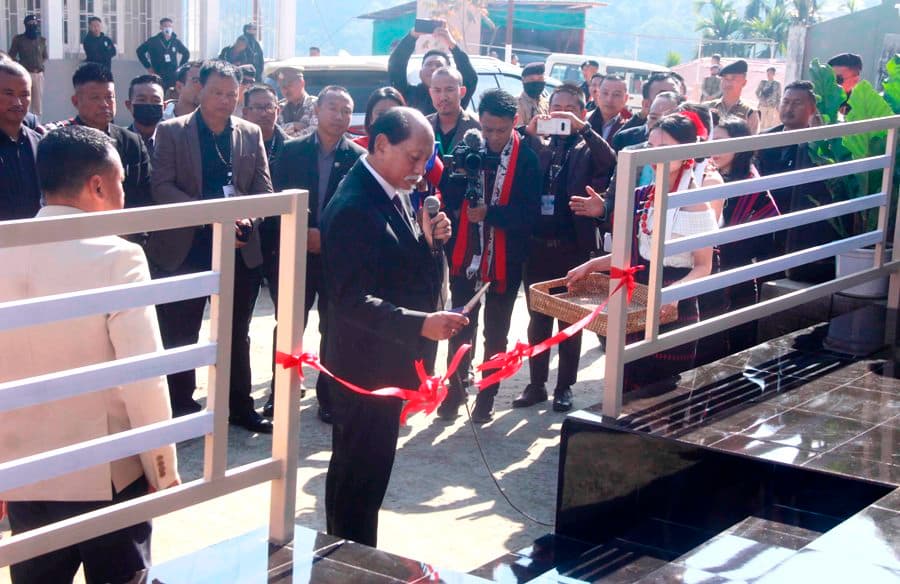
On the occasion, the Chief Minister also officially declared Chungtia Village a tourism destination.
Short addresses were delivered by AKM president Lanutoshi Aier, Naga Students’ Federation president Mteisuding Heraang, Central Nagaland Students' Association president Zuchobemo Jungio, and minister Metsubo Jamir.