


Over 10,000 kg of tea leaves go to waste after floods sever road access, crippling Mon growers' livelihoods and trade.
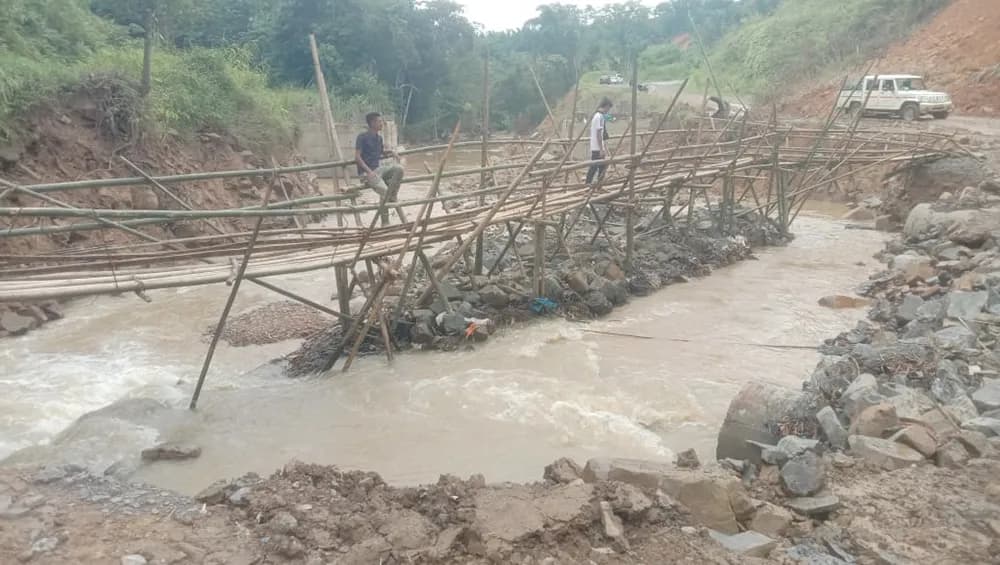
DIMAPUR — More than 10,000 kilograms of freshly plucked tea leaves have gone to waste in Mon district after floods and landslides severed road connectivity to processing factories, dealing a severe financial blow to hundreds of growers whose livelihoods depend on tea cultivation.
The crisis unfolded after the NHIDCL bridge connecting Shiyong village in Wakching sub-division to Tizit was washed away by floodwaters on July 19, cutting off the only road used to transport freshly harvested tea leaves. With repeated landslides damaging approach roads and no alternative route available, pickup vehicles were unable to reach tea processing factories before the leaves lost their quality.
According to Wakching Area Students' Union (WASU) president Longme Lemanghu, tea transportation resumed only on Wednesday evening after villagers and volunteers restored a temporary crossing, but not before an estimated 10,000 kg of harvested tea leaves had to be discarded.
"The damage has already been done," Lemanghu told Eastern Mirror, adding that every trip across the makeshift crossing remains risky, particularly during heavy rain.
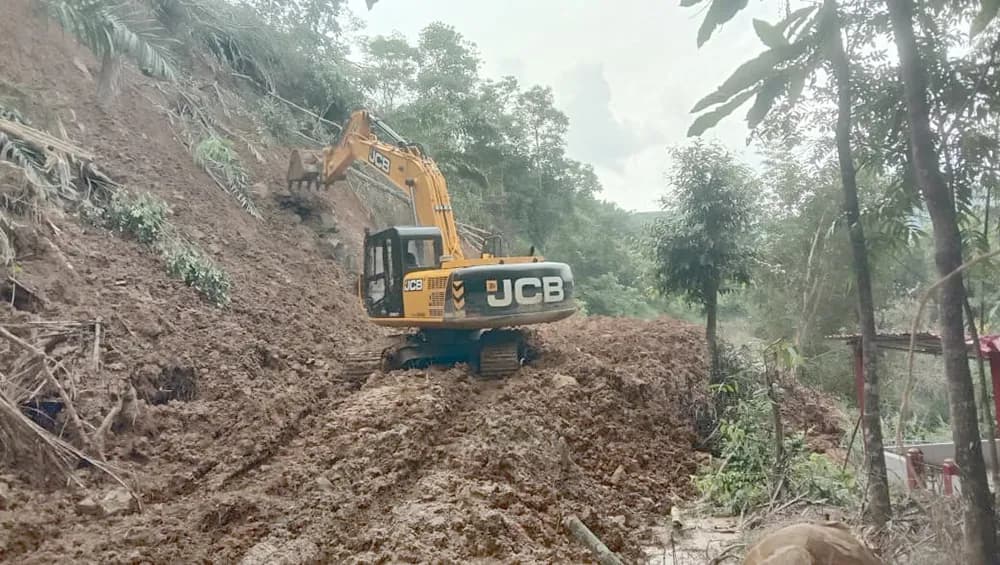
He said that the district administration deployed a JCB excavator around July 22-23 to restore the damaged road, but continuous rainfall hampered the work and further deteriorated road conditions.
Officials from the National Highways and Infrastructure Development Corporation Limited (NHIDCL) later inspected the site but informed villagers that constructing a permanent concrete bridge was not immediately feasible because of the high water level and strong river current.
In the absence of a permanent solution, the students' union and local residents undertook restoration work on their own. A temporary bridge completed on July 28 was washed away within two days by fresh floods.
Undeterred, volunteers rebuilt the crossing by laying six Hume pipes and covering them with soil, restoring limited connectivity on August 5. WASU subsequently issued a public advisory allowing vehicles to use the road at their own risk.
The prolonged isolation has affected tea growers from Shiyong, Wakching, Wanching, Chingtang, Tanhai and several neighbouring villages, where tea cultivation is the primary source of income for many households.
According to Lemanghu, the affected villages normally record tea transactions worth INR 2 lakh to INR 3 lakh daily during the peak harvesting season. A single pickup vehicle typically carries between 900 and 1,500 kilograms of freshly plucked leaves, with three to four vehicles transporting produce to factories each day, depending on labour availability.
Tea growers faced a difficult choice during the disruption. As freshly plucked leaves could not be transported for processing, many plantation owners allowed villagers to collect the leaves for household use, while others permitted labourers to take them instead of wages because there was no market left for the produce.
The crisis has been compounded by a prolonged power outage that has persisted since July 19 after floodwaters damaged electricity infrastructure. Although Shiyong has a green tea processing unit, it has remained non-functional due to the lack of power.
Villagers are relying on solar energy wherever possible while authorities work to restore electricity from the Mon side.
While connectivity has been partially restored, Lemanghu cautioned that the temporary crossing remains highly vulnerable. Another spell of heavy rainfall, he warned, could wash away the makeshift structure again, isolating thousands of tea growers and disrupting the region's fragile tea economy once more.