
NSRLM and BRAC International launch SAY-SOBLOK to support 4,000 extremely vulnerable households across Nagaland.
Nagaland launches SAY-SOBLOK programme
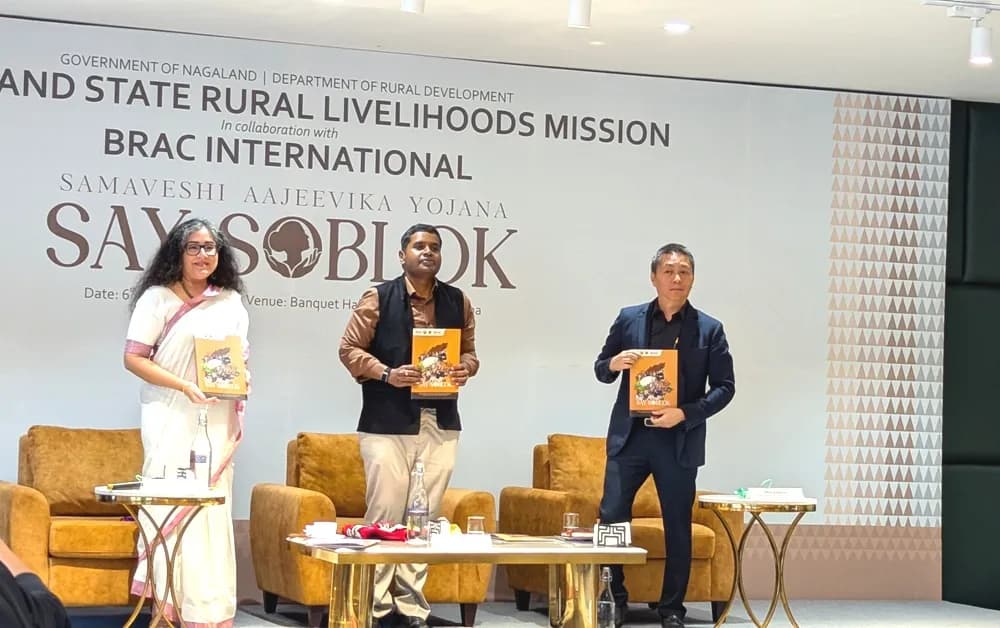
KOHIMA — The Nagaland State Rural Livelihoods Mission (NSRLM) and BRAC International have signed a Memorandum of Understanding (MoU) to collaborate on the Samaveshi Aajeevika Yojana (SAY)-SOBLOK programme, aimed at supporting 4,000 extremely vulnerable households in Nagaland.
Commissioner and Secretary, Department of Rural Development, Thavaseelan K, formally launched the programme at the Banquet Hall of Hotel Vivor, Kohima, on Tuesday.
Launching the programme, Thavaseelan said the strength of a rural development initiative was measured by how effectively it reached people for whom participation itself was difficult.
He said the programme would further advance NSRLM’s goal of social inclusion.
He said the three-year technical collaboration between NSRLM and BRAC International would provide an opportunity to develop the graduation approach carefully, with BRAC bringing experience in implementing graduation programmes and NSRLM contributing its institutional presence and established relationships with communities.
“The quality of this partnership will depend on how well that experience is adapted to the circumstances of families in Nagaland,” he said.
Also read: Nagaland: NSRLM to launch SAY-SOBLOK for 4,000 vulnerable households
Thavaseelan stressed the need for fair identification of beneficiary households and meaningful engagement with communities. While acknowledging the value of community knowledge, he said it was also important to identify whose voices might be missing.
He called for clear selection criteria, verification mechanisms and a simple system through which households could raise concerns or report omissions.
He also said livelihood choices should be appropriate both to individual households and local economies, noting that villages differed in their access to land, transportation and markets.
He cautioned that livelihood activities that appeared viable on paper could be difficult to sustain where inputs were costly or markets were distant.
The official urged district and block teams to make coordination a regular part of their work, stating that convergence would be central to the programme.
He said the needs and choices of participating households should remain at the centre of the implementation process, with clear responsibilities and regular mechanisms to address challenges.
Moa Sangtam, Joint Secretary and Mission Director, NSRLM, highlighted the findings of a baseline survey conducted in August 2025.
The survey found 2,501 persons with disabilities (PwDs) aged 16–25 residing in the surveyed villages across the state. Of these, 261 had Unique Disability ID (UDID) cards, while 2,240 did not.
A total of 1,049 PwDs were members of self-help groups (SHGs), while 1,452 were not part of SHGs.
The survey also identified 469 women-headed households with children in the 16–25 age category and 600 vulnerable households without substantial income.
Providing an overview of NSRLM’s social inclusion initiatives, Sangtam said there were 437 exclusive PwD SHGs and 103 mainstream SHGs with PwD members.
He added that NSRLM had identified 11,652 vulnerable households, while 1,140 elderly SHGs had been promoted with a total membership of 8,304 elderly persons.
Shweta S Banerjee, India Country Lead, BRAC International, said a collaborative coalition could bring positive change to participating households.
She said communities in Nagaland would drive the SAY-SOBLOK programme and assured that BRAC would provide technical assistance, global learning and research resources required for implementation.
Kshovan Guha, Lead Coaching, SAY National PMU, outlined the action points and next steps.
He said the immediate focus would be on selecting districts and sub-districts for SAY-SOBLOK based on the SAY implementation framework under DAY-NRLM.
He said this would be followed by orientation of Nagaland SRLM staff, onboarding of technical and research agencies, and establishment of the Programme Management Unit (PMU).
The baseline and profiling of participating households are scheduled to be undertaken in March 2027.
With the formal launch and signing of the MoU, the partners will now move towards operationalising the programme and translating the collaboration into targeted support for vulnerable households across Nagaland.