

Nagaland launched the NSQAAF pilot programme to improve school quality through assessments, self-evaluation and accreditation standards.
Share


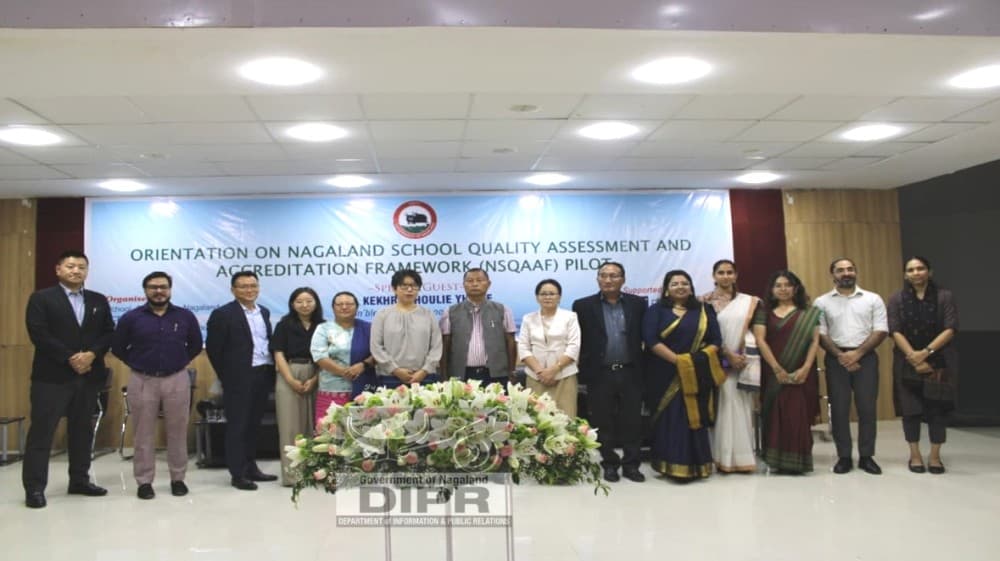
DIMAPUR — A one-day orientation programme on the Nagaland School Quality Assessment and Accreditation Framework (NSQAAF) pilot programme was held at the Capital Convention Centre, Kohima, on June 19.
The programme brought together heads of institutions and proprietors from 100 selected schools, along with 90 external evaluators, a DIPR report stated. The initiative is supported by the Central Square Foundation.
Addressing the gathering, Advisor for School Education, Dr. Kekhrielhoulie Yhome, highlighted the importance of the NSQAAF in improving the quality of education in Nagaland.
He said the framework would help schools identify their strengths and areas requiring improvement through structured assessments across five key domains—administration, curriculum, assessment, infrastructure and inclusiveness.
Describing the pilot as an opportunity for schools to raise educational standards, Dr. Yhome said the initiative would contribute to building a stronger and brighter future for school education in the state.
He informed that the pilot covers 100 selected schools from both government and private sectors. Nagaland currently has around 1,900 government schools, 880 private schools and a dozen central schools, with nearly 34,000 teachers serving students at an average teacher-student ratio of 1:12.
The advisor also pointed to challenges facing the state's education system, including schools with very low or no student enrolment.
He said some government schools would need to be amalgamated to address these issues, while new schools would continue to be opened and regulated to uphold every child's Right to Education.
Commissioner and Secretary, School Education, and chairperson of the Interim Nagaland State School Standards Authority (NSSSA), Kevileno Angami, said the NSQAAF establishes standardised criteria for evaluating both government and private schools.
She emphasised that the framework is not a one-time exercise but is intended to become part of a permanent independent regulatory mechanism for maintaining school quality.
Kevileno said the pilot would provide valuable baseline information to assess whether schools are progressing in the right direction.
Since the framework is aligned with the National Education Policy (NEP) 2020, she urged schools to regularly undertake self-assessment exercises to continuously improve educational standards.
Additional Secretary, School Education and SCERT, Vikhweno Chale, said the NSQAAF reflects the vision of the NEP 2020 by shifting the focus from compliance to learning outcomes, transparency and self-assessment.
Developed under the Ministry of Education, the framework is based on the National Assessment Programme (NAP) formulated by NCERT in collaboration with various stakeholders.
She said the framework comprises five domains, 53 sub-domains and 338 standards designed to assess the overall health of the school education system. Each domain is categorised into three performance levels applicable from preschool to Class XII, enabling the Nagaland State School Standards Authority to maintain minimum quality and professional standards across schools.
Chale also urged parents to rely on verified information rather than hearsay when assessing schools, noting that the framework would make reliable school quality information more accessible.
She encouraged schools to implement the pilot with honesty and sincerity so that the findings could help shape an effective state-specific accreditation system.
In her welcome address, SCERT Director and NSSSA member Keruupfeu Rupreo said the NSQAAF had been developed to strengthen school education and ensure every child has access to meaningful, inclusive and high-quality learning opportunities.
She described the framework as a tool for self-reflection and continuous improvement rather than one for judgment, encouraging participants to actively engage in discussions and provide feedback to strengthen the framework.
The orientation programme featured technical sessions conducted by Central Square Foundation resource persons Niharika Suresh, Prasuti Sharma and Zephyr Pegu.