


ICAR-NRC on Mithun Director calls for stronger One Health surveillance across the Northeast to manage zoonoses
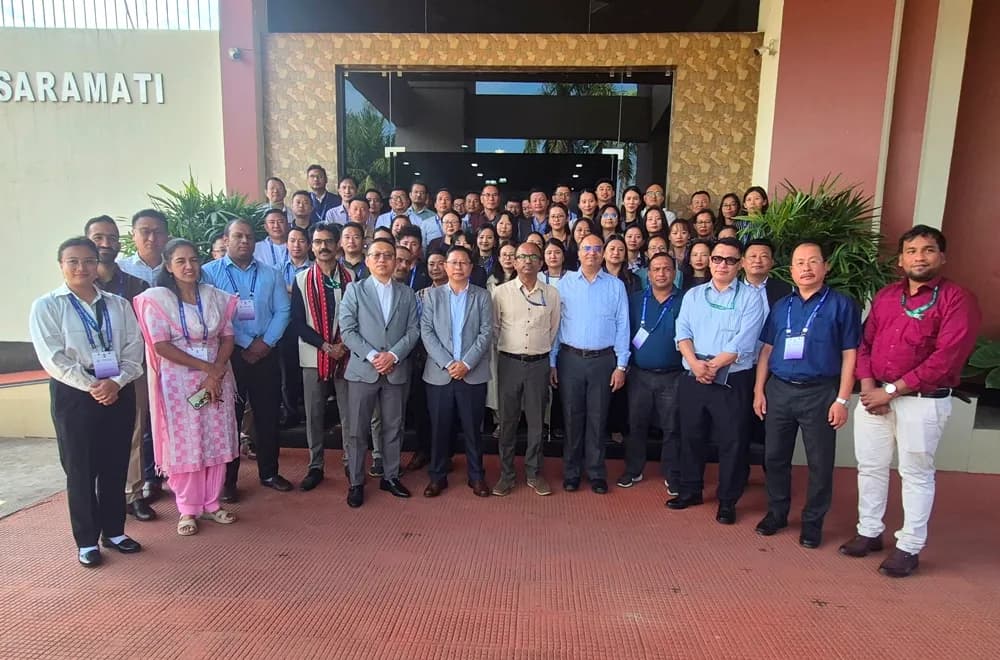
DIMAPUR — The Northeast, particularly Nagaland, requires greater focus on the ‘One Health’ approach to prevent and manage diseases that can spread between humans and animals, Director of the Indian Council of Agricultural Research (ICAR)-National Research Centre (NRC) on Mithun, Medziphema, Dr. Girish Patil S said on Wednesday.
Speaking at the first contact session of ‘Sector Connect: Enhancing Preparedness for Integrated Response - Field Epidemiology Programme in One Health (FEP-OH) in Northeast India’, held at Hotel Saramati in Dimapur, Dr. Patil expressed surprise that a serious initiative on ‘One Health’ was being taken up in the region only now, although the Sector Connect (FEP-OH) was launched in 2023.
He said the region’s biodiversity, movement of people across locations, and transportation of livestock products from other states make it critical to strengthen surveillance and prevention. Urging the National Centre for Disease Control (NCDC) to give greater attention to the Northeast, he stressed that ‘One Health’ is essential not only for outbreak management but also for prevention.
Stressing the need to identify and address risks before diseases spread, he said that once an outbreak occurs, little can be done.
Also read: Nagaland gets first dedicated children’s hospital in Dimapur
The three-day programme is being organised by the NCDC under the Ministry of Health and Family Welfare in collaboration with the Department of Health and Family Welfare. The three-month, in-service training programme aims to strengthen coordination among professionals working in human health, animal health, wildlife, food safety, and environmental sectors.
Northeast’s unique vulnerabilities
Speaking on the animal research perspective of ‘One Health’, Dr. Patil said the approach recognised the links between human, animal, and environmental health, requiring different sectors to share information rather than work in isolation.
He cited the use of pesticides in agriculture, which can enter the food chain through animals and affect humans, as an example of interconnected health risks. He also pointed to antimicrobial resistance caused by the use of antibiotics in poultry and livestock without observing the required withdrawal period, which contributes to the emergence of drug-resistant organisms.
Climate change, the spread of disease-carrying vectors, pollution, and food safety were highlighted as other interconnected concerns. Dr. Patil added that even communication between an animal health worker detecting a parasitic disease and a nearby medical practitioner could form part of a ‘One Health’ response.
He noted that the approach was particularly relevant to Nagaland, where people and animals often live in close proximity in interior villages. Many households rear poultry, ducks, rabbits, pigs, cattle, and mithun, while animal products form a major part of the local diet.
He cited figures indicating that meat consumption in the Northeast, particularly Nagaland, was around 15 kg per capita compared with 7 kg nationally, while milk consumption was about 50 gm per capita against 450 gm nationally.
Referring to a survey conducted by the NRC on Mithun on meat products consumed during the Hornbill Festival over the past three years, Dr. Patil said findings published in food journals recorded the consumption of various species, including squirrels and deer. Describing the festival as a convergence of different species, he said this reinforced the need for closer attention to food safety and disease surveillance.
Calls for stronger surveillance, laboratory support
On research initiatives, Dr. Patil said the centre, alongside institutions in Barapani and the Indian Council of Medical Research (ICMR), was studying parasitic zoonoses by collecting serum samples from humans and animals under the National Initiative on ‘One Health’.
Citing COVID-19 as an example of zoonotic spillover, he underscored the need for early-warning systems, surveillance of wildlife and humans, integrated monitoring, data sharing, and stronger laboratory facilities. He added that samples should be tested closer to where they were collected rather than routinely dispatched to Delhi or Guwahati.
Dr. Patil said Nagaland’s medical college in Kohima, veterinary college, research institutions, and Nagaland University could contribute to the initiative. However, he stated that effective implementation would depend on leadership decisions to facilitate sample and data sharing alongside regular inter-institutional coordination. He assured that two laboratories under ICAR would support ‘One Health’ activities.
Sector Connect aims to strengthen joint response
Earlier, Joint Director of NCDC Dr. Sanket Kulkarni explained that the One Health approach involved multiple sectors in disease prevention and containment rather than relying solely on the human health sector.
Citing diarrhoea as an example, Dr. Kulkarni said investigations could reveal contamination of water due to leaking pipes or sewage entering drinking water pipelines. Similarly, typhoid could spread through contaminated food or water, requiring coordination with sectors beyond healthcare.
He stated that Sector Connect was designed to build the capacity of professionals from human health, animal health, environment, wildlife, and points of entry so they could work together during disease outbreaks.
The initiative is jointly undertaken by the NCDC and the Department of Animal Husbandry and Dairying, Government of India. Prior to its launch in 2023, the Field Epidemiology Training Programme focused on human health and covered eight states. Since the introduction of Sector Connect, more than 300 individuals from six to seven states have undergone training.
The programme involves three days of training each month over three months, along with assignments, exercises, and field investigations in which participants from different sectors work together to address outbreaks.
Dr. Kulkarni said this was the first contact session for the current batch in Nagaland and the first Sector Connect contact session in the Northeast.
Director of Animal Husbandry and Veterinary Services Dr. Kuokehebi Gwirie said livestock farmers and butchers are among those most susceptible to zoonotic diseases due to close contact with animals. Diseases could also be transmitted through livestock products such as meat, milk, and eggs.
He said the department monitored diseases listed by the World Organisation for Animal Health through sampling and surveillance in collaboration with national and regional laboratories. Zoonotic diseases detected in Nagaland in recent years included rabies, anthrax, leptospirosis, tuberculosis, paragonimiasis, and cysticercosis.
Dr. Gwirie added that the state has prioritised rabies, scrub typhus, Japanese encephalitis, leptospirosis, brucellosis, and cysticercosis under the Integrated Disease Surveillance Programme. Rabies elimination by 2030 remains an immediate priority, with the department working towards 100% vaccination coverage.
According to a report provided by Dr. Kikon, State Nodal Officer for ‘One Health’ in the Directorate of Health and Family Welfare, an estimated 60% of known human infectious diseases originate from animals, while 75% of emerging infectious diseases are zoonotic. The report stated that zoonotic diseases cause an estimated 2.5 billion cases of illness and 2.7 million deaths globally each year.
The training brought together participants from the Health and Family Welfare, Animal Husbandry and Veterinary Services, Food Safety, and Forest, Environment and Climate Change departments in Nagaland.