

North East Christian University and USTM joint special lecture series featured Marie McAndrew discussing diversity, equity, and inclusion in higher education.
Share


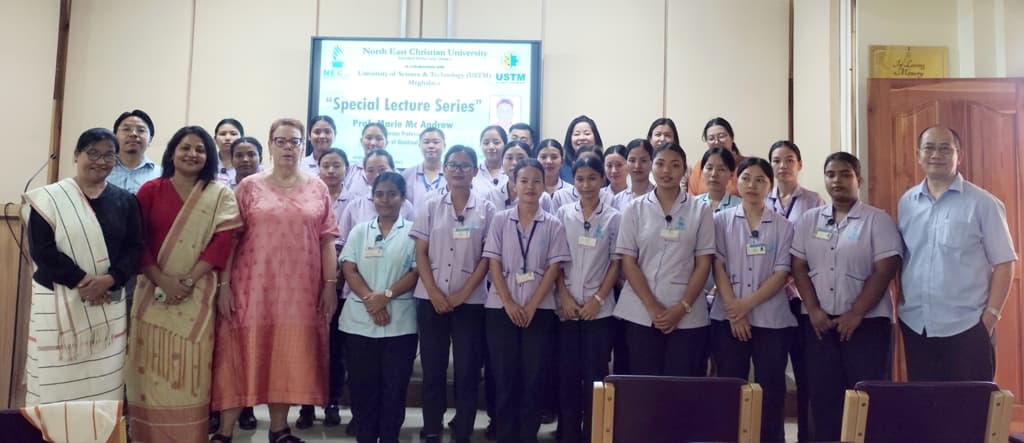
DIMAPUR — The Internal Quality Assurance Cell (IQAC) of the North East Christian University (NECU), in collaboration with the University of Science and Technology (USTM), Meghalaya, organised a special lecture series featuring Marie McAndrew, Emeritus Professor at the University of Montreal, Canada, as the speaker.
During the first lecture, titled "Taking into account linguistic and cultural diversity: A tool in the development of inclusive schools", McAndrew outlined the critical management of ethnocultural diversity in higher education.
According to an update, the presentation analysed how core diversity markers, such as language, religion, and origin, influence modern campuses and reshape traditional institutional mandates. She highlighted that academic institutions hold a pivotal responsibility, as education can either reproduce or actively reduce socio-economic inequalities and deep-seated cultural prejudices.
Also read: SAMETI Medziphema conducts training on natural farming for ATMA functionaries
The lecture highlighted that modern universities must look far beyond basic enrolment metrics to actively ensure the long-term retention, academic success, and social inclusion of minority students.
A key feature of the discussion was an overview of the University of Montreal’s newly targeted Equity, Diversity, and Inclusion (EDI) Action Plan. This strategy establishes clear institutional goals to eliminate systemic barriers within educational, working, and living environments. It counters harassment while promoting diverse methodological perspectives in scientific research.
McAndrew concluded that building an inclusive campus serves as a powerful comparative asset for any university. Embracing diversity helps secure top-tier talent, prepares students to live and work in a globalised world, and garners strong international recognition.
In her second lecture, titled "The management of ethnocultural diversity in higher education", McAndrew’s presentation framed linguistic and cultural diversity as critical assets for educational systems.
She noted that culturally sensitive curricula significantly improve academic success. They strengthen a child's overall sense of belonging and build vital trust between schools and minority families.
The lecture highlighted several key institutional practices such as zero-tolerance policies against systemic or indirect discrimination, language integration using flexible coursework and translation services, and diverse textbooks that intentionally reflect minority group knowledge.
However, significant challenges remain, according to her. Schools must balance common curricula with minority perspectives. They must avoid essentialising cultural differences among the student body.
In her final lecture, "Aboriginal people in Quebec: Myths and reality", the speaker highlighted the complex realities of the 11 Aboriginal nations living across Quebec. The presentation deconstructed the generic "Aboriginal" category by mapping out three distinct linguistic and cultural families: Sedentary Iroquoian, Nomadic Algonquin, and Nomadic Nordic Eskaleut (Inuit).
McAndrew traced a historical legacy that transformed native populations from sovereign allies into wards of the state under the 1876 Indian Act, which continues to fuel modern socio-economic disparities. For instance, 2019 data showed a stark 15.5 per cent unemployment rate among Indigenous populations compared to 7.2 percent for non-Aboriginal citizens. Furthermore, only 8.9 per cent of Indigenous individuals held a university degree.
Despite a history of territorial conflicts and competing nationalisms during the 1980s and 1990s, the presentation highlighted a strong shift toward reconciliation in the new century.
She concluded that modern equity action plans and land acknowledgements are essential steps to advance true systemic reconciliation.