


NN Nagi School, Dimapur, holds 7th annual day ‘Winter Flair,’ a floral crescendo.
Share


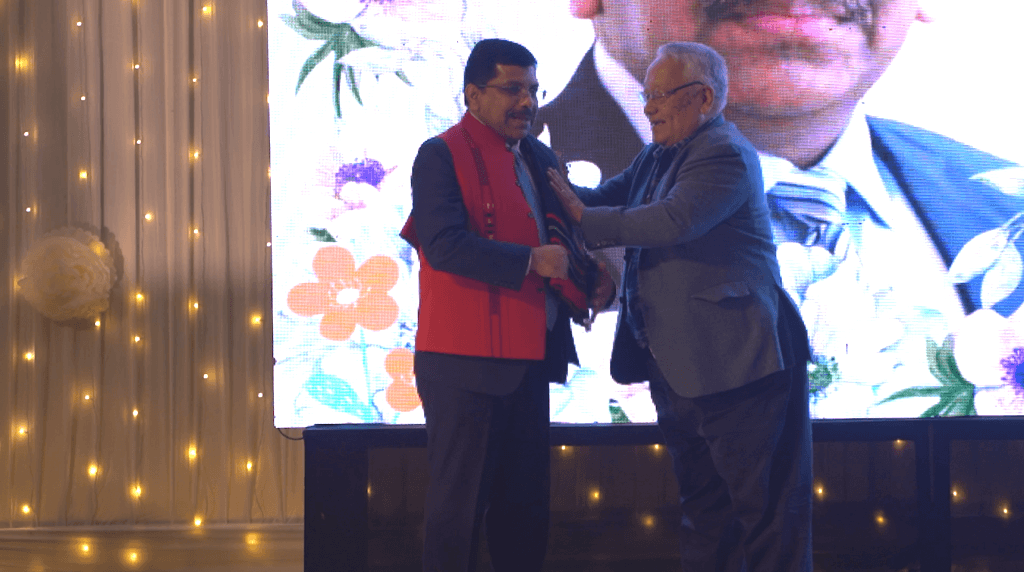
DIMAPUR — NN Nagi School, Dimapur, marked its 7th annual day titled ‘Winter Flair,’ a floral crescendo that showcased creativity, joy, effort and the school’s vibrant cultural focus.
The event was held at the school’s auditorium on Friday.
The Grade 2 students presented a mesmerising, beautifully choreographed skit based on the Angami Naga folk tale of Sopfünuo—a story of a woman and her child driven from their village by the husband only to meet a tragic end at the hands of forest spirits on their way back to Rüsoma. The performance vividly brought Nagaland’s landscape to life.
The school’s inclusivity shone when Grade 6 and 8 students staged “Fantasia” a dazzling gala that brought the glamour of the Met Gala to life through a burst of creativity.
Also read: Nagaland Literature Festival explores storytelling in AI era
Dr. Joseph Emmanuel, Chief Executive & Secretary of the Council for the Indian School Certificate Examinations (CISCE) and the event’s special guest, praised the way students are nurtured, noting that every school strives to bring out the best in each child—precisely the purpose of education.
He explained that all educational institutions aim to uncover a child’s potential and equip them for adult life’s challenges, but it is the delivery of education with the right values and a forward-looking vision that truly sets an institution apart.
He noted that the students were enthusiastically encouraging one another, praising this as the art of collaboration—working together and caring for each other.
Dr. Emmanuel stressed that such innate human qualities must be protected, preserved and nurtured, for they hold the key to a better world. “We must cultivate these skills in our learners,” he said.
“Education today is not merely about transmitting information; information is ubiquitous—on Google, the internet, YouTube, everywhere. What matters now is teaching children to discern and use the right information.”
He added that the National Education Policy’s shift away from rote learning toward building capacities and competencies reflects this need.
Additionally, he emphasised that a child’s true potential outweighs any fear of failure, urging them to act boldly, celebrate their achievements, and learn from their mistakes.
Given that nearly a third of India’s population is under 35, said that the country will stay youthful for the next 30‑40 years. Yet he questioned how to capitalise on this demographic dividend, stating that the benefits will materialise only if “we educate our young learners correctly.”
He described education as the ability to tell right from wrong and to act rightly, stressing that values, ethics and integrity are indispensable.
When people are shaped into capable, principled individuals, they become assets to the nation; a society rich in such persons will inevitably grow into a strong, emerging power, so the country’s future hinges on the quality of human resources produced by its education system, he said.
He equated the functioning of a school as a fourwheel vehicle— the management serves as the steering wheel, the faculty and teachers as the engine, the parents provide the supportive rear wheel, and the students the drivers.
“When all four wheels are in perfect balance, the institution moves swiftly, grows rapidly, and reaches its destination without delay,” he added.