

Bangla Bhasha Prachar O Prasar Samiti launches NBSE prescribed Class 10 Bengali textbook ‘Sahitya Parikrama’ in Dimapur.
Share


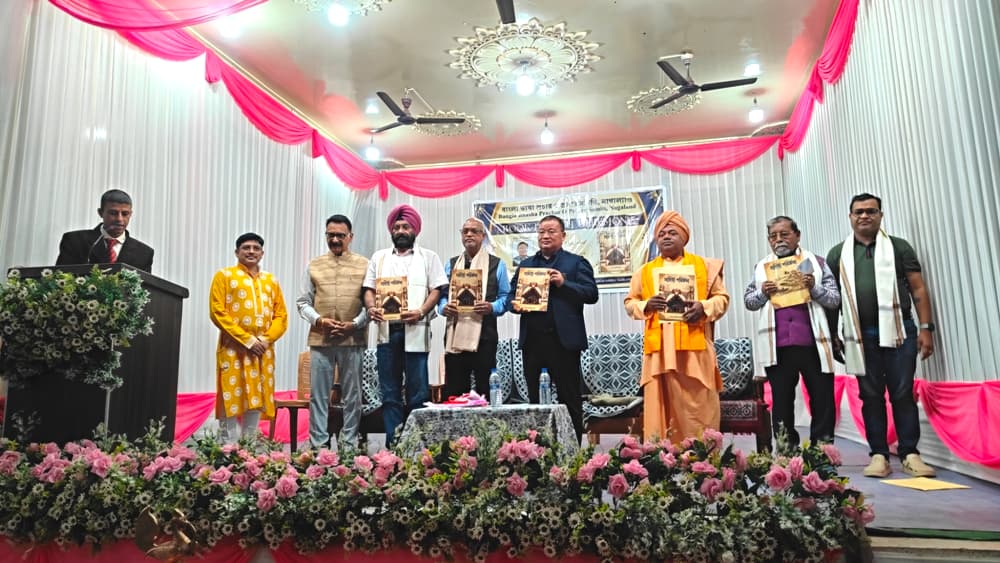
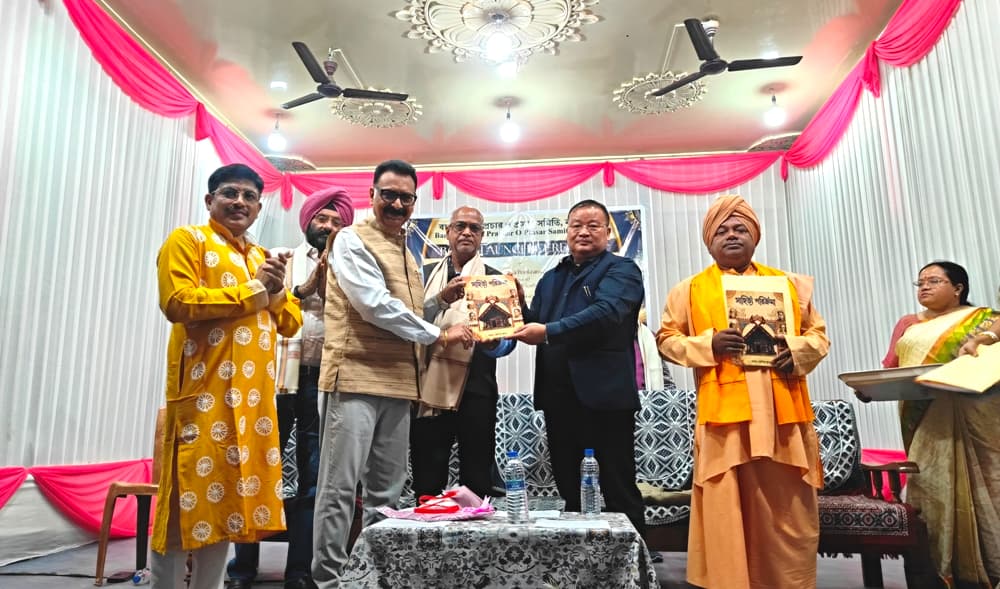
DIMAPUR — The Bangla Bhasha Prachar O Prosar Samiti (BBPOPS), Dimapur, launched the Bengali textbook “Sahitya Parikrama” for Class 10 under the Nagaland Board of School Education (NBSE) at the Pranab Jubilee Auditorium, Pranab Vidyapith Higher Secondary School (PVHSS), Dimapur, on Thursday.
Addressing the gathering as the chief guest, Deputy Commissioner of Dimapur, Dr. Tinojongshi Chang, who also unveiled the book, congratulated the chairperson and the team behind the making of the textbook. He hoped that the book would enlighten the younger generation of the Bengali community on the knowledge of the language and their mother tongue.
Dr. Chang observed that many people tend to forget their languages, which are slowly diminishing and vanishing. He noted that even in Naga society, especially among students living in Dimapur and Kohima, there is a tendency to forget their languages. He added that some hesitate or feel ashamed to speak their languages, being more inclined towards English and Nagamese.
Stating that language is one's identity and culture, he warned that unless one knows how to speak and write their language, "one day you will be nowhere." He encouraged students to focus and try to learn their own mother tongue.
Acknowledging the world of technology and Artificial Intelligence (AI), the deputy commissioner noted that while students are often addicted and confined to gadgets, technology cannot substitute human knowledge. He stated that human resources are one of the most important resources. He advised students to have a positive attitude to achieve their goals and become assets to society, their parents, communities, and the country.
Chairman of the Samiti and Principal of PVHSS, Manoj Bhattacharjee, stated that the NBSE had entrusted the Samiti with the responsibility of publishing the Bengali textbook. He described this responsibility as a trust and a recognition of their collective commitment to promote, preserve, and strengthen Bengali language education in Nagaland.
Read more local news: Unauthorised check gates shut across Dimapur following inspection drive
Bhattacharjee assured that the book was prepared strictly in accordance with the NBSE syllabus and curriculum. He remarked that the book is not just a compilation of lessons but "a bridge connecting language with identity, culture with education, and aspirations with opportunity".
He noted that in Nagaland, very few students opt for Bengali as a subject despite a huge Bengali-speaking population, which made publishers reluctant to print the book due to the low demand.
A message from Araile Imchen, Academic Officer (Language), NBSE, was read out, in which she congratulated the Samiti on the launch. She stated that the textbook is comprehensive, aligned with the syllabus, and covers a range of literary pieces and language skills suitable for Class 10 students.
President of Dimapur Bengali Samaj, KK Paul, speaking as special guest, highlighted the rich legacy of Bengali literature, citing figures like Rabindranath Tagore, Kazi Nazrul Islam, and Bankim Chandra Chattopadhyay. He lamented that today, while children sing Bengali songs, they often use English alphabets because they cannot read or write in Bengali. He pointed out that the Bengali language has achieved recognition as the sixth most spoken language in the world and urged students to practise it.
Swami Chinmayananda, Chairman of Bharat Sevashram Sangha, Dimapur and Karbi-Anglong, quoted the poet Michael Madhusudan Dutta to illustrate the realisation of the richness of the Bengali language after neglecting it for foreign treasures.
He stressed that practising the Bengali language is essential to prevent a communication gap between generations. He also mentioned that the need for the book had long been felt, and earlier the textbooks had to be brought from Assam. With its launch, he said, a long-standing requirement had finally been fulfilled.
The textbook has been compiled and edited by Swagatam Ray (Headmaster if Dimapur Railway High School), Sarmistha Mukherjee, Rajkumar Ghosh, Swati Chakraborty and Dilip Das.
The prose section includes “Jeevan Smriti” by Rabindranath Tagore, “Ahwan” by Bibhuti Bhushan Bandyopadhyay, “Swarajer Adarsho” by Subhash Chandra Bose, “Padma Nadir Majhi” by Manik Bandyopadhyay, and “Swayangsiddha” by Dr. Easterine Kire.
The poetry section features “Paper Bhagee” by Krittibas Ojha, “Deenodaan” by Rabindranath Tagore, “Rooposi Bangla” by Jibanananda Das, and “Aekti Moroger Kahini” by Sukanta Bhattacharya.
The novel section includes “Mej Didi” by Sarat Chandra Chattopadhyay.