


Visually impaired artisan Sahlem Konyak from Yuching village wins a state award for wood carvings preserving Konyak heritage through touch and memory.
Share


-1770131782376.jpg&w=1200&q=75)
KOHIMA — K Sahlem Konyak, a 31-year-old visually impaired artisan from Yuching village in Mon district, is keeping the Konyak heritage alive through practice, memory and touch.
He is one of the two awardees in the ‘special category’ of the state-level award on handicraft and tribal textiles for 2025–26. Sahlem was awarded in the category of wood carving.
“I don’t see anything, but I did them with my hands,” Sahlem told Eastern Mirror.

Having lived with visual disability since he was young, Sahlem learnt the art of wood carving and crafting at the age of 15. Most of his works depict Konyak heritage and traditions, involving the carving of figures from raw wooden pieces, which requires precision.
“In this world, I am different from others and couldn’t do much like others. So I decided that as long as I live, I will work. That’s when I started making crafts,” he said.
Also read: Nagaland: Governor’s Award 2025 conferred
It has now been 16 years since he began carving and making handicrafts, and this is the first time that his work has been recognised.
-1770131786440.jpg&w=1200&q=75)
“The department didn’t know about my work before, but today they recognised my work and called me here. I am so happy for that,” Sahlem said during the award presentation programme held in Kohima on January 29.
Using basic traditional tools such as chisel, machete (dao) and sledge hammer, he makes all his crafts by touch. For him, carving figures of men and women is one of the most challenging tasks.
His first craft was carving figures. He has made many such pieces and is currently working on one as well.
His sample submission for the award consisted of wooden figures of Konyak women pounding rice on a traditional pounding table with wooden tools. It took him 30 days to complete the piece.
Exclusives read: From the forest: Noklak women turn nettle bark into heritage art
“I did it with my hand and it was very difficult to make it in the absence of proper tools,” he said.
His younger brother, Yanpoh Konyak, said they collect wood from the forest and bring it home for Sahlem to work on his carvings.
Born in 1994, Sahlem did not originally have any visual disability. His vision was affected due to an illness in 2000, after which he went blind. At that time, he mostly stayed at home because of his condition.
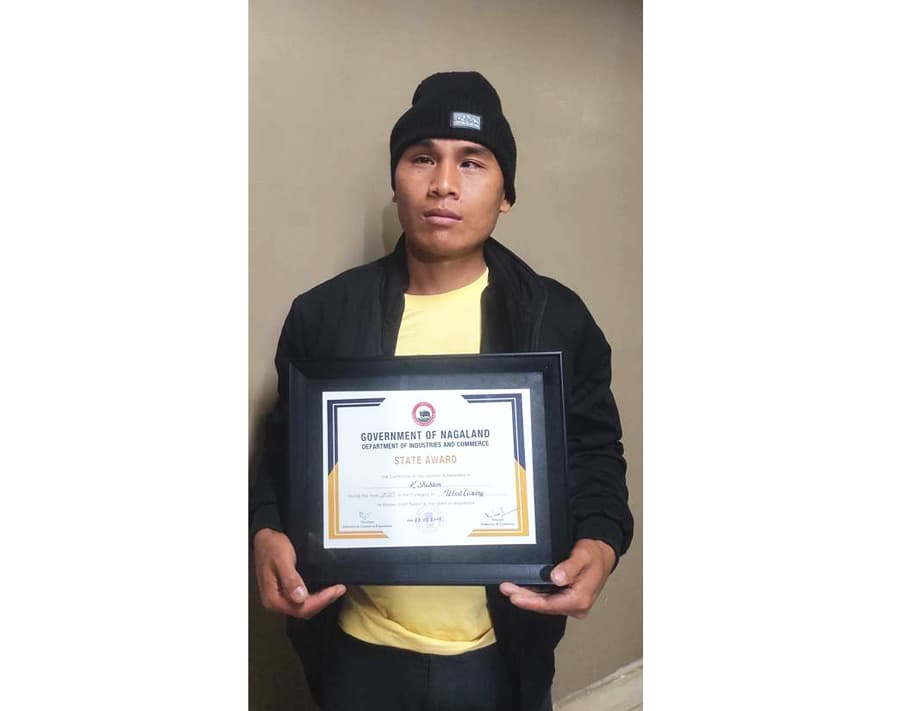
That was when he began carving. Above all, he said God blessed him with this talent and he has been doing this work full time.
N Bangyoh Naam, a village member, said that most of Sahlem’s crafts have so far been kept at home as there is no market for them. This is the first time his work has received exposure and recognition from the department.
Naam added that Sahlem does the carving and shaping, while his younger brothers paint the pieces, as he cannot distinguish colours.
The Department of Industries and Commerce presented the state-level award to a total of 15 artisans from 2024–25 and 2025–26 after a seven-member committee headed by the director and experts in the field judged the entries based on several criteria and selected the winners.
This is the first time that the Ministry of Textiles introduced a ‘special category’, under which two artisans were selected and awarded — K Sahlem in wood carving and Imnasunep in cane and bamboo.
While the award certificate comes with monetary benefits, the main focus is on handholding the awardees after the award, according to P Tokugha Sema, director of Industries and Commerce. The awardees will receive a pension of INR 8,000 per month after attaining the age of 60 years. However, for the ‘special category’ awardees, there is no age limit, and they will receive their pension immediately.
Asenla Walling, Executive Engineer and Programme Officer (Textiles), said Sahlem’s work reflects Naga heritage and everyday life in the Konyak community. His carvings capture attire, ornaments, postures and hairstyles, portraying the rhythm of domestic life in the village. She further noted that his work highlights the importance of shared work among women in the Konyak community.