


Joint research from Nagaland University and University of Science and Technology, Beijing, demonstrates that discarded apple leaves can deliver eco-friendly protection against metal corrosion
Share


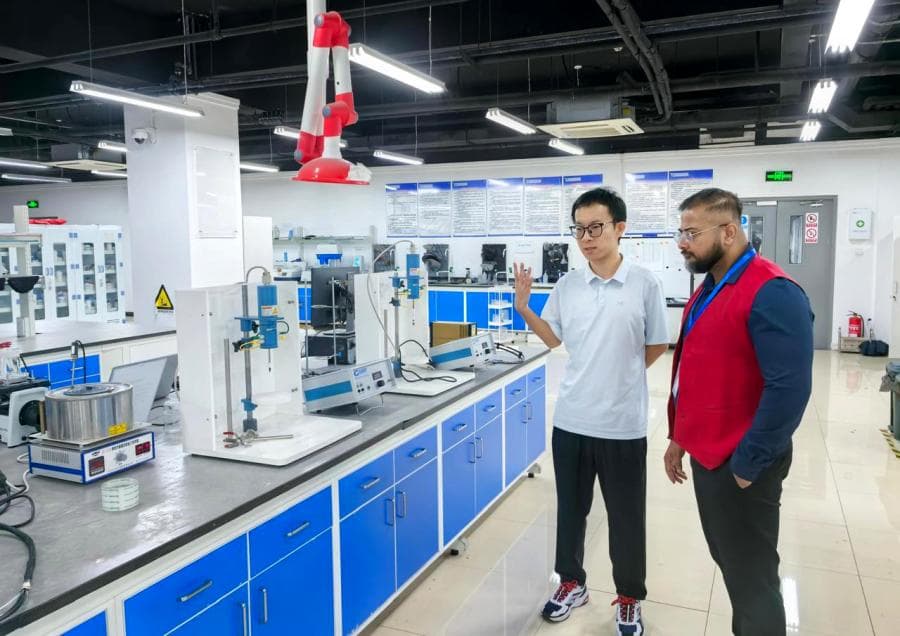
DIMAPUR — Researchers from Nagaland University and University of Science and Technology, Beijing, have demonstrated that carbon quantum dots derived from discarded apple leaves can deliver long-lasting, eco-friendly protection against metal corrosion, a persistent global industrial challenge.
In a press release, the Nagaland University stated that the research highlighted a sustainable alternative to conventional, often toxic, corrosion inhibitors used across infrastructure and manufacturing sectors.
The collaborative study, led by Prof. Ambrish Singh of Nagaland University and Prof. Yujie Qiang of the University of Science and Technology, Beijing, showed that the newly developed apple-leaf carbon quantum dots (ACDs) can suppress copper corrosion in acidic environments with an inhibition efficiency of 94.0 per cent at low concentrations, improving to 96.2 per cent over longer exposure periods.
Such performance levels are considered highly promising for real-world industrial applications where metals are routinely exposed to harsh chemical conditions, it stated.
The findings were published in Journal of Alloys and Compounds, a leading peer-reviewed journal publishing research on the synthesis, structure, properties and applications of metallic alloys and advanced compounds.
Congratulating the researchers, Prof. Jagadish Kumar Patnaik, Vice-Chancellor of Nagaland University, said, “I am proud that a Nagaland University–led international research team has demonstrated how apple-leaf waste can be transformed into an eco-friendly corrosion inhibitor with up to 96.2% protection for copper.
“This Indo–China collaboration exemplifies our commitment to sustainable, high-impact science that addresses real-world challenges while reducing reliance on toxic chemicals. Such innovations reinforce Nagaland University’s role in advancing green technologies for infrastructure and manufacturing sectors.”
Beyond industrial benefits, the study also underscores the value of waste-to-wealth approaches. By transforming agricultural residue into high-value functional nanomaterials, the work supports circular economy models and offers potential income avenues for farming communities.
Elaborating on the applications of the research, Prof. Ambrish Singh, Department of Chemistry, NU, and also a visiting professor at National University of Science and Technology Beijing, said, “The end applications of this research span several critical sectors. In industries such as oil and gas, chemical processing, power generation and wastewater treatment, acidic environments accelerate corrosion, driving up maintenance costs and safety risks.
Biomass-derived inhibitors like apple-leaf ACDs could significantly extend the service life of pipelines, storage tanks and industrial equipment while reducing environmental and health hazards associated with conventional chemicals.”
Speaking about research, Prof. Yujie Qiang, National Centre for Materials Service Safety, University of Science and Technology Beijing, said, “Using a green hydrothermal process, our research team converted apple leaves, an abundant agricultural waste, into nanoscale carbon particles doped with sulphur and nitrogen.
“These elements create multiple active sites that strongly adhere to metal surfaces. Electrochemical tests confirmed that the ACDs form a compact, stable protective film on copper, effectively blocking corrosive ion transfer. Advanced theoretical modelling further revealed that specific nitrogen-containing groups play a key role in anchoring the protective layer to the metal surface.”
While the current results are based on laboratory-scale validation, the researchers plan to advance toward pilot-scale testing and real-world deployment, including integration with existing protective coatings.
“The collaboration positions Nagaland University at the forefront of sustainable corrosion science and reinforces the role of international partnerships in addressing global materials challenges through environmentally responsible innovation,” the release stated.