


Nagaland State Rural Livelihoods Mission held a training programme on Indian Sign Language for immersion site staff in Kohima to promote inclusion.
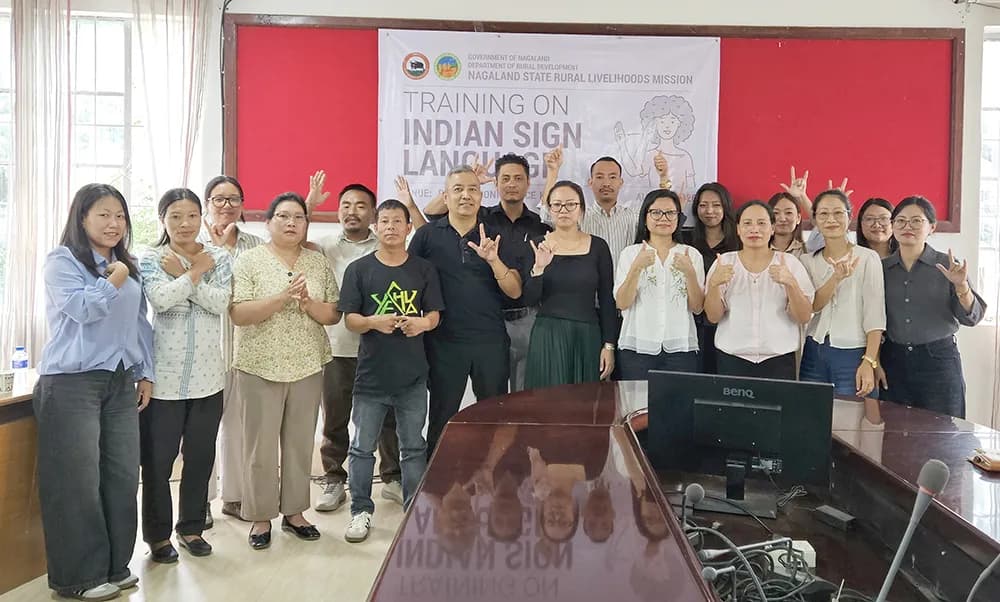
DIMAPUR — The Nagaland State Rural Livelihoods Mission (NSRLM), under the Social Inclusion and Social Development (SISD) vertical, organised a training on Indian Sign Language (ISL) for Immersion Site staff at the RD Mini Conference Hall in Kohima on August 4 and 5.
The sessions were facilitated by certified Indian Sign Language interpreter Ruokuokhrienuo Vizotha, who provided practical and interactive training on the fundamentals of Indian Sign Language, according to an update.
Topics covered included deaf awareness and deaf culture, the importance of inclusive communication, basic signs and vocabulary, greetings, numbers, sentence formation, facial expressions, non-verbal communication, and everyday conversational skills.
The resource person pointed out the importance of breaking communication barriers to ensure equal participation and access to services for persons with disabilities. She encouraged participants to continue practising sign language and to incorporate inclusive communication practices into their day-to-day responsibilities.
Participants engaged in demonstrations, role plays, group activities, and practical exercises throughout the programme. The hands-on sessions enabled participants to build confidence in using basic Indian Sign Language and enhanced their understanding of the communication needs of persons with hearing impairments.
The training forms part of ongoing efforts by the NSRLM to strengthen the capacities of Immersion Site staff under the SISD vertical. By equipping field functionaries with basic Indian Sign Language skills, the mission seeks to improve accessibility, promote meaningful participation of persons with disabilities, and reinforce the principles of equality, dignity, and inclusion in rural development initiatives.
Addressing the participants, Chief Operating Officer (Programmes) of NSRLM, M Rollan Lotha, spoke on the importance of creating an ecosystem that is accommodative and will ensure the enhancement of demands for entitlements and basic rights. Stating that the training is aimed at strengthening the capacity of frontline functionaries to communicate effectively and to promote inclusive, accessible, and equitable service delivery across communities, he encouraged participants to consciously implement such efforts down to the grassroots level.