


Nagaland launched “Naturally Nagaland” and signed a T-Works MoU to boost MSMEs, innovation and market access across the state.
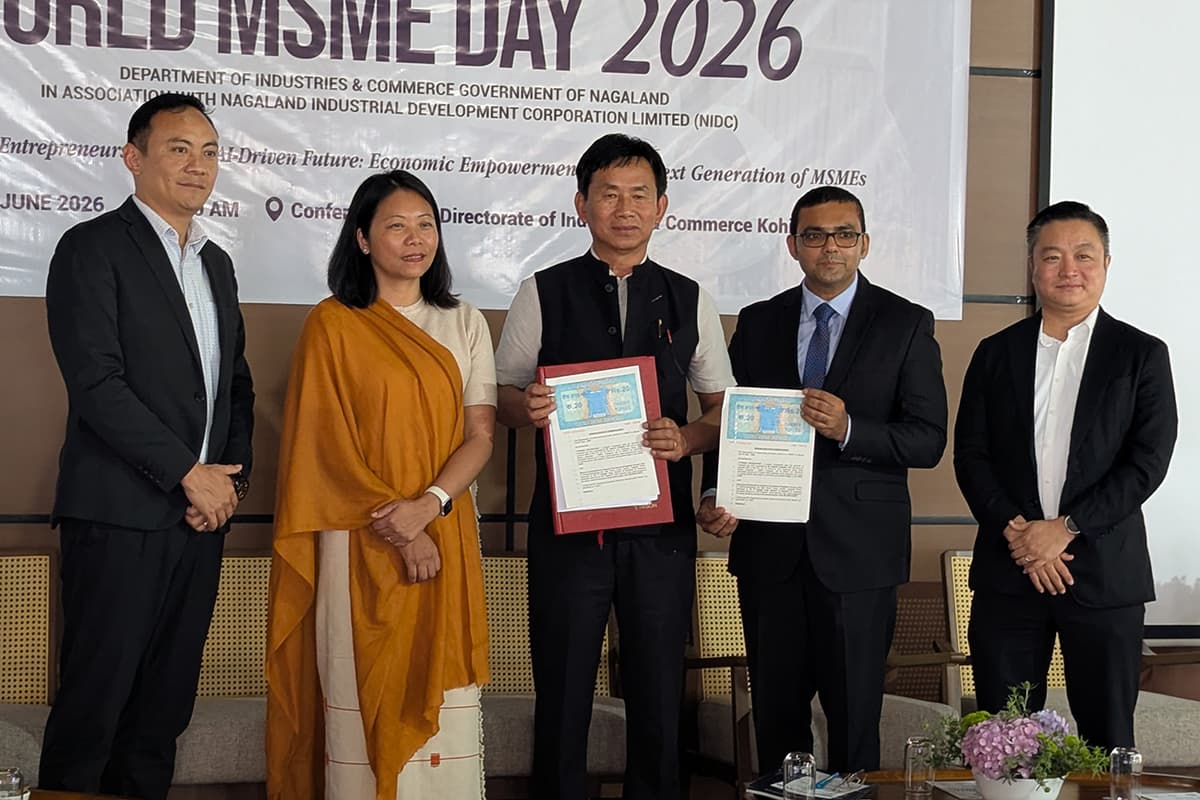
‘Naturally Nagaland’ initiative launched on MSME Day
KOHIMA — Nagaland marked Micro, Small and Medium Enterprises (MSME) Day with the launch of the “Naturally Nagaland” initiative and the signing of a memorandum of understanding (MoU) aimed at strengthening the entrepreneurial ecosystem in the state.
Advisor for Industries & Commerce Hekani Jakhalu officially launched the initiative and addressed entrepreneurs from across the state at the conference hall of the Industries & Commerce directorate, Kohima, on Friday.
Jakhalu said that a total of 52,801 enterprises had been registered on Udyam as of June 25, 2026, marking an increase of about 4,000 registrations in three months. Speaking on the importance of Udyam registration, she said it is the identity card for enterprises and urged entrepreneurs to register.
Nagaland has a total of 82,913 MSMEs registered, of which 52,599 are micro, 189 small, 13 medium and 30,112 IMEs (UAP).
A memorandum of understanding between T-Works and the Government of Nagaland was also signed by the director of Industries and Commerce and the chief executive officer of T-Works to strengthen innovation, product development, prototyping support and entrepreneurship in the state.
On the agreement, Jakhalu said the signing of the MoU aims to provide expertise to entrepreneurs and reflects the government's seriousness towards the MSME sector.
She also appealed to T-Works to provide the best expertise to local entrepreneurs.
The advisor expressed confidence that the MSME sector would become stronger and that entrepreneurs would continue to scale up in the future.
Deputy Secretary of Industries & Commerce Chonpenthung Ezung said that the “Naturally Nagaland” Initiative is a flagship market development platform under the Raising and Accelerating MSME Performance (RAMP) Scheme being implemented by the department.
He said the initiative has been conceived to strengthen the branding, visibility and market accessibility of MSMEs from Nagaland by bringing together the efforts of multiple stakeholders under a unified platform.
Ezung said that with the world moving towards native, sustainable and authentic products, it is time for the state to think globally and prepare MSMEs for export readiness.
He added that export success depends not only on price competitiveness but also on compliance, certification, quality, environmental responsibility, carbon footprint reduction and proper export documentation.
Noting that buyers across the world are looking for products they can trust, he said the state's real strength lies in native talent and traditional knowledge.
He said that, particularly in textiles, Nagaland must identify and document authentic designs, motifs and patterns, protect them through GI tags and present them as part of a strong narrative that appeals to international buyers.
The official also said that despite Nagaland being blessed with unique products, traditional skills and entrepreneurial talent, many producers continue to face challenges in establishing a strong brand identity and accessing larger markets beyond their immediate localities.
According to Ezung, “Naturally Nagaland” aims to bridge this gap by creating a credible, government-supported brand framework that promotes authentic, natural and indigenous products from the state.
The initiative aims to provide mentorship programmes for 750 MSMEs, onboard e-commerce platforms, set up a Naturally Nagaland Centre, participate in national exhibitions and establish product development centres.
Nagaland Industrial Development Corporation chairman Kvulo Lorin, while providing an overview of the RAMP scheme implementation in Nagaland, said that over 49,000 MSMEs have directly benefited from the initiative.
He said that more than 35,000 entrepreneurs have been trained and 30,000 women entrepreneurs have received targeted support. The programme conducted 882 focused workshops and awareness programmes across all 16 districts, 55 subdivisions and 63 RD blocks.
Lorin added that efforts are being made to ensure that women entrepreneurs, persons with disabilities and youth in remote districts have access to opportunities.
Joint director of Industries and Commerce Cholzo Sophie said that the MSME sector contributes nearly 30% to India's GDP, 46% of exports and is the second-largest employer after agriculture in the country.
Tsachola Sangtam of HillCraft Co. and Neivi Khieya of Karmel Timber also shared their success stories under the RAMP programme.