


Nagaland projects INR 337 crore deficit despite INR 74 crore surplus, citing reduced central tax share and discontinued grants impact finances.
Share


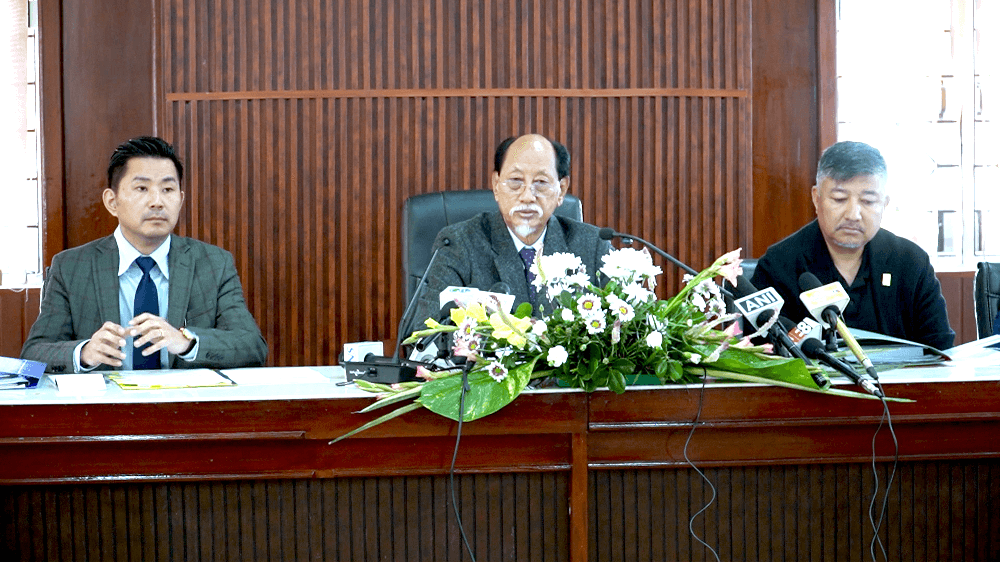
KOHIMA — Nagaland government has projected a deficit budget of INR 337.04 crore for the financial year 2026–27, with Chief Minister Neiphiu Rio flagging a sharp decline in the state’s share of central taxes and discontinuation of key grants as major concerns impacting the state’s finances.
The budget estimates indicate that the year will generate a surplus of INR 74.77 crore. However, due to a negative opening balance of INR 411.81 crore, the state is projected to close the year with a deficit of INR 337.04 crore.
Rio also informed that the closing deficit for 2025–26 is estimated to improve by INR 431.39 crore. Against a projected deficit of INR 843.21 crore in the budget estimates, it is now expected to close at INR 411.81 crore in the revised estimates.
Presenting the budget, the chief minister estimated gross receipts at INR 22,507.10 crore. These include the state’s own tax and non-tax revenue of INR 2,714.44 crore, the state’s share in central taxes of INR 7,341.28 crore, central assistance (grants and loans) of INR 9,471.08 crore, internal debt of INR 2,978.77 crore, and recovery of loans and advances of INR 1.53 crore.
Also read: Frontier Nagaland Territorial Authority Bill introduced in Assembly; Rio eyes April rollout
Climate crisis hits home: Kikon raises red flag in Assembly
Gross expenditure is estimated at INR 22,127.33 crore. This includes non-developmental expenditure (including servicing of debt) of INR 13,337.51 crore, servicing of debt (including repayment of Ways and Means Advances) of INR 2,618.74 crore, and development expenditure (including Centrally Sponsored Schemes) of INR 6,171.08 crore.
WATCH MORE:
Addressing a press conference after the presentation, Rio said that the 16th Finance Commission has discontinued Revenue Deficit Grants (RDG) for the period 2026–31 and reduced Nagaland’s inter-se share of central taxes from 0.569% to 0.481%. This, he said, accounts for a deficit of INR 752.42 crore compared to the previous year’s budget estimates.
He informed that the state had projected a requirement of INR 8,113.70 crore before the Finance Commission but did not receive the expected allocation.
According to the chief minister, he met the Union finance minister on February 4 and apprised her of the state’s concerns. “If the state’s projection is not met, government salaries, pensions, debt servicing and other exigencies cannot be paid,” he said.
He added that in subsequent communications, the state conveyed a minimum requirement of INR 4,500 crore for the current year to meet essential obligations. Following what he described as a concurrence from the Centre, the state has proceeded with the budget by anticipating at least INR 4,500 crore in grants in lieu of RDG.
Rio said that the state’s own revenue generation shows improvement compared to the previous year. Own tax revenue is projected to increase by 10.52% (INR 197.75 crore), while own non-tax revenue is expected to grow by 7.5% (INR 44.56 crore).
He also presented a development (state programme) outlay of INR 1,350 crore, marking a 12.5% increase from the previous year’s allocation of INR 1,200 crore.
Sector-wise, General Services and Others received INR 259.98 crore (19.26%), followed by General Economic Services at INR 253.97 crore (18.81%), State Share Pool to Centrally Sponsored Schemes at INR 250 crore (18.52%), and Social Services at INR 235.74 crore (17.46%).
WATCH MORE:
Other allocations include grants to the Frontier Nagaland Territorial Authority (FNTA) of INR 100.57 crore, budget initiatives of INR 62 crore, agriculture and allied sector of INR 59.74 crore, and transport sector of INR 41.42 crore.
Finance Commissioner Kesonyü Yhome said that the state government is hopeful of receiving the minimum support from the Centre following the chief minister’s intervention. However, he said that if the amount is not released, the government will undertake a mid-course review of finances and revisit plan outlays, including possible recasting.
Yhome explained that the reduction in the state’s share of central taxes is a primary reason for the downturn in the budget, stating that while some states have benefited, others have seen a decline under the 16th Finance Commission award.
He also pointed to a slowdown in GST collections following rate rationalisation in recent months, describing it as a trend observed across the country.
Another contributing factor, he said, was the exclusion of Ways and Means Advances (WMA) from budget projections after a review of the budgeting process, which has resulted in a reduction in the overall budget size compared to the previous year.
INR 62 crore new schemes
The state government has introduced 17 new initiatives in the budget with a total outlay of INR 62 crore, to be implemented by respective departments. Notably, this is the first time Nagaland has adopted an SDG-linked budget framework along with a gender budget statement.
Among key measures, creches will be set up in major government offices, starting with the Civil Secretariat, to support working women. An Innovation Seed Fund of INR 2 crore will assist 1,000 nano women entrepreneurs, while 50 ‘pink scooty taxis’ will be piloted in Kohima, Mokokchung and Chümoukedima to expand women’s participation in transport.
To address water security, the government will roll out a Strategic Water Resilience Initiative (INR 24 crore), focusing on storage, rainwater harvesting and groundwater recharge. Renewable energy push includes an INR 11 crore solar initiative to install rooftop systems in all village council buildings.
Environmental sustainability efforts include green economy initiatives and bamboo value chains, while INR 5 crore has been allocated to expand skill development and entrepreneurship under NSEDM. A new Nagaland Apprenticeship and Placement Exchange (NAPEx) will connect youth to jobs and create a workforce registry.
In education, incentives for STEM students and open learning schemes (INR 1 crore each) aim to boost access and employability. Community wellbeing, cleanliness incentives for local bodies, and a sports advancement programme (INR 3 crore) are also included.
To strengthen revenue, new mechanisms such as a fund mobilisation cell, land revenue reforms, e-stamps and e-GRAS will be introduced. Business growth will be supported through value-addition incentives, logistics for agri-produce (INR 5 crore), and initiatives for weavers.