


Nagaland DEFCC team led by Y Kikheto Sema visits Rain Forest Research Institute Jorhat to explore collaboration on agarwood cultivation.
Share


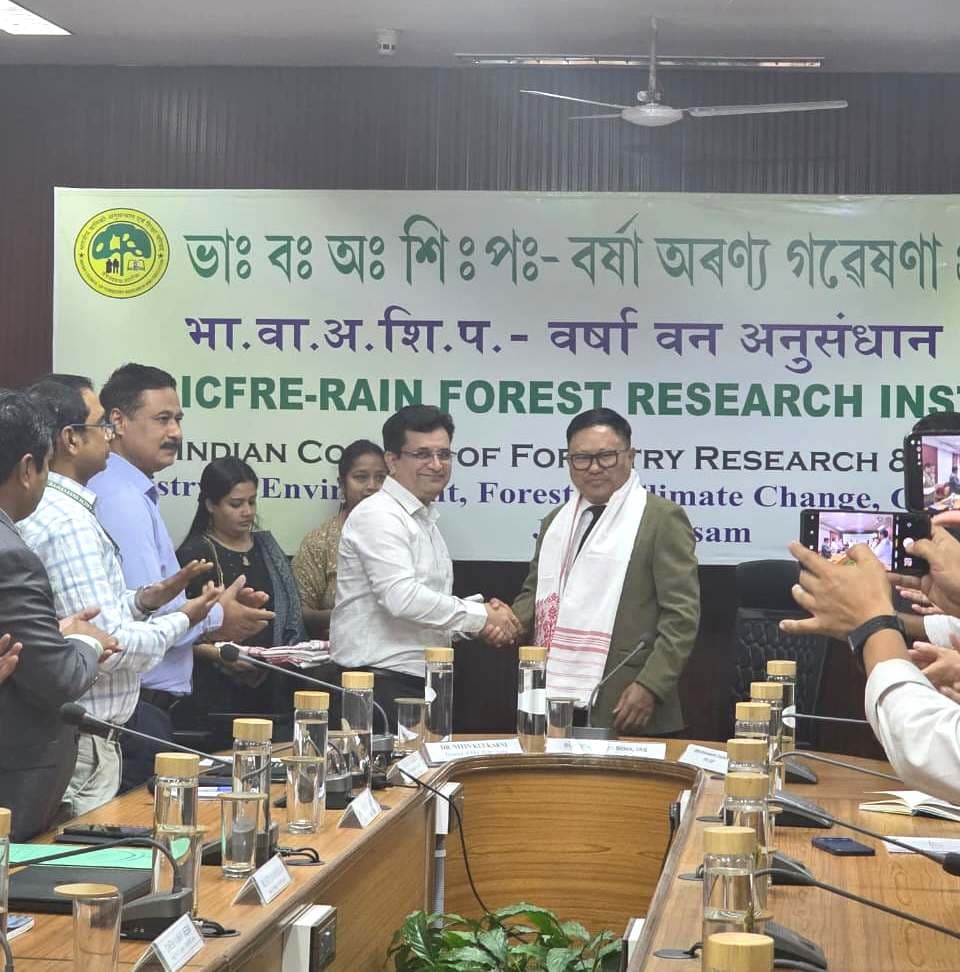
DIMAPUR — A delegation of eight officers from the Department of Environment, Forests and Climate Change (DEFCC), Government of Nagaland, led by Principal Secretary Y Kikheto Sema, visited the Rain Forest Research Institute (RFRI), Jorhat, Assam on March 6.
The objective of the visit was to explore avenues for scientific collaboration with the institute in the areas of sustainable forest management, research support, and improved cultivation techniques of economically important tree species like agarwood, teak, a DIPR report stated.
The delegation held discussions with Nitin Kulkarni, Director of RFRI, and a team of scientists heading various research divisions.
The interaction included a presentation on the institute’s mandate and research activities, followed by visits to research facilities such as the Bambusetum and the institute’s museum.
Also read: JD (U) Nagaland welcomes Nishant Kumar into active politics
During the deliberations, Kikheto highlighted the potential of agroforestry in Nagaland, noting that the traditional practice of shifting cultivation (jhum) is increasingly becoming economically unviable and ecologically unsustainable. He said that scientific agroforestry interventions with species such as agarwood could provide a sustainable and profitable alternative for farmers.
Citing the India State of Forest Report, he said around 800 sq km of forests were lost in Nagaland between 2013 and 2023 due to deforestation and degradation.
In contrast, agarwood cultivation could provide significantly higher economic returns over a period of about 10 years while generating livelihood opportunities for rural youth.
Kikheto also noted that Nagaland possesses rich agarwood resources and may have nearly 25 lakh agarwood trees.
However, he expressed concern that the state’s export quota for agarwood chips/powder and oil stands at only 3,400 kg and 180 kg per year respectively—about 2–3% of the national quota.
Officials informed the delegation that the quota allocation was based on a Non-Detrimental Finding (NDF) study conducted by the Botanical Survey of India.
Kikheto said the survey should have been conducted in consultation with the state government and across the state, and added that the matter would be taken up with the Government of India.
He further pointed out that due to lack of awareness and a clear agarwood policy, farmers in Nagaland often sell their produce at low prices to buyers from neighbouring states.
The principal secretary suggested exploring integrated plantation models combining agarwood with coffee and other crops suitable for the state.
Referring to the Government of India announcement in the Union Budget 2026 to support agarwood cultivation and trade in the North East, Kikheto said the initiative provides a timely opportunity for Nagaland to develop a structured and scientifically guided agarwood sector.
He also noted the need for technical support such as quality planting material, appropriate spacing, intercropping practices, processing and trade.
While observing that agarwood from Nagaland with natural infection is in high demand in West Asia and Southeast Asia, he said fungal infection and agarwood formation remain inconsistent in some areas.
The delegation was informed that RFRI has developed an indigenous inoculum named “Sashi”, which can achieve agarwood infection within two years.
Kikheto requested the institute to assist farmers in artificial inoculation of agar trees using the technology.
During the meeting, both sides agreed that RFRI and the Government of Nagaland would collaborate on priority areas including resource mapping of agarwood, expansion of cultivation, improvement of species suited to Nagaland’s agro-climatic conditions, artificial inoculation techniques, supply of quality planting material and capacity building for forest officials and farmers.
It was also agreed that a Memorandum of Understanding would be signed between the state government and RFRI to facilitate scientific agarwood cultivation and strengthen the sector in Nagaland.