MONDAY, DECEMBER 01, 2025
Nagaland climbs to 8th in national HIV response ranking as experts call for unified, urgent action
Nagaland rose to 8th in National AIDS Control Organisation rankings as leaders warned that urgent, united action is still needed to curb HIV.
Share


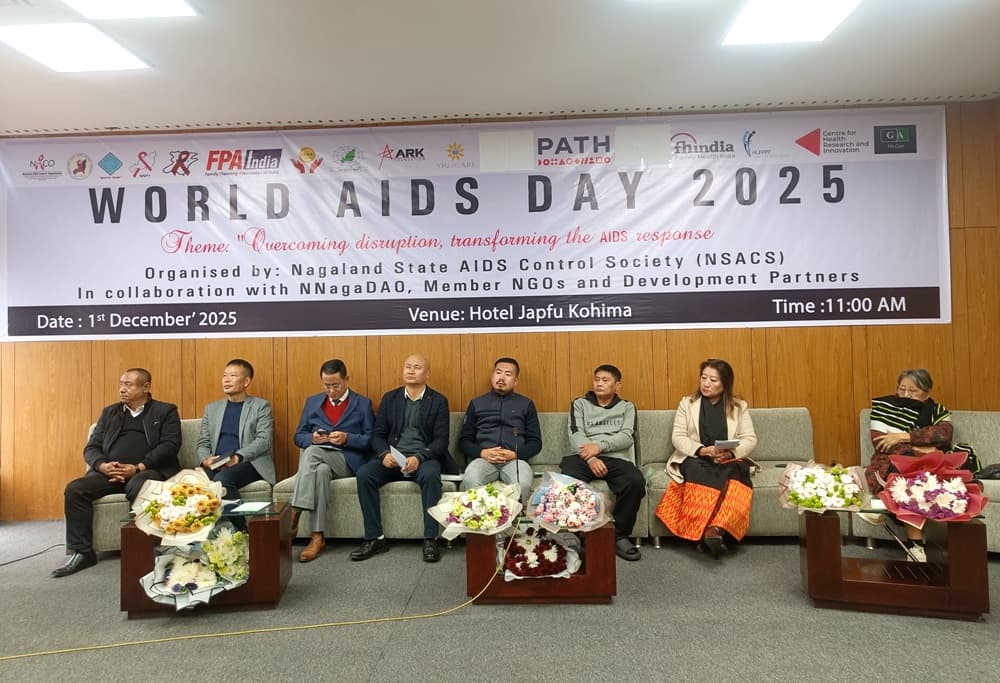
KOHIMA — Nagaland marked World AIDS Day 2025 with a cautiously optimistic message: the state has climbed from 19th to 8th place in the National AIDS Control Organisation’s (NACO) national performance rankings, signalling major progress—but leaders and experts warned that the fight is far from over.
At a programme organised by the Nagaland State AIDS Control Society (NSACS) in collaboration with NNagaDAO, member NGOs and development partners in Kohima, various speakers provided multiple insights into the state’s HIV scenario.
The event was held on the global theme, ‘Overcoming disruption, transforming the AIDS response.’
Delivering the keynote address, Dr. Ahu Sekhose, Project Director of NSACS, revealed that Nagaland is now among six states in India positioned to achieve the global “95-95-95” target—ensuring 95% of people living with HIV (PLHIV) know their status, 95% of those diagnosed receive treatment, and 95% on treatment attain viral suppression.
He attributed Nagaland’s improved national ranking to consistent performance across 50 indicators, adding that NACO had recently awarded five-star quality certification to 38 Integrated Counselling and Testing Centres (ICTCs) in the state.
While most Northeast states continue to report rising HIV trends, Dr. Sekhose said that Nagaland has stabilised its trajectory since 2004, despite having the second-highest prevalence rate after Mizoram.
Also read: The 'safest state' paradox: Nagaland's low crime data hides a crisis of gender-based violence
He cited major behavioural shifts, including a decline in injecting drug use among key populations—from 39% in 1994 to 2.54% today.
“We are fighting a winning battle,” he said, cautioning that sustained support and collective responsibility are essential to ensure that HIV “no longer remains a threat to society.”
NNagaDAO president Abou Mere warned that while overall indicators are improving, worrying new patterns are emerging—particularly among young people.
HIV prevalence among individuals aged 15–49 now stands at 1.37%, reflecting both expanding risk behaviours and the spread of the epidemic beyond earlier hotspots.
“What started as a localised epidemic has permeated all districts,” he said, underscoring the urgent need for expanded prevention, testing and treatment services.
He raised concerns about persistent funding constraints, which are hampering the scale-up of vital programmes.
Read more: Nagaland has 14,830 HIV patients receiving treatment
Call to revive LFA
President of Network of Nagaland People Living with HIV (NNP+), Lanu Aier, issued yet another appeal for the revival of the Legislators’ Forum on AIDS (LFA), which was disbanded in 2020.
The forum, he said, played a critical political and advocacy role that official agencies alone cannot fulfil.
“Legislators can bridge gaps where organisations struggle to reach. Their withdrawal has created a vacuum,” he said, urging the government to restore the forum in the interest of PLHIV.
Kohima Press Club president Alice Yhoshu highlighted the media’s critical role in shaping public perception.
She said that journalists must strengthen public education on HIV&AIDS and challenge the ignorance and prejudice that persist across communities.
Co-convenor of Global Naga Forum Prof. Rosemary Dzuvichu pointed out that while NSACS has brought positive changes, the daily struggles of PLHIV remain poorly understood.
“They are not living in luxury,” she said, urging urgent interventions in skill development, employment and nutritional support, including access to protein-rich diets essential for immunity.
A mission, not a project
Former president of Naga Mothers’ Association Padmashree Neidonuo Angami delivered a poignant reflection on the decades-long fight against drugs and HIV in the state.
She recalled how the NMA was founded during the height of Nagaland’s drug crisis, propelled by a moral and spiritual imperative to save young lives.
She warned that shrinking donor support, reduced government health budgets and expectations for states to raise their own revenue pose serious threats to HIV interventions.
“These are catastrophic developments for a state that depends heavily on central funding,” she said.
Angami stressed that real transformation relies not on grants alone but on community-driven commitment.
She urged government agencies, churches, civil society, affected communities and educational institutions to collaborate.
“Everybody must work together because this is a mission—not a project—to save lives,” she said.
Popular Articles
Nagaland Districts