


Naga Research Scholars’ Forum holds its second Autumn Meet at NEHU, discussing fieldwork, academic publishing and research presentations
Scholars shared experiences of navigating field challenges, overcoming publication rejections and bridging the gap between theoretical frameworks and ground realities
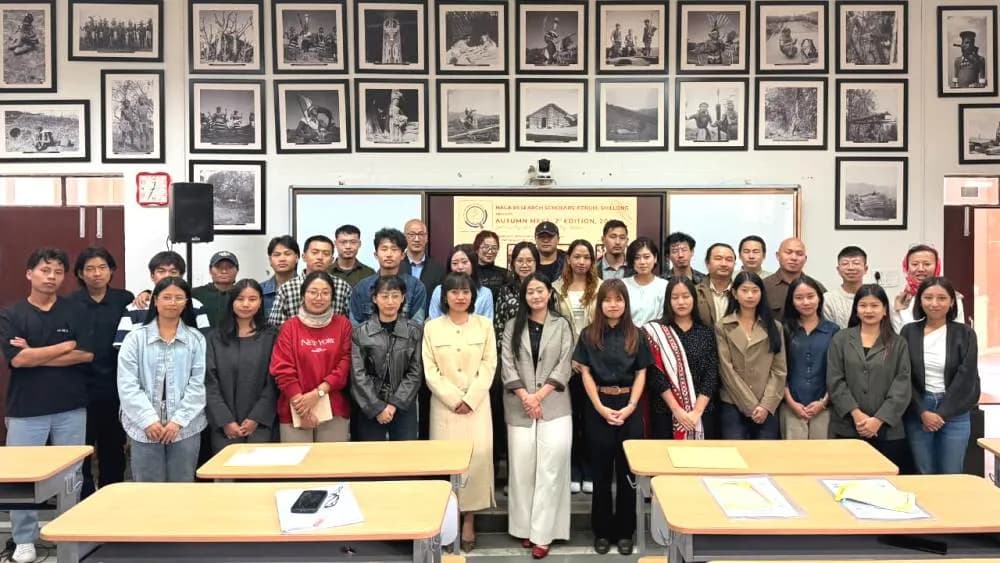
DIMAPUR — The Naga Research Scholars' Forum, Shillong (NRSFS), organised the second edition of its Autumn Meet 2026 at North-Eastern Hill University (NEHU) on October 24, bringing together research scholars to discuss the challenges of academic research, fieldwork experiences and effective presentation of research findings.
Held on the theme “Intersecting Minds, Illuminating Future,” the programme featured discussions on the relationship between theory and field realities, the challenges of academic publishing, and the importance of critical thinking and effective communication in research.
The first session, titled “Between Theory and Ground: The Making of Research,” featured three speakers who shared their research experiences and perspectives on the practical and intellectual challenges of academic work.
Dr. Ab. Dijinbou of the Department of Culture and Creative Studies discussed the relationship between theoretical frameworks and field realities, drawing on folklore and cultural contexts to explain how myths and folk songs can provide insights into cultural memory, history and changing traditions.
Emphasising the need to question assumptions and guard against ideological influences and confirmation bias, he encouraged researchers to remain open to new interpretations rather than allow existing beliefs to shape their findings.
He also highlighted the importance of conceptual analysis and generating new insights, noting that traditions are continually reinterpreted by communities rather than remaining static.
Zulotoshi Imchen of the Department of Geography shared his experiences of conducting fieldwork in Aizawl and Shillong, highlighting challenges such as language barriers, unfamiliar surroundings and adapting to new environments.
He also spoke about the difficulties of academic publishing, particularly the repeated rejection of research papers.
He said continued writing, extensive reading and improvements in research techniques and analytical approaches helped him learn from setbacks.
Describing research as a long and sometimes lonely journey, Imchen encouraged scholars not to allow rejection to undermine their confidence, emphasising that persistence and continuous learning are essential to academic growth.
Aras Kumar Gurung of the Department of Anthropology spoke about his fieldwork among the Sherpa community in Nepal in the context of mountain climbing.
He challenged the tendency to view Sherpas primarily through their association with mountaineering, calling for a broader understanding of their social and cultural lives.
Gurung recounted the difficulties of reaching remote field sites, including travelling by bus and walking for two to three days.
He also highlighted the need for careful preparation, appropriate medicines, suitable clothing and safety equipment when conducting research in challenging environments.
His experiences included concerns raised by a national park warden regarding the collection of wildlife samples, as well as encounters with local guides and the risks associated with high-altitude conditions.
Despite the challenges, Gurung extended his stay beyond the original plan, gaining deeper insights into the community and its way of life.
His presentation underscored the importance of adapting to unfamiliar circumstances and understanding people within their social and environmental contexts.
The speakers' experiences highlighted how field realities can challenge theoretical assumptions, academic rejection can test a researcher's perseverance, and unexpected encounters can generate new insights.
During the interactive session, participants discussed qualitative data analysis, academic publishing and the meaning of engaging critically with the field.
Responding to a question on qualitative research, Dr. Dijinbou explained that conversations with elderly informants sometimes extended beyond the immediate research topic but later proved valuable for thesis work or separate research papers.
Addressing a question on repeated publication rejections, Imchen stressed the importance of understanding journal requirements, improving analytical approaches and strengthening research methods through continuous practice and reading.
The discussion also examined whether fieldwork should be limited to visiting places and recording respondents' accounts or involve deeper engagement with the historical, cultural and social contexts shaping people's experiences.
Participants reflected on the need to move beyond description and critically examine underlying meanings, silences and perspectives, including those often overlooked in earlier accounts.
The second session featured a workshop on academic presentation conducted by Pheloseno Shaiza of the Department of Anthropology.
The workshop focused on improving PowerPoint presentations and organising academic content effectively.
As part of a group activity, participants were divided into five groups, each given a book and asked to select a topic for presentation.
With 20 minutes to prepare, the groups had to identify the central idea, assess its significance and present the most relevant information coherently.
The exercise highlighted the importance of clarity, critical selection of information, collaboration and effective communication, demonstrating that successful academic presentations depend more on conveying key messages than on filling slides with information.
The programme was chaired by Vizovonuo Suohu, while E Ongarhoni Ovung delivered the welcome address. Ebina Panmei proposed the vote of thanks, followed by lunch and the dispersal of participants.
The Autumn Meet provided a platform for research scholars to exchange experiences and reflect on the demands of academic life, emphasising that meaningful research requires critical inquiry, perseverance, engagement with communities and the ability to communicate knowledge effectively.