

Mount Tiyi College’s History department organised an inter-semester drama competition in Wokha, with students presenting historical themes through creative performances.
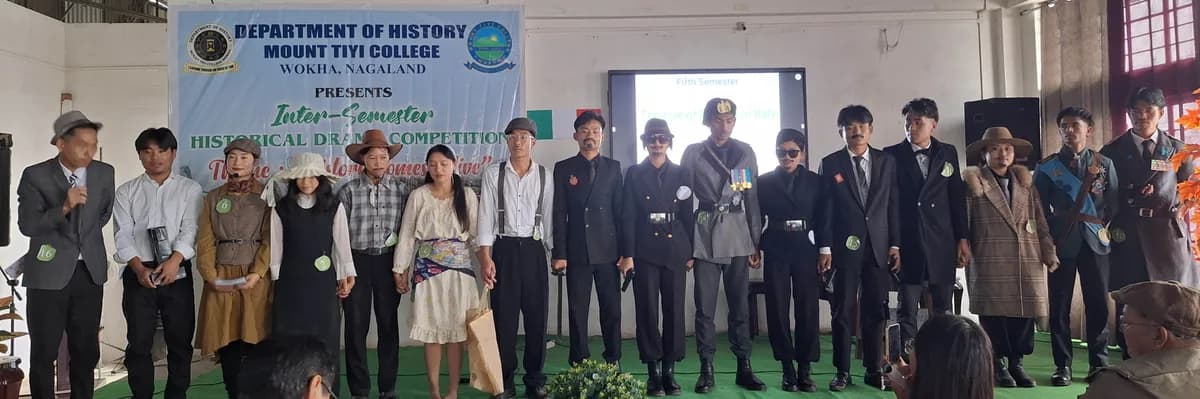
WOKHA — The Department of History, Mount Tiyi College (MTC), Wokha, organised an inter-semester historical drama competition on the theme “History Comes Alive” at the college conference hall on October 1.
The competition was organised as part of the department’s academic initiative to encourage students to engage with history beyond conventional classroom learning through storytelling, acting and stage presentation.
Students from the first, third and fifth semesters participated in the competition. The first semester presented ‘Slavery in Ancient Greece,’ the third semester staged ‘France 1789: The Cry for Liberty,’ while the fifth semester presented ‘The Rise of Fascism in Italy.’
The performances combined historical content with dialogue, acting, costumes, creativity and stage presentation to portray the respective themes.
Welcoming the gathering, Dr. Libemo Kithan, Head of the Department of History, said the programme reflected the importance of learning beyond the classroom.
He said historical events, personalities and experiences could be better understood when students engaged with them creatively rather than viewing history solely as recorded information.
Principal Dr. Bweyhunle Khing appreciated the department for organising the initiative and said practical activities such as drama and presentations could make learning more engaging and effective.
She encouraged faculty members to incorporate more experiential learning methods into classroom teaching and urged students to actively participate in such programmes.
Vice Principal Dr. Khyopenthung Tsopoe also lauded the initiative, describing the competition as an innovative academic exercise.
He said the performances demonstrated how history could “come alive” when presented creatively.
In a brief discourse on the origins of drama from the perspective of English literature, Tsopoe traced the development of medieval drama to practices within the Catholic Church, where biblical stories were enacted for congregations unable to understand Latin.
He noted that such performances later moved beyond church premises to public spaces and eventually evolved into organised theatre traditions.
Referring to William Shakespeare’s early experience as a supporting actor before becoming one of the most celebrated playwrights in English literature, Tsopoe highlighted the evolution of drama into diverse forms of theatre, cinema and visual productions.
He also commended the students for their confidence, creativity and acting skills.
Myingthunglo Murry, Assistant Professor, introduced the panel of judges and briefed participants on the competition rules. Performances were assessed on historical content and relevance, historical accuracy, acting and dialogue delivery, direction, costumes, creativity, stage presentation, coordination and overall impact.
The fifth semester emerged as champions, while the third semester secured the first runner-up position and the first semester finished as second runner-up.
In the individual categories, Chenithung of the first semester was adjudged best actor, while Hayivani Jami of the fifth semester received the best actress award.
Tumben Erui of the fifth semester won the best narrator award, while Oponthung of the same semester was adjudged best costume.