


Union Minister Ram Nath Thakur reviews agricultural programmes in Longleng and flags slow work at District Hospital.
Share


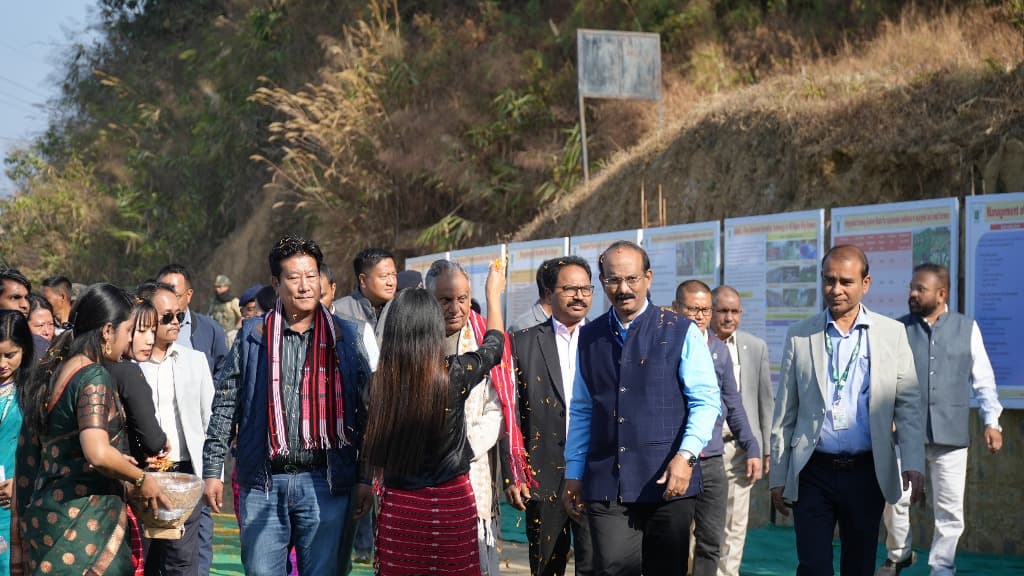
DIMAPUR — Union Minister of State for Agriculture and Farmers Welfare Ram Nath Thakur reviewed agricultural programmes and ongoing development works in Longleng district on February 18 and the 19th and expressed dissatisfaction over the progress of construction at District Hospital Longleng.
The minister, who was on a two-day visit to the district, inspected development projects at the district headquarters, including the NECTAR project at Bautung Government Higher Secondary School and the District Hospital. During the inspection, he was not satisfied with the work progress of the hospital, according to a DIPR update.
On February 18, an official programme was held at the DPDB Hall, Longleng, attended by heads of departments and civil society organisations. Deputy Commissioner W Manpai Phom delivered the welcome address and presented a detailed district report through a presentation.
Also read: Village communities key to conserving Nagaland’s biodiversity — CCF Chalkapure
In his address, Thakur said the Prime Minister remains committed to the development of the Northeast region and emphasised the welfare of farmers. He urged the agriculture and allied departments to provide details on the total cultivated area, number of hectares under farming and the number of farmers involved. He also enquired about the functioning of the Soil Testing Laboratory in the state and whether it is benefiting farmers.
He called on officials to ensure proper implementation of government schemes so benefits reach the grassroots level and asked that their effectiveness in Nagaland be reviewed. He also encouraged agricultural scientists to intensify practical solutions and innovations for farmers.
MLA A Pongshi Phom, speaking on behalf of the district, highlighted that around 70 percent of Nagaland’s population depends on agriculture and that shifting cultivation is widely practised due to terrain conditions. He requested allotment of funds for construction of agri-link roads to improve farm access, reduce transportation cost and connect farmers to buyers.
President of the Phom People’s Council YB Angam Phom requested sanction for a feasibility study to establish a regional agriculture university and a research centre in Longleng to modernise traditional farming and transform jhum cultivation into a sustainable industry.
During the visit, Thakur also interacted with villagers at Orangkong village, self-help groups and senior citizens, and visited the traditional morung and handicraft stall, where a cultural programme was presented, the update stated.
On Thursday, the minister visited ICAR-Krishi Vigyan Kendra (KVK) Longleng and reviewed agricultural development programmes aimed at improving livelihood security. He emphasised modernising jhum cultivation through scientifically validated, location-specific technologies and transitioning towards low-input, climate-resilient farming systems without compromising indigenous knowledge.
He reviewed demonstrations on low-input crop varieties suitable for hill agriculture and appreciated promotion of water harvesting structures such as jal kund and rainwater storage systems to address moisture stress and erratic rainfall.
The minister stressed development of location-specific technologies, value addition and post-harvest management to reduce losses and enhance farmers’ income. He encouraged entrepreneurship development among women farmers through processing, seed production and allied agri-enterprises.
He also underscored conservation of local germplasm and farmers’ rights and called for stronger convergence between research, extension and line departments to accelerate adoption of proven technologies. The visit concluded with a tour of KVK experimental units, where he expressed satisfaction over its role in strengthening sustainable agriculture and rural livelihoods.
Thakur was accompanied by MLA A Pongshi Phom, DC W Manpai Phom and senior officials from various departments and civil society organisations.