

Nagaland Board of School Education 2026 results show HSLC pass rates declining across districts, while HSSLC improves across Arts, Commerce and Science streams.
Share


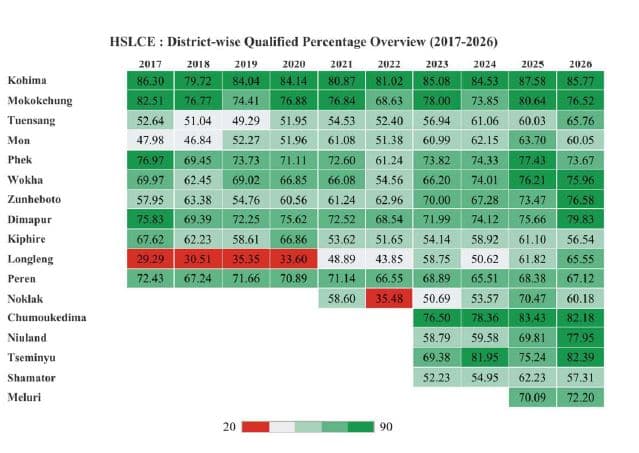
DIMAPUR — The 2026 HSLC results declared by the Nagaland Board of School Education (NBSE) have raised concern after recording a decline in the overall qualified percentage across all 17 districts compared to 2025.
The NBSE data shows that while a handful of districts registered improvements, the gains were limited and did not offset the broader downward trend.
Seven districts improved their pass percentage: Longleng (61.82% to 65.55%), Niuland (69.81% to 77.95%), Tseminyu (75.24% to 82.39%), Zunheboto (73.47% to 76.58%), Tuensang (60.03% to 65.76%), Meluri (70.09% to 72.20%), and Dimapur (75.66% to 79.83%).
See Table
In terms of topper distribution, Dimapur (32.50%) and Kohima (22.50%) dominated, followed by Wokha (12.50%) and Chümoukedima (10%). Tuensang and Mokokchung accounted for 6.25% each.
Niuland, Shamator, Peren and Meluri recorded no representation among the toppers. Of the total 80 toppers, 79 were from private institutions, with just one from a government school.
Also read: Dimapur student tops Nagaland HSLC exam with 98.33%, eyes medical career
Gender-wise, female students continued to outperform males, recording a qualified percentage of 72.72% against 71.31%.
However, four districts—Tuensang (66.92% vs 55.72%), Mon (57.04% vs 53.50%), Zunheboto (74.52% vs 73.15%) and Longleng (61% vs 59.03%)—saw higher male performance.
In contrast, the HSSLC 2026 results reflected an overall improvement across all three streams—Arts, Commerce and Science—with the Science stream registering the most significant gains.
In the Arts stream, offered across all 17 districts, seven districts recorded a decline in qualified percentage: Mon (84.50% to 74.95%), Kiphire (87.55% to 83.28%), Noklak (92.09% to 67.97%), Chümoukedima (91.61% to 89.26%), Niuland (94.74% to 94.29%), Shamator (95.00% to 78.46%) and Meluri (84.13% to 72.38%).
In the Commerce stream, available in select districts, Tuensang maintained a 100% pass rate, while Peren dropped sharply from 100% in 2025 to 58.82% in 2026. Dimapur (79.39% to 78.19%) and Chümoukedima (84.03% to 81.67%) also recorded slight declines.
The Science stream, also limited to select districts, saw notable improvement across districts. Wokha achieved 100%, a sharp rise from 42.86% in 2025, while Kiphire improved significantly from 42.86% to 89.89%.
All districts recorded gains except Longleng, which declined from 45.83% to 40%. Noklak, newly introduced to the Science stream, recorded a qualified percentage of 80%.
Topper concentration remained uneven across streams: in Arts, Kohima accounted for over 64% of toppers, with 14 districts having no representation; in Commerce, Dimapur contributed over 92% of toppers, while Kohima accounted for 7.69%; in Science, Dimapur dominated with over 88%, followed by Mokokchung and Kohima at 5.88% each.
Private institutions continued to dominate topper lists across all streams, with minimal representation from government schools.
Gender-wise, females outperformed males in all streams—Arts (89.57% vs 80.85%), Commerce (83.37% vs 80.54%) and Science (87.57% vs 83.14%).
The NBSE’s 2026 results show contrasting trends, with HSLC pass percentages declining across all 17 districts, while HSSLC improved in all streams, led by Science. However, topper concentration in a few districts and no representation from 14 districts in Arts highlight existing regional disparities.
Females outperformed males across streams, underscoring both progress and the need to address gaps in HSLC performance.