


Minister Metsübo Jamir, urges the Ao Kaketshir Mungdang (AKM) to take decisive action to guide the organisation in the right direction.
Share


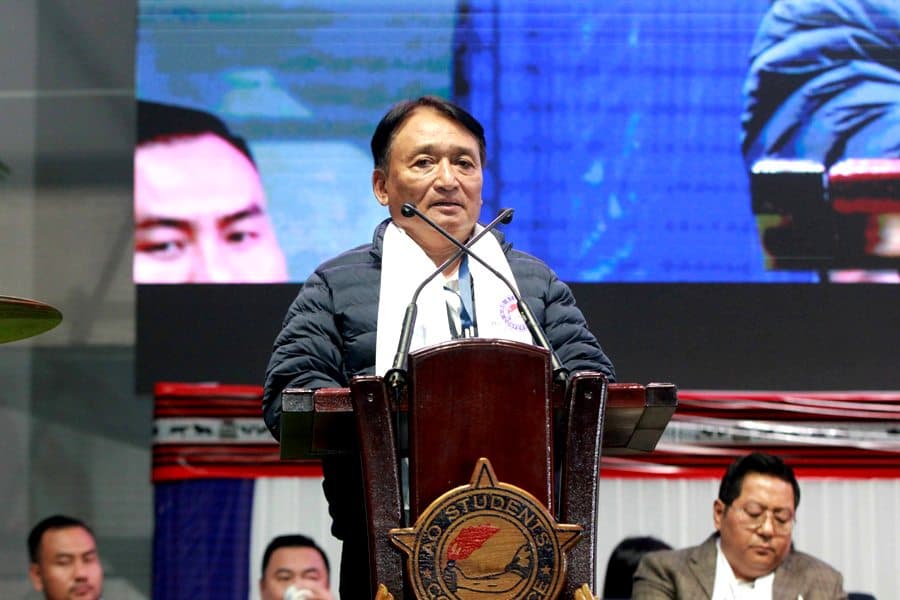
CHUNGTIA — Minister for Rural Development and State Institute of Rural Development (SIRD), Metsübo Jamir, stated that the founding leaders of the Ao Kaketshir Mungdang (AKM) have left behind a remarkable legacy of leadership, sacrifice, responsibility, and forward-thinking vision for future generations.
The minister called on the present AKM leadership to reflect deeply—through introspection and retrospection—and take decisive action to guide the organisation in the right direction for both the present and the future.
Speaking as the special guest on the second day of the 70th AKM general conference held at Chungtia village, Mokokchung district, on January 14, Jamir urged the students to stay true to the conference theme.
“We must not rest content with our past accomplishments,” he said. “Instead, we should advance towards the new horizons we have envisioned, with steadfast determination and unwavering enthusiasm.”
He described the youth as the true strength of any nation and community, stressing that the progress of the Ao people depends on them. “Do not rely solely on parents or elders,” he advised. “The responsibility of leading the Ao community and contributing to its welfare lies firmly in your hands.”
Also read: Ready with alternative political arrangement after Naga settlement, says Chief Minister Neiphiu Rio
“Our hopes and dreams now rest with the younger generation,” he added. “We are approaching our sunset, while yours is the sunrise. Harness your energy to serve the people with full dedication and build the vibrant society you dream of.”
“How you carry it forward depends entirely on you. If your light shines brightly, the world will recognise and honour your efforts,” he encouraged the student community.
Highlighting contemporary challenges, he observed the growing trend of individualism and impatience among young people. He encouraged them to cultivate patience, perseverance, and a commitment to continuous learning, as the future belongs to them.
NSF president calls for Naga unity
President of the Naga Students' Federation (NSF), Mteisuding Heraang, in his greetings message, lauded AKM's historical role as a key vanguard in upholding Naga identity and its significant contributions to the broader Naga cause.
Expressing concern over the current state of Naga society, he lamented its fragmentation due to various forms of division and “ism.” As one of the most educated communities, he urged the Ao people to step forward and lead by example. The NSF, he said, has consistently fought for the rights of all Naga people since its inception.
Addressing misconceptions among the younger generation (particularly Gen Z), he clarified that the NSF was not established merely to handle student issues. It was founded by visionary leaders across Naga areas to champion the rights and aspirations of the entire Naga people, he added.
He emphasised two critical points: the urgent need for Naga unity and the importance of transparency in political efforts.
Recalling historical milestones—such as the Naga Club's memorandum to the Simon Commission in 1918, the formation of the NNC, and the establishment of the NSF in 1947, he called for reigniting the flame of unity amid the current landscape of over 28 groups pursuing Naga aspirations.
Taking the opportunity with senior political leaders present, he challenged Naga political groups to act with sincerity and honesty in advancing the collective Naga cause.
On the issue of the Inner Line Permit (ILP), Heraang said that the NSF has long advocated and pushed for its effective implementation. Efforts include passing resolutions in assemblies, submitting representations to form an independent commission, and conducting awareness tours across tribes, he informed.
Preserve Ao identity amidst global change Advisor Temjenmemba
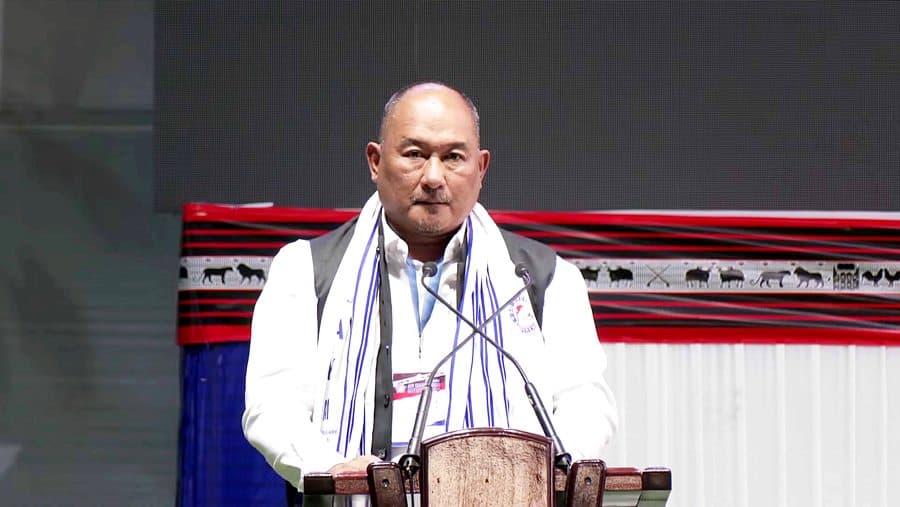
Advisor for Transport & Technical Education, Temjenmemba, on Wednesday described the Ao community’s enduring rich culture, traditions, and language as the community's foundational identity, which cannot be discarded.
He called on the conference to reflect on how to integrate this identity with global transformations.
The advisor was addressing the second day of the 70th AKM general conference's Ao Language Spelling Bee competition.
“As we race toward technological progress, we will face immense challenges,” he noted. “We must ensure our cultural heritage complements this advancement and our progressive mindset in a forward-moving society.”
Temjenmemba warned that in a rapidly evolving world—spanning industry, technology, and AI—the subjects one studies today in colleges and institutions could soon become obsolete, replaced by new paradigms within years.
“Who knows? In the next two decades, even our abundant natural resources like minerals and petroleum might turn into liabilities. We must therefore envision a future aligned with this fast-changing landscape and begin preparing today for the uncertainties ahead,” he urged.
“To adapt to the rapidly changing world, some modifications to our cultural, traditional, and linguistic heritage are essential.”
Observing a compartmentalised thought process among the Ao people, he stressed the need to connect grassroots efforts with a progressive outlook to build a truly advancing society.
“Our guiding question should be: In anticipation of the future, what can I—or we—do for our people?” he said. “This mindset must start at the grassroots and extend to the highest levels, transcending individualism, clannism, and tribalism,” he added.
Acknowledging the Ao community's current challenges, he described this as the perfect moment for introspection and strategic preparation against anticipated and unforeseen futures.
“We need social engineering, planned from today, to bridge the gaps posed by the unpredictable future,” he added.
Meanwhile, in the Ao Language Spelling Bee competition Langpankong Kaketshir Mungdang was declared as the winner followed by Asetkong Kaketshir Telungjem Mungdang and Ongpangkong Kaketshir Mungdang as the first and second runners-up, respectively.
70th AKM general conference resolutions
%20along%20with%20his%20colleagues%20during%20the%20valedictory%20%20programme%20of%2070th%20AKM%20General%20Confernce%20at%20Chungtia%20on%20Thursday.-1768495657939.jpg&w=1200&q=75)
Despite academic excellence achieved by many students, securing sustainable livelihoods remains a challenge. To address this, training programmes will be introduced based on strategic skill development and career conclaves, covering entrepreneurship, career guidance, financial literacy, job melas, research, and innovation.
The law college established by AKM to mark its golden jubilee has produced notable personalities but struggles to maintain academic relevance for the current generation. Office bearers and executive members are directed to collaborate with the Ao Officers' Telongjem to address this and take appropriate steps.
The AKM will develop a digital and entrepreneurship repository featuring career paths, expert interviews, and counselling sessions, to be shared across various social media platforms.
An Act East Policy Implementation Committee will be formed to guide proficient students (especially in English and music) toward enrolment in educational institutions and opportunities in economic markets. Priority will be given to skill acquisition in regional languages, science and technology, and commerce, enabling job placements in neighbouring states and countries.
In preparation for the AKM centenary celebrations in 2029 at Waromung, the organisation will approach the government for improved transport and communication facilities.
A new team of AKM office bearers (2026-29 tenure) was also elected led by Lanulemba Longchar as president, Bendangangba (vice president), Aomayang Longkumer (general secretary), Arenlong Imsong (assistant general secretary), Imlikokba Kichu (education secretary), Akangnungba Aier (cultural secretary), Watinungsang (sports secretary), and Nokshimetem Jamir (information secretary).