


Nagaland launches its Agarwood Policy 2026 to boost cultivation, trade and rural livelihoods while seeking higher export quotas.
Share


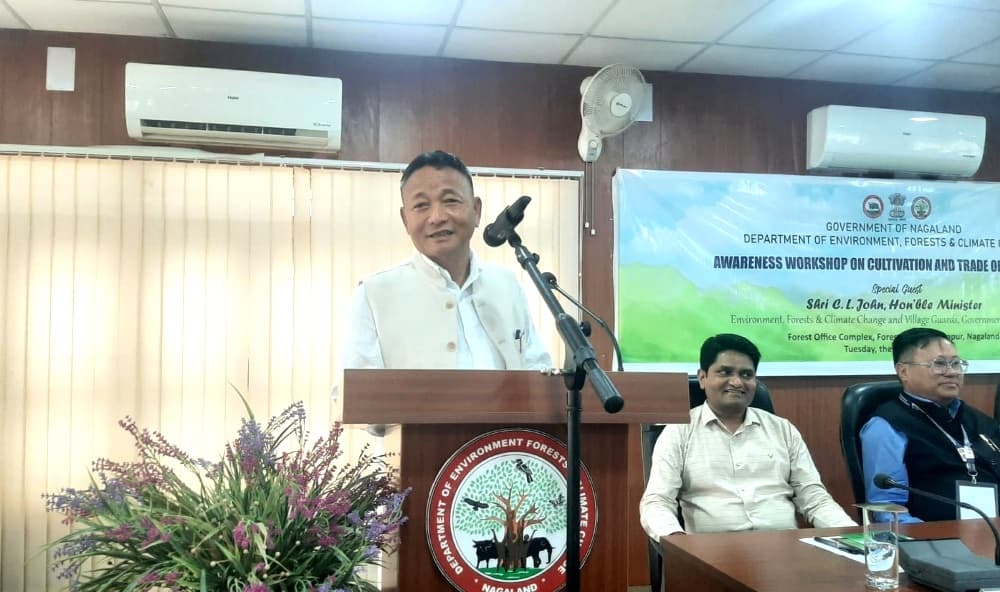
DIMAPUR — Minister for Environment, Forest and Climate Change (EF&CC) and Village Guard, CL John on Tuesday said Nagaland was poised to harness the vast economic potential of agarwood following the approval of the Nagaland Agarwood (Conservation and Promotion) Policy, 2026.
Addressing an awareness workshop on agarwood cultivation and trade organised by the Department of EF&CC at the Forest Office Complex, Dimapur, the minister said the new policy framework would enable the state to develop the sector in a structured manner while ensuring conservation and sustainable utilisation of the resource.
Describing agarwood as a highly valued evergreen aromatic tree species, John said it is widely used in traditional medicine, incense and perfumes across international markets.
However, due to illegal harvesting and trade, agarwood has been listed under the Convention on International Trade in Endangered Species of Wild Fauna and Flora (CITES), making its trade subject to strict regulations.
He said Nagaland's favourable climate and soil conditions make it ideal for cultivating premium-quality agarwood.
He also noted that farmers in the state have increasingly taken up agarwood cultivation because of its high economic returns, while traders are showing growing interest in sourcing the product from Nagaland.
Also read: Mission Coffee launched with INR 49.48 crore investment in Nagaland
Referring to a 2024 report by the Botanical Survey of India (BSI), the minister said Nagaland has around 22.8 lakh agarwood trees that are more than two years old.
He said the Nagaland Agarwood (Conservation and Promotion) Policy seeks to encourage cultivation on private and community lands, strengthen the rural economy, generate employment and improve livelihoods through government support mechanisms.
According to the minister, the state government will submit a comprehensive cluster-based proposal to the Ministry of Development of North Eastern Region (MDoNER) to facilitate the growth of the sector.
John pointed out that neighbouring states such as Assam and Tripura have made considerable progress in agarwood cultivation, while Nagaland lagged behind due to the absence of a dedicated policy.
With the new policy in place, he said the state is now better positioned to tap into the expanding market.
Referring to the Directorate General of Foreign Trade's (DGFT) revised export policy, he said Nagaland currently has an annual export quota of 3,400 kg of agarwood chips and 180 kg of agarwood oil, accounting for only 2.25 per cent and 2.55 per cent of the national quota respectively.
Appealing to the Centre to revise the export limits, John said higher quotas would enable farmers and traders in Nagaland to benefit more substantially from the growing global demand for agarwood products.
He further assured that the Forest department would formulate the necessary rules and provide support to farmers through the supply of quality planting materials, scientific inoculation techniques, processing facilities and market linkages.
Speaking at the programme, Y Kikheto Sema, Principal Secretary for EF&CC and Development Commissioner, stressed the importance of pursuing sustainable socio-economic development.
He said that with peace prevailing in Nagaland for nearly two decades, the state should now focus on economic growth and employment generation.
Given the limitations posed by Nagaland's terrain for establishing large and medium industries, Sema said agro-based, forest-based and mineral-based sectors offer the greatest potential for development.
Highlighting the state's agricultural strengths, he said Nagaland's produce enjoys premium organic value. However, although nearly 70 per cent of the population depends on agriculture, traditional jhum cultivation is no longer economically viable or environmentally sustainable. He added that Nagaland lost nearly 800 sq km of forest cover between 2013 and 2023.
Recalling the coffee plantation initiative launched in 2016, Sema said the government aims to bring 50,000 hectares under coffee cultivation by 2030.
Since Arabica coffee thrives under forest canopy, he said the initiative contributes to both forest restoration and livelihood generation.
He added that Nagaland coffee has gained national recognition and has the potential to create employment opportunities for nearly one lakh people.
Sema said agarwood presents similar opportunities and can be cultivated alongside coffee, sandalwood and areca nut.
Despite the state's capacity to produce high-quality agarwood, he said the sector has remained underdeveloped because of limited awareness and the absence of a proper policy framework.
According to Sema, agarwood cultivation can generate returns significantly higher than traditional jhum cultivation while promoting environmental sustainability and improving rural livelihoods.
The inaugural session was followed by technical presentations on agarwood cultivation and commercialisation. PL Agrawal, Principal Chief Conservator of Forests (PCCF), Tripura, led a session covering registration procedures, harvesting methods, artificial inoculation and processing techniques.
Representatives from the Ministry of Environment, Forest and Climate Change (MoEFCC) and the DGFT also delivered presentations on Certificates of Origin and regulatory requirements governing agarwood trade.
The programme concluded with a panel discussion on promoting agarwood cultivation and trade involving experts and representatives from MDoNER, the North Eastern Council (NEC), the North Eastern Regional Agricultural Marketing Corporation (NERAMAC) and the Rain Forest Research Institute (RFRI).