


Krishi Vigyan Kendras in Zunheboto, Phek and Longleng organise training programmes and distribution drives to boost sustainable farming and livelihoods.
Share


DIMAPUR — Krishi Vigyan Kendras (KVK) in Zunheboto, Phek, and Longleng districts conducted various training programmes and distribution drives to promote sustainable farming and livelihood security.
KVK Zunheboto distributes potato seeds, threshers
KVK Zunheboto, Nagaland University, in collaboration with ICAR–Indian Agricultural Research Institute (IARI), New Delhi, distributed 5,000 kg of high-yielding potato seed variety ‘Kufri Jyoti’ to farmers of Zunheboto district under the North Eastern Hill (NEH) Programme.
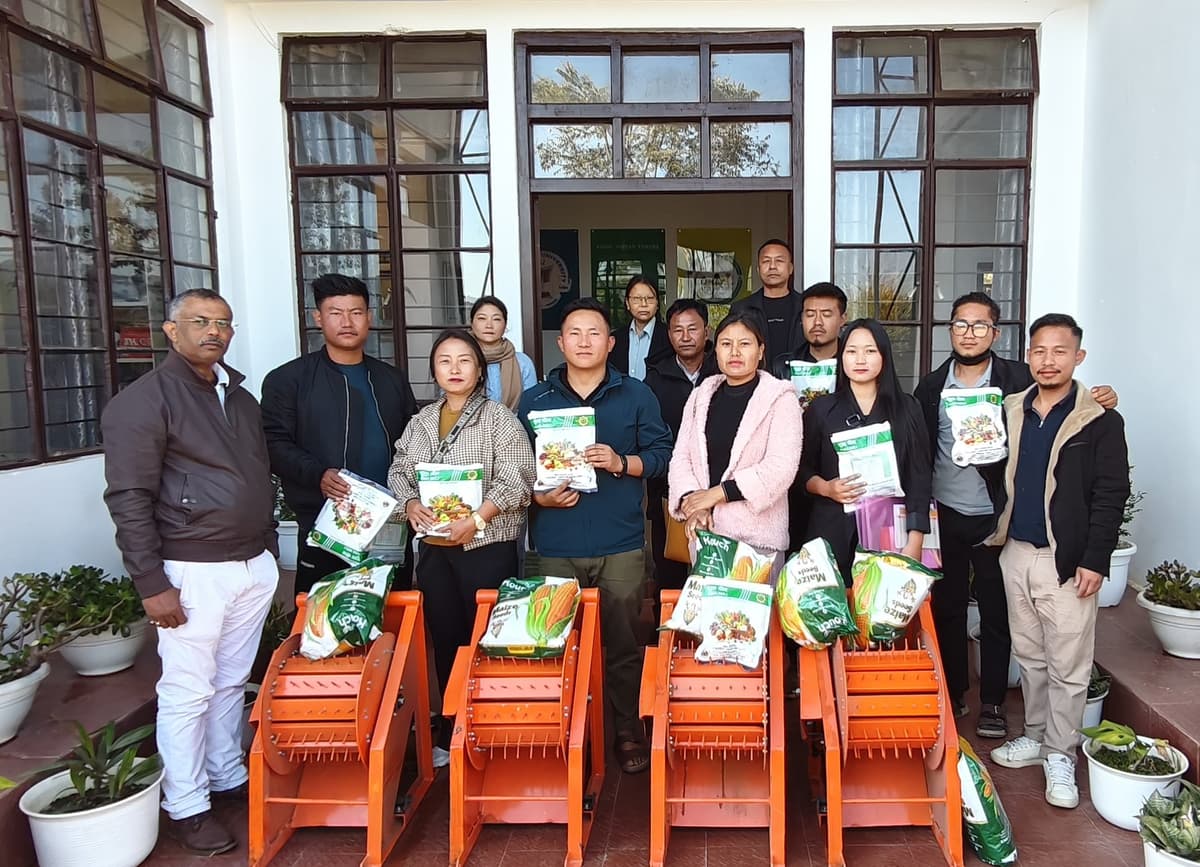
According to a press release, the initiative aimed to enhance productivity and farmers’ income. In addition, 13 pedal-operated paddy threshers developed by IARI were distributed to farmers to facilitate efficient harvesting. These threshers are designed to save time and labour, particularly benefiting small and marginal farmers by reducing post-harvest drudgery.
Also read: Nagaland University researchers propose ‘Digital Rehabilitation Law’
Simultaneously, as part of the ongoing five-day residential training programme on Natural Farming for Community Resource Persons (CRPs) and Krishi Sakhis under the National Mission on Natural Farming (NMNF), which commenced on December 10, a series of technical sessions and practical demonstrations were conducted.
The sessions highlighted low-cost, farmer-friendly technologies that reduce dependence on chemical inputs while improving soil fertility, crop quality, and sustainability. Dr. Rakesh Kumar Chaurasia, principal scientist and head of KVK Zunheboto, briefed the participants on cattle rearing practices and their role in Natural Farming systems.
Further, Naropongla, STO (Farm) and nodal officer, NMNF, demonstrated the preparation of natural inputs, including bio-formulations, mulching techniques, vermicomposting, and their on-field application methods.
As part of the programme, bilingual technical folders in the local language, along with maize and vegetable seeds, were distributed to the CRPs.
Poultry training held at Pholami village
A three-day training programme on “Empowering rural livelihood through scientific backyard poultry management” was organised by ICAR–Indian Veterinary Research Institute (IVRI), Bareilly (Uttar Pradesh), in collaboration with ICAR–Krishi Vigyan Kendra (KVK), Phek (ICAR–National Research Centre on Mithun, Medziphema, Porba) under ICAR–ATARI, Zone VII, Umiam, from December 13 to the 16th for the farmers of Pholami Village, Phek district.
During the programme, Dr. Sanjeev Kumar Singh, senior scientist and head, highlighted the importance of poultry-based training programmes. Dr. M H Khan, principal scientist and head, noted the role of poultry farming in rural livelihood security, nutritional improvement and economic upliftment of farmers.
The technical sessions were conducted by experts from ICAR KVK Phek, Porba and ICAR–NRC on Mithun. Dr. T Esther Longkumer, CTO (Soil Science), delivered a lecture on poultry waste management and its integration with natural farming systems. This was followed by a session by Dr. Hannah K Asangla, CTO (Agronomy), on income generation activities in agriculture and allied sectors.
Dr. Harini K R, SMS (Animal Science), spoke on scientific feeding and housing management practices for chicks and layers. Dr. Ragulraj, STO, ICAR–NRC on Mithun, Porba, focused on hatchery management, disease control, value addition and marketing of poultry products. Manjunath K S, SMS (Horticulture), delivered a lecture on protected cultivation of horticultural crops and its importance in integrated farming systems.
As part of the programme, poultry chicks along with starter feed were distributed to the participating farmers. The training concluded with a farmer–scientist interaction. Certificates of participation were also distributed to all the trainees.
Training on plant disease management in Longleng
ICAR–KVK, Longleng, conducted a one-day training programme on plant disease management under organic farming at Noksosang village.
The training was led by Shubhendu Kumar Behera, subject matter specialist (Plant Pathology), who highlighted the importance of organic disease management practices in maintaining plant health and reducing disease incidence.
During the programme, Dr. Avaneesh Kumar, SMS (Agronomy), and Dr. Kalu Ram, SMS (Fruit Science), were also present and interacted with the participants. They shared insights on soil health management, the role of organic inputs in crop production, and the integration of organic practices for improving productivity and sustainability.
A total of 33 farmers participated in the training programme.