

The Kohima district administration and municipal council hold a meeting with stakeholders to strategise on waste segregation and sanitation drives.
Share


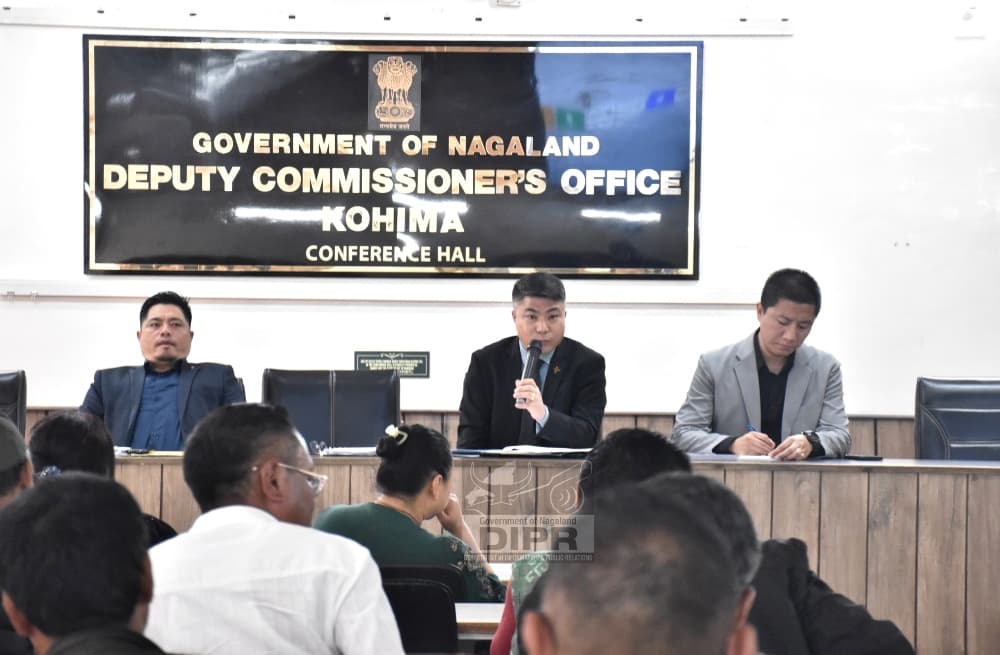
DIMAPUR — A meeting on sanitation and waste management was convened at the deputy commissioner’s conference hall in Kohima on Tuesday with officials, community leaders, ward representatives, and other stakeholders to deliberate on measures for effective waste management and sanitation in the district.
The Deputy Commissioner (DC) of Kohima, B Henok Buchem, who chaired the meeting, stressed the need for collective responsibility in maintaining cleanliness and ensuring proper waste management practices.
According to a DIPR report, he stated that sanitation and waste management cannot be the responsibility of a single department or agency alone but require active participation from every citizen, colony, and ward.
Highlighting the issue of clogged drainage across the district, the DC stated that blocked drains have become a major concern and informed that a mission-mode drive would be undertaken to address the problem. He requested councillors, colony chairmen, and sector magistrates to work in coordination for the effective implementation of sanitation measures across all 19 wards.
The DC further stressed that the segregation of waste at the source has become essential and appealed to colony leaders to ensure that households cooperate in segregating waste. He pointed out the importance of enhancing awareness activities and the dissemination of information, education, and communication materials at the grassroots level. He informed that a two-week campaign would be undertaken to sensitise the public.
Read more local news: Third Nagaland Potato Festival scheduled for May 15 in Jakhama
Alemyapang Longchar, Chief Executive Officer of the Kohima Municipal Council, informed that although several discussions had been held previously on waste segregation, implementation had remained a challenge. However, with the support of the district administration, efforts are now being intensified under the Swachh Bharat Mission (Urban) 2.0.
The CEO informed that under SBM-U 2.0, the Government of India has been promoting scientific waste management practices and sustainable sanitation systems. He stated that one of the key objectives is to ensure that all household waste is properly segregated so that no waste ultimately reaches landfill sites untreated. He further informed that a target has been set to close all landfill areas by October 1.
It was informed that waste would broadly be categorised into biodegradable waste, dry waste, sanitary waste, and special care waste requiring separate handling. Focus was also laid on expanding awareness campaigns, after which sanitation committees would take responsibility for monitoring implementation. It was informed that fines and penalties would be imposed for non-compliance once the awareness phase is completed.
During the interaction session, participants highlighted various challenges, including a shortage of sanitation workers, inadequate funding, a lack of vehicles, and maintenance issues. Concerns were also raised regarding the disposal of bio-medical and hospital waste.
Earlier, the meeting started with a presentation by a representative from the Prege Eco Green Foundation on the topic "Converting waste to worth: A sustainable solution for Kohima", which highlighted the importance of segregation at the household level.