


ICAR Nagaland Centre releases 7 high-yielding short-duration rice varieties
Share


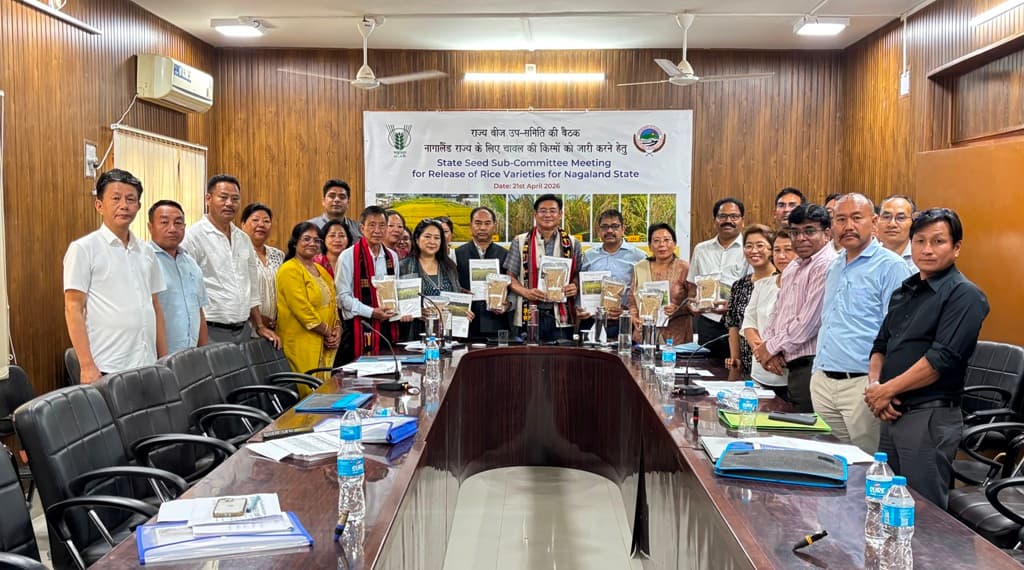
DIMAPUR — In a landmark development for the agricultural sector of Nagaland, the State Seed Sub-Committee has approved the release of seven newly developed short-duration rice varieties tailored specifically for the state.
The decision was taken during a meeting held on April 21 at the ICAR Research Complex for NEH Region, Nagaland Centre, Medziphema, in accordance with established protocols for varietal release.
An update from ICAR Nagaland Centre stated that rice cultivation in Nagaland has traditionally been dominated by long-duration, low-yielding varieties, posing significant constraints to productivity and cropping intensity. Recognising the urgent need for transformation, it stated that scientists have focused on developing improved varieties that combine shorter maturity periods with higher yield potential and resilience.
Also read: Minister C L John inaugurates new Forest Beat Office in Chen town
Presenting the findings of a decade-long breeding programme, Dr. Harendra Verma, Scientist (Plant Breeding and Genetics), highlighted that nearly 990 breeding lines were rigorously evaluated over multiple seasons and locations. From this extensive screening, 30 promising lines were shortlisted, culminating in the development of seven elite rice varieties.
It stated that the newly approved varieties mature within 115–120 days, significantly reducing crop duration while offering a yield potential of 5–7 tonnes per hectare. Importantly, they demonstrate enhanced tolerance to key biotic and abiotic stresses, making them well-suited to the diverse agro-climatic conditions of Nagaland.
Following detailed deliberations, the State Seed Sub-Committee unanimously approved all seven varieties for release and recommended them for further formalities for gazette notification.
Addressing the gathering, the chief guest and advisor of Agriculture, Mhathung Yanthan, described the approval of the seven rice varieties as a defining milestone in the state’s pursuit of agricultural self-reliance and resilience. He emphasised that the introduction of those scientifically developed, short-duration varieties would play a transformative role in enhancing productivity, reducing cultivation risks and strengthening food and nutritional security.
He further underscored that the achievement reflected the successful convergence of scientific innovation and policy support and called upon all stakeholders including line departments, extension agencies and farming communities to ensure the timely multiplication, dissemination, and large-scale adoption of these varieties across the state.
Dr. H Kalita, Head of the Nagaland Centre of ICAR Research Complex for NEH Region, underscored that the release represented the culmination of over nine years of dedicated research, reflecting the institute’s commitment to region-specific agricultural solutions.
It mentioned that the meeting witnessed the participation of key members of the State Seed Sub-Committee including senior officials from the departments of Agriculture and Horticulture, alongside District Agriculture Officers, KVK representatives and faculty from Nagaland University.
It added that eminent scientists such as Dr. SP Das, director of ICAR-NRC on Orchid, and Dr. SV Ngachan, former director of ICAR Research Complex for NEH Region, were also present.
It further stated that the approval of those seven short-duration rice varieties is expected to significantly enhance crop productivity, enable multiple cropping and strengthen climate resilience in Nagaland’s farming systems. It added that the initiative marked a crucial step toward improving farmers’ livelihoods and ensuring sustainable agricultural growth in the region.