

White Owl Literature Festival opened in Chümoukedima with sessions on anime, oral storytelling and reflections on reading, culture and folklore.
Share


DIMAPUR — The third edition of White Owl Literature Festival and Book Fair, presented by Penguin India, was inaugurated on Thursday at Zone Niathu by The Park, Chümoukedima.
The festival celebrates literature, ideas, storytelling and cultural exchange, bringing together authors, poets, thinkers, publishers and readers on a shared platform to engage in meaningful dialogue.
Addressing the gathering as chief guest, Speaker of Nagaland Legislative Assembly Sharingain Longkumer described the event as a congregation of “beautiful minds.”
He remarked that what people read ultimately shapes what they speak, and what they speak defines who they become—urging the audience to recognise the importance of reading with passion and purpose.
He said that the festival was a celebration of stories and inspiring minds, adding that the theme chosen by the festival director was apt. Longkumer also lauded the journey of the festival director, describing it as a beautiful story in itself.
Also read: Inclusive by design: White Owl Literature Festival puts diverse voices centre stage
Highlighting Nagaland’s rich tribal diversity and India’s wider cultural plurality, he said that there was much to learn from one another, adding that storytelling remains the most powerful way to share lived experiences.
He expressed hope that the festival would serve as a platform for authors, publishers, storytellers and literary enthusiasts to exchange ideas.
-1770309575977.jpeg&w=1200&q=75)
Referring to the growing influence of digital media, the NLA speaker cautioned against exposing children to it without adequate maturity and urged parents and educators to encourage reading, stressing the importance of preserving folklore and allowing children to grow up with literature.
Delivering the keynote address, senior journalist and the first woman president of the Press Club of India, Sangeeta Barooah Pisharoty, recalled that the maiden edition of the festival had stood out for its effort to celebrate literature in one of the remotest corners of the country by connecting local readers with a diverse range of authors.
According to her, the festival created valuable networking opportunities between national and regional writers, contributing to the growth of a literary community in a region long identified primarily with ethnic conflict.
Pisharoty maintained that the foundation laid in 2024 to steadily push literary boundaries has succeeded in establishing a significant new space for literature in Northeast India.
She added that literary festivals not only promote cultural and intellectual growth and critical thinking through dialogue, but also indirectly boost local economies by encouraging tourism.
%202-1770309579291.jpeg&w=1200&q=75)
Acknowledging platforms such as the Shillong Poetry Circle, she said that they have played a crucial role in highlighting English-language writing from the Northeast.
While some writing from the region emerged in the 1960s and 1970s, she shared that a more sustained push began in the 1980s, gaining wider recognition by the early 2000s.
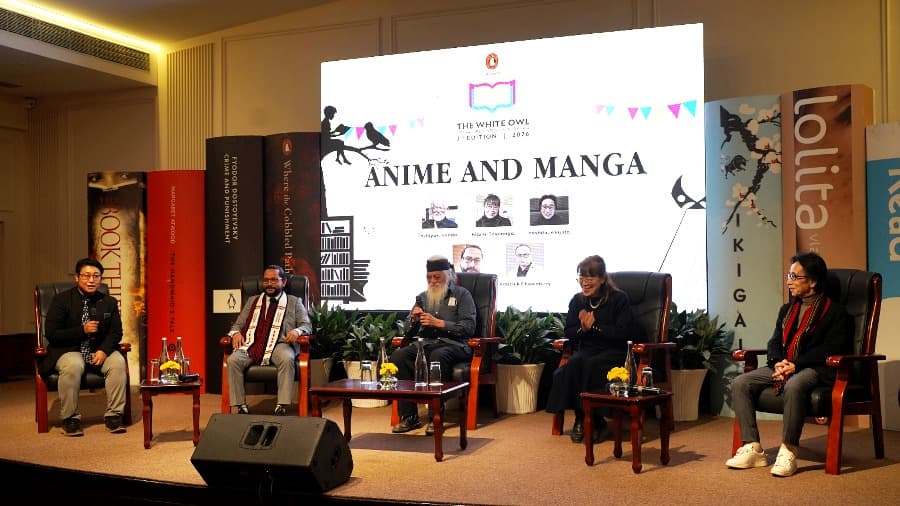
On the first day, the opening session focused on ‘Anime and Manga,’ featuring Japanese artist Toshiyuki Honda and others as panellists.
Honda explained the distinction between manga and anime, pointing out that while manga exists on paper, anime brings still images to life through movement.
He credited the global rise of manga and anime to visionary creator Osamu Tezuka, creator of Astro Boy, and highlighted the influence of Disney on Japanese animation.
Highlighting manga’s universal appeal, Honda said that it has helped children across cultures learn to read and connect.
He also expressed concern over violence-focused games and stressed the need for more animated works based on folklore, asserting that countries such as India and China possess rich storytelling traditions.
He maintained by saying that creative work driven by passion never feels like suffering.
This was followed by the second session, an oral storytelling segment titled ‘Stories by the Sacred Fire,’ featuring narrators Chollen Chang, Tokishe Achumi, Ramdi Nren and BR Kemp.
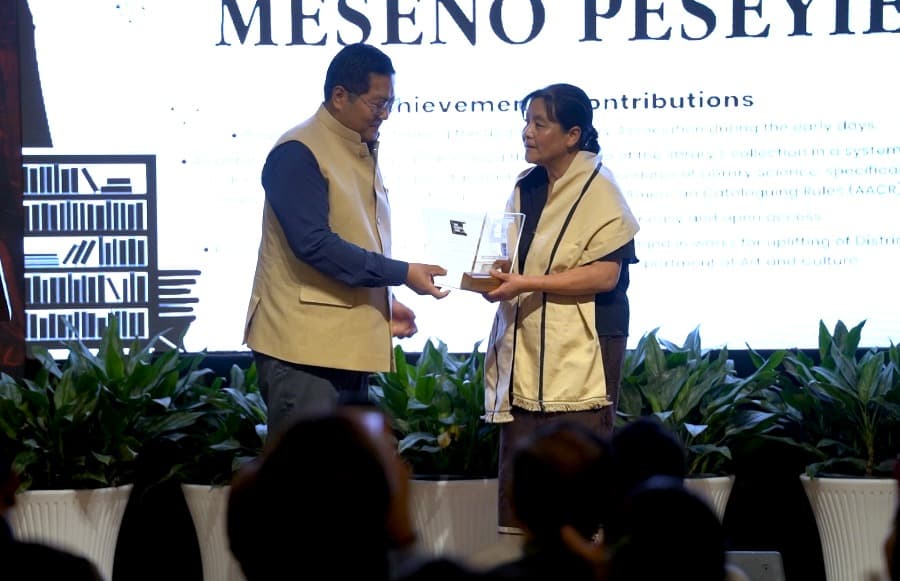
During the festival, the White Owl Librarian’s Honour was awarded to Meseno Peseyie for her role in the formation of Nagaland Library Association.
She is currently serving as joint director of Art and Culture and is actively engaged in strengthening district and rural libraries under the department.