


ENPO clarifies FNTA as a 10-year interim arrangement under Article 371A, reiterates statehood demand remains unchanged.
Share


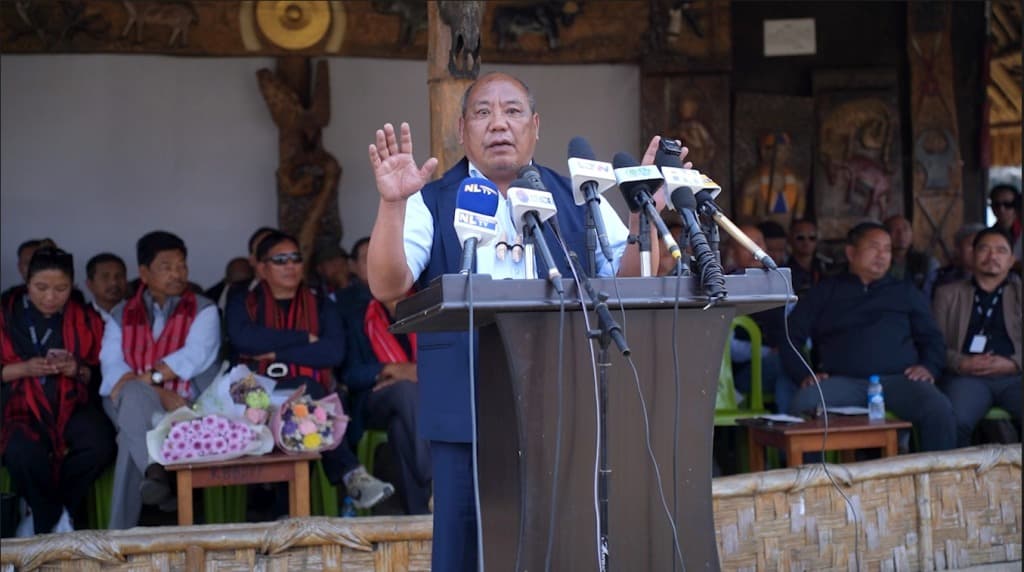
DIMAPUR — Following the major breakthrough achieved on February 5, with the signing of a tripartite Memorandum of Agreement (MoA) between the Centre, Nagaland government and Eastern Nagaland Peoples’ Organisation (ENPO) for the creation of Frontier Nagaland Territorial Authority (FNTA), ENPO president A Chingmak Chang on Saturday said that the arrangement would fall under Article 371(A) of the Constitution and remain in force for a period of 10 years.
Addressing reporters in Dimapur, Chang clarified that the ENPO’s demand for separate statehood remains unchanged, describing the FNTA as a “unique and special arrangement” offered by the Ministry of Home Affairs as an interim measure.
The ENPO delegation was accorded a civic reception and prayer programme organised jointly by the Eastern Nagaland Peoples’ Union (ENPU) Dimapur, ENPU Kohima and ENPU Chümoukedima, following the signing of FNTA agreement. Thousands from communities comprising the eastern districts of Nagaland, clad in traditional attire, gathered at Dimapur Airport and later at Konyak Paan to welcome the delegation.
Also read: One-year interim setup for ENPO areas before elections, says Nagaland Dy CM Patton
Explaining the benefits of the arrangement, Chang said that eastern Nagaland would receive financial and developmental support directly from the MHA. He added that a joint committee comprising representatives of the Centre, state government and ENPO would oversee the interim arrangement and monitor progress.
He said that the FNTA would function like a mini-secretariat, headed by a principal secretary or additional chief secretary, while the interim setup would be constituted by the governor in consultation with the ENPO.
Overcome with emotion while addressing the gathering at Konyak Paan, Chang briefly broke down as he recalled the decades-long struggle for statehood. He described the FNTA as a “people’s movement” and a significant first step towards the ultimate goal of statehood.
According to him, the tripartite agreement have given birth to a “baby boy”—the FNTA. “Now the responsibility is to nurture it and take it forward,” he said, urging unity among the eight tribes of eastern Nagaland.
“If we stand back-to-back and work together, we can succeed. We must not separate ourselves but move forward in unity and peace,” Chang told the gathering.
-1770465983070.jpeg&w=1200&q=75)
He thanked other Naga tribes and civil society organisations for their support, stressing that the FNTA would operate within the framework of Nagaland and its state boundaries.
“Yes, the government of India will provide funding, but we are not separating from Nagaland — we remain a part of Nagaland,” he said, appealing for continued cooperation to uplift eastern Nagaland.
Chang also informed that a thanksgiving and declaration programme would be organised once further details are shared by central leaders.
Addressing the gathering, ENPU Dimapur president NT Thamlong Phom said that the signing of the MoA marked the beginning of a challenging journey.
“This is a make-or-break moment. If we succeed, future generations will remember us. Our unity has brought us this far, and we must sustain it,” he said.