


Former Maharashtra home minister Padamsinh Patil and seven others in the 2006 murder of his cousin and Congress leader Pawanraje Nimbalkar and his driver.
Share


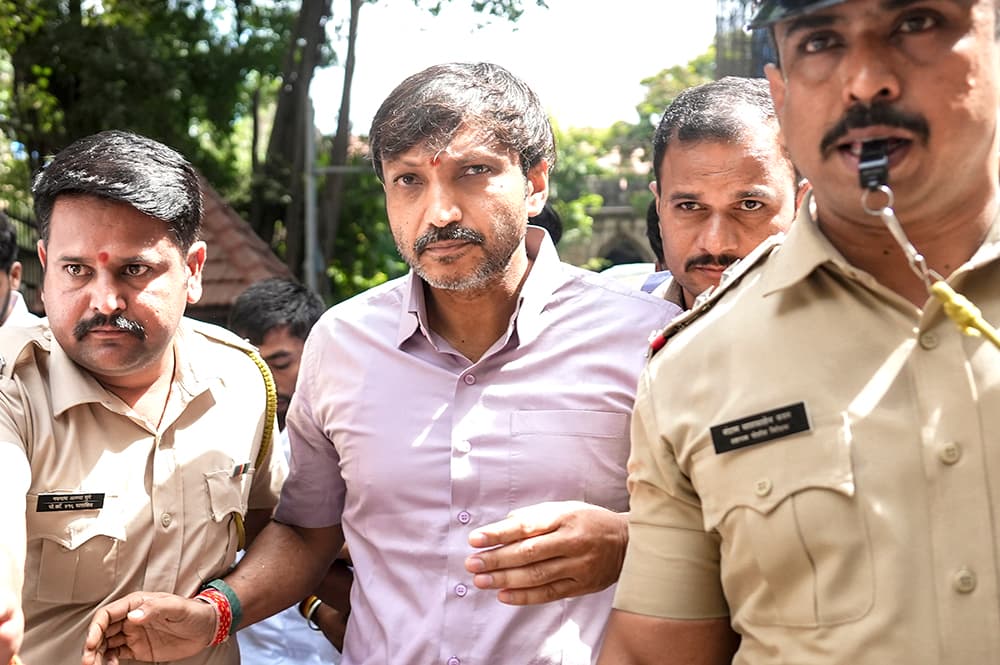
MUMBAI — A special CBI court here on Saturday acquitted former Maharashtra home minister Padamsinh Patil and seven others in the 2006 murder of his cousin and Congress leader Pawanraje Nimbalkar and his driver, citing "serious lapses and omissions in the investigation" and holding that a political rivalry itself was not the proof of participation in a criminal conspiracy.
The verdict in the high-profile case prompted Nimbalkar's son and Shiv Sena (UBT) MP Omprakash Raje Nimbalkar to ask 'who killed my father then', even as the Central Bureau of Investigation said it will challenge the acquittal before the Bombay High Court.
The prosecution heavily relied on the testimony of accused-turned-approver Parasmal Jain. But special CBI court judge Satyanarayan Navandar held that his testimony was completely unreliable. The judge also came down heavily on the CBI for failing to gather crucial digital evidence, such as the mobile phones or call detail records (CDRs) of the accused.
Approver Jain had been kept in illegal custody by the police for a significant period, the court noted, adding that there were so many contradictions in his statements that it led to the collapse of the prosecution's entire story.
Padamsinh Patil (now 85), a former MP of the undivided Nationalist Congress Party (NCP) and stepbrother of current Deputy Chief Minister Sunetra Pawar, and seven other accused faced the murder trial.
On June 3, 2006, Pawanraje Nimbalkar and his driver, Samad Kazi, were on their way from Mumbai to Osmanabad (now Dharashiv) when two hitmen intercepted the car at Kalamboli in Navi Mumbai and opened fire, killing both on the spot. The Navi Mumbai police initially probed the case, but the High Court later transferred it to the CBI after Nimbalkar's wife expressed dissatisfaction over the progress.
Patil was arrested in June 2009 after the central probe agency took over, but a sessions court granted him bail in September 2009.
Criticising the probe, the special court said that "the matters which were capable of objective verification were either not investigated with the required diligence, or were left unsupported by reliable documentary evidence." A serious and heinous crime may ultimately remain unpunished, but a person can not be convicted on the basis of dubious evidence, the judge said.
Parasmal Jain, who turned approver in the case, was not "a witness worthy of credit", and his testimony suffered from "serious infirmities, material contradictions, substantial improvements, inherent improbabilities and lack of independent corroboration," the court said.
The CBI's case was that political rivalry post-2002 soured relations between Pati and Nimbalkar. In 2002, activist Anna Hazare had leveled allegations of corruption against Patil regarding a "sugarcane scam", leading to the latter resigning as a minister. The bitter feud with Nimbalkar prompted Patil to orchestrate his killing, the CBI alleged.
Parasmal Jain had initially accepted the contract of Rs 30 lakh from co-accused Mohan Shukla and Satish Mandade to kill Pawanraje Nimbalkar, the CBI claimed.
The court held that bitter rivalry is "not unseen or rare in politics", but "proof of motive by itself is not proof of conspiracy or participation in the offence...the prosecution must still prove, by reliable and independent evidence, that the accused acted upon that motive and participated in the alleged conspiracy or offence."
Further, the court noted that Jain was granted pardon 13 years after charges were initially framed, after the accused's final submissions had been recorded, and introducing an approver's testimony at the very end of a trial raises grave suspicions of manipulation.
"If evidence of an approver is recorded after completion of entire evidence of prosecution, then there is every possibility of manipulation of the facts, improvements and alterations in the testimony to establish the missing links," the court stated.
Besides Patil, the other accused were Latur-based businessman Satish Mandade, retired state excise inspector Mohan Shukla, Dinesh Tiwari, Mahatam Chaudhary alias Pintu Chaudhary, Kailash Yadav, Gyanendra Pandey alias Dhirendra Pandey alias Chhote Pandey and Shashikant Kulkarni. All of them were acquitted.
The trial began in July 2011. During the 15-year-long trial, the court examined 128 witnesses, including Anna Hazare. Jain had confessed that Patil had simultaneously given a contract to eliminate the activist. Hazare testified about receiving threats from Patil.
A CBI spokespersons said in Delhi that the agency had presented strong evidence against the accused, and it will challenge the judgement before the high court.
Reacting to the verdict, MP Omprakash Raje Nimbalkar alleged that the police, who conducted the probe initially, were under pressure from Padamsinh Patil, a former home minister.
"The CBI carried out a thorough investigation. Once we receive and study the written judgment, we will certainly approach the high court. The only question my family has is: if all the accused have been acquitted, who killed Pawanraje?" the Dharashiv MP said.
"For 20 years, we attended every hearing and pursued the legal battle with the expectation that the guilty would be punished," he added.
Notably, Omprakash Raje Nimbalkar is among the six 'rebel' Shiv Sena (UBT) MPs who are said to be ready to cross over to the rival Shiv Sena led by deputy Chief Minister Eknath Shinde. Sena (UBT) leader Sanjay Raut had said earlier this week that Omprakash Raje had been told that he would have to switch sides for a favourable verdict in his father's murder, a claim the latter denied.
Poland and Ukraine have recently made progress on the issue of the exhumation of Polish victims. A December meeting between the two presidents in Warsaw had signalled progress on historical reconciliation.