


Vedpal Singh calls for community participation and public awareness to prevent and control forest fires in Nagaland.
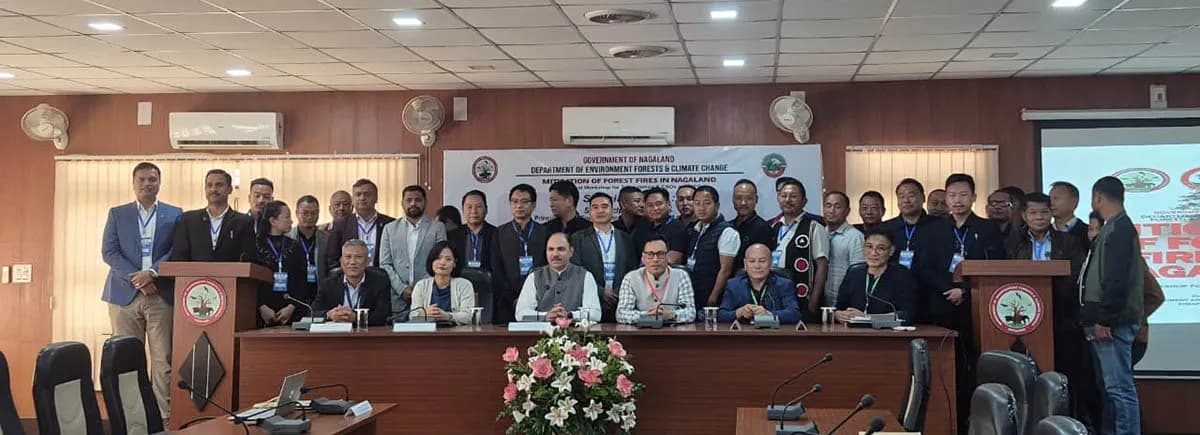
Vedpal Singh says public awareness and local involvement are crucial as most forest fires are man-made
DIMAPUR — Emphasising that most forest fires are man-made, Principal Chief Conservator of Forests (PCCF) and Head of Forest Force, Department of Environment, Forests and Climate Change, Vedpal Singh, on Friday stressed the need for greater community participation and public awareness to prevent and control forest fires in Nagaland.
Addressing a state-level workshop on “Mitigation of Forest Fires in Nagaland” in Dimapur, Singh said that unlike most other states, where forests are largely government-owned, forest ownership in Nagaland rests predominantly with the people, particularly communities, villages and clans, with a few forests also owned by individuals.
He said this makes public awareness and community involvement essential, as local people are the primary stakeholders and first responders in protecting forests.
The workshop was organised by the State Environment & Forestry Training Institute (SEFTI) and the Department of Environment, Forests and Climate Change for tribal hohos, civil society organisations (CSOs) and divisional forest officers (DFOs).
“Forest fires, in 99% of the cases, are man-made. If the public is aware, then the chance of a forest fire breaking out will also decrease,” Singh said, while acknowledging that some fires may occur naturally.
He cautioned that even intentional burning could lead to accidental forest fires, particularly during jhum cultivation. Carelessness during picnics, cooking and other activities in forests was also identified as a major cause.
Singh urged people to exercise extra caution while burning jhum fields, organising picnics, hunting or lighting fires in forest areas, especially during the winter season.
He said people should assess weather conditions and surrounding vegetation before lighting fires, adding that windy conditions required even greater precaution.
“While burning jhum fields, take a little more precaution; when having a picnic, look around carefully; if it is very windy, even more precaution needs to be taken,” he said.
He emphasised that preventing fires from starting in the first place was far more effective than attempting to control them after they had spread.
Once a forest fire breaks out, he said, it could quickly become uncontrollable, making firefighting efforts extremely difficult.
Drawing from his experience as a Divisional Forest Officer in Uttarakhand, Singh recalled that chir pine forests in the state caught fire almost every alternate year.
Despite repeated efforts, he said, controlling a forest fire after it had gained momentum was often nearly impossible.
Recalling an incident from two years ago, he said that despite efforts lasting three to four days, the fire could not be controlled, eventually leaving nature to burn whatever remained.
“It’s not that we did not try. We tried. But forest fire is such a thing that once it starts, you cannot even go near it. Forget about controlling,” he said, adding that counter-firing was among the few effective methods of controlling large forest fires, although it was also a destructive process.
Singh outlined three key areas in which community participation was essential: ownership and first response, prevention, and response during emergencies.
On ownership and first response, he said that since forests largely belonged to communities, villages and clans, local people were better placed to know who entered forest areas and what activities were being carried out. This made them the first line of response, rather than the Forest department alone.
On prevention, he said village councils, churches, CSOs and other community platforms could play an important role in raising awareness and discouraging activities that could trigger fires.
The third component, he said, was collective response whenever a fire broke out, irrespective of whether the affected forest belonged to a particular village, individual or community.
While the Forest department and disaster management authorities would respond, their efforts would not be sufficient without the cooperation of nearby villages and local organisations.
He stressed that the department alone could not manage forest fires without the support of tribal hohos, CSOs, villagers and other stakeholders.
He called for coordinated efforts to ensure that communities assist government agencies in extinguishing fires.
Also read: 39 Naga ancestral remains arrive in Delhi
Earlier, SEFTI Director Rampaukai, in his keynote address, said three modules had been designed for the programme.
The first module focused on building the capacity of field officers, describing them as the frontline of forest administration and the direct interface between the government, people and the natural resources they were entrusted to conserve.
The second module, conducted on Friday, brought together DFOs, who head district-level forest offices, and tribal hohos and CSOs, which have considerable influence over villages under their respective tribes.
The objective was to sensitise these stakeholders collectively on forest fire prevention and management.
Rampaukai said the initiative recognised that land in Nagaland was predominantly community-owned, with forests, biodiversity, wildlife and medicinal plants located on village lands.
Local communities were therefore the custodians of these resources, while the government's role was to guide, facilitate and support them in managing and controlling forest fires.
He pointed out that forest fires did not distinguish between church land, individual land or community land, destroying everything in their path.
Such fires resulted in the loss of wildlife, medicinal plants and trees, with the consequences ultimately borne by landowners, communities and the Forest Department.
“If all the resources that we are protecting get burned, it is our loss as well. So it’s an equal loss for all of us,” he said.
Emphasising the importance of shared responsibility, Rampaukai said communities and the Forest department must complement each other's efforts, with the common objective of conserving forests and biodiversity and preventing forest fires from destroying valuable natural resources.