


MSME camp in Dimapur aims to boost Nagaland entrepreneurs by improving access to schemes, credit, and market opportunities.
Share


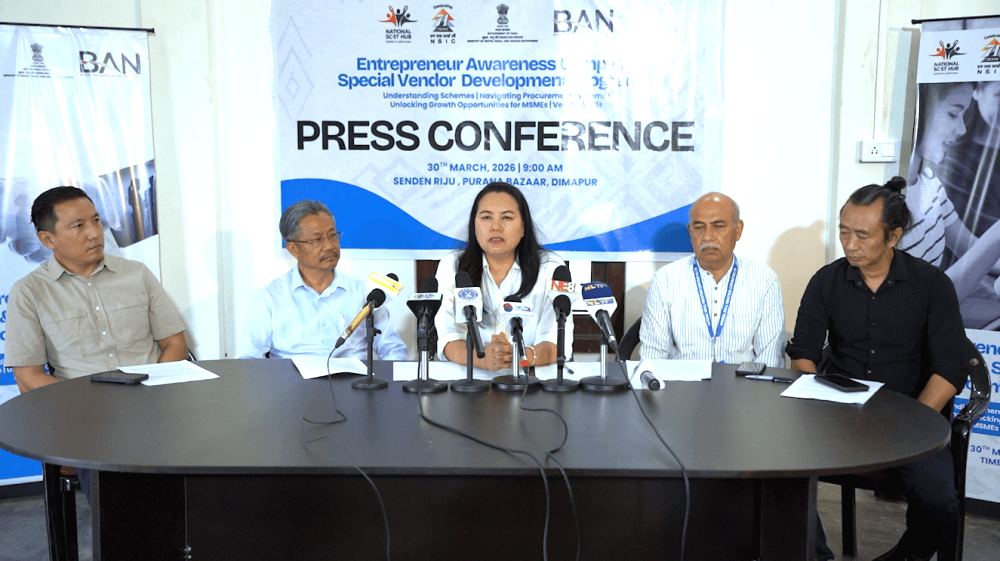
DIMAPUR — Stressing the need to strengthen Nagaland’s underdeveloped MSME ecosystem, Ministry of Micro, Small and Medium Enterprises (MSME) Joint Secretary Mercy Epao on Saturday announced an Entrepreneur Awareness Camp and Vendor Development Programme in Dimapur on March 30.
Addressing a press conference in Purana Bazaar, Epao said that the programme seeks to address the structural challenges holding back the state’s MSME ecosystem.
Organised in collaboration with the state government and the Business Association of Nagas (BAN), the initiative will bring together multiple central agencies, financial institutions and technical experts under one platform to directly engage with entrepreneurs and aspiring business owners.
Epao pointed out that while Nagaland is rich in niche products and human resource potential, its MSME ecosystem remains underdeveloped compared to other states, largely due to limited awareness of government schemes and inadequate access to institutional support.
Also read: NLA passes INR 22,127 crore budget for 2026–27, Rio pitches ‘Developed Nagaland 2047’ vision
“The idea is to identify low-hanging fruits, leverage our strengths and create employment opportunities by connecting entrepreneurs to schemes, credit and markets,” she said.
The one-day programme will offer on-the-spot facilitation services, including free and fully digital Udyam registration, enabling businesses to formally enter the MSME framework and access a wide range of government benefits.
WATCH MORE:
Highlighting the importance of formalisation, Epao said that registration is the first step for entrepreneurs to avail incentives such as the Production Linked Incentive (PLI) schemes and other benefits offered by various ministries and departments under the government of India.
She identified lack of awareness as the biggest hurdle in the state and said that the ministry is working towards saturating all districts with information on schemes and opportunities. “The government is reaching out with full support, but entrepreneurs must come forward to avail these benefits,” she added.
To strengthen value chains and improve product competitiveness, experts from institutions such as the National Institute of Design, Indian Institute of Packaging and NEIST Jorhat will be present at the camp to provide technical guidance and handholding support.
A key highlight of the programme is the ‘Special Vendor Development Programme,’ which will focus on enhancing market access by linking local entrepreneurs with procurement opportunities through platforms like the Government e-Marketplace (GeM). Representatives from Central Public Sector Undertakings (CPSUs) are expected to share their procurement requirements, opening avenues for Nagaland-based businesses to enter national supply chains.
Epao further informed that around 15 to 20 representatives from various central ministries will participate in the programme, presenting schemes tailored for different sectors, including those specifically designed for Scheduled Tribe entrepreneurs.
She drew attention to initiatives such as the National SC-ST Hub (NSSH), which provides capacity building and support services, and the Business Accelerator Programme (BAP), under which up to 90% of training costs are covered through premier institutions like the Indian Institutes of Management. “No entrepreneur from Nagaland has availed the BAP so far, despite its wide uptake in other parts of the country,” she said.
On the issue of credit access, Epao acknowledged that lack of collateral remains a persistent challenge, particularly due to the non-acceptance of land pattas by banks. As a solution, she highlighted the Credit Guarantee Fund Trust for Micro and Small Enterprises (CGTMSE), which offers collateral-free loans with up to 90% guarantee coverage for women and 75% for others.
She also pointed to emerging opportunities under the Open Network for Digital Commerce (ONDC), which aims to onboard five lakh MSMEs nationwide, with 50% slots reserved for women entrepreneurs—an opportunity she said Nagaland can leverage effectively.
NSIC General Manager Rajesh Madan claimed that given Nagaland’s predominantly Scheduled Tribe population, a large number of entrepreneurs stand to benefit from targeted schemes.
BAN president L Mongkum Jamir said the state currently has around 49,000 registered MSME units, in addition to a substantial informal sector comprising an estimated 30,000 to 40,000 enterprises. He suggested that lack of awareness has been a key factor limiting growth and participation in government programmes.
BAN vice president Benthungo Kithan highlighted the scale of untapped opportunities in government procurement, stating that central agencies alone procure goods and services worth over INR 1,000 crore annually in Nagaland. Of this, 4%—approximately INR 40 crore—is mandatorily reserved for SC/ST entrepreneurs under existing provisions.