


The Ao Senden hosted a seminar in Mokokchung on Article 371(A) and the Nagaland Village Council Act 1978, urging Nagas to understand and protect their rights.
Share


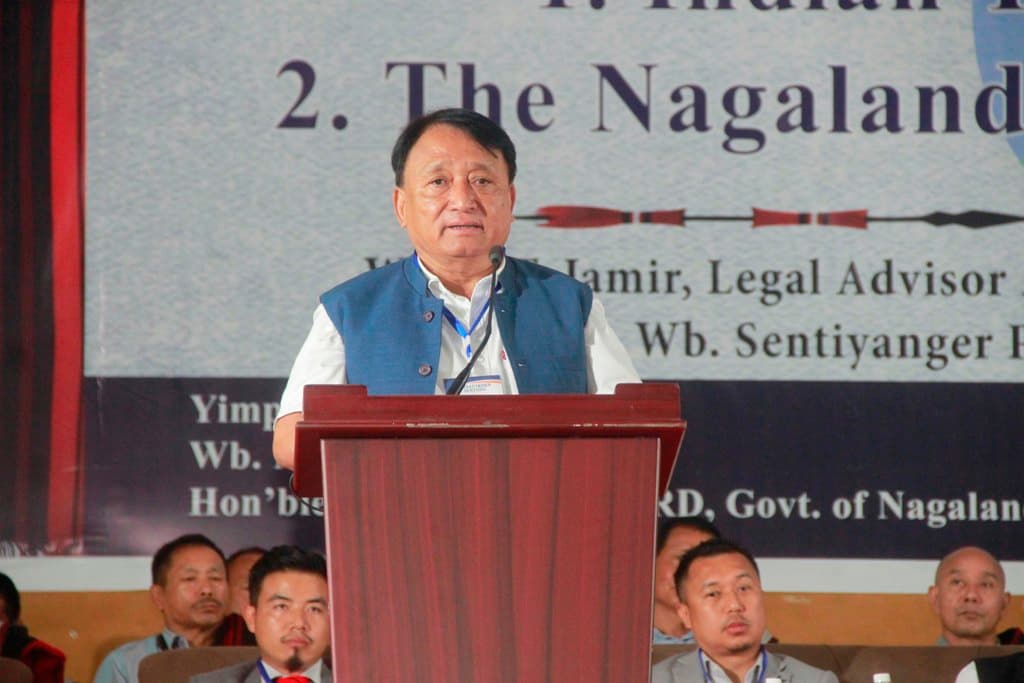
MOKOKCHUNG — A seminar on Article 371(A) of the Indian Constitution and The Nagaland Village Council Act 1978 was organised by the Ao Senden at the Town Hall in Mokokchung on Tuesday.
The event was hosted by the Minister for Rural Development and State Institute of Rural Development, Metsubo Jamir.
Land reluctance slowing development
Minister Jamir, in his speech, expressed concern that many Nagas do not take the significance of Nagaland’s statehood, attained on December 1, 1963, seriously.
He pointed out that the creation of the state was accompanied by special constitutional protections under Article 371(A), the Bengal Eastern Frontier Regulation, and income tax exemptions. He said these measures were incorporated to safeguard the interests of the Naga people, who had a small population, along with their land and resources at the time.
Jamir lamented that despite these hard-won rights secured by far-sighted forefathers, the present generation often fails to value them.
Also read: Academic achievers felicitated in Kohima, Pughoboto and Yachem
He criticised the reluctance to part with land for developmental projects, stating, "Why do we complain about what we don’t have when we are unwilling to give land for development? Our development progress is halted because of our hesitation to give land."
On the issue of income tax exemption, the minister noted the irony that while Nagaland benefits from taxpayer funds collected from the rest of India, the state frequently complains that central funds are insufficient. He urged the Ao people to move away from a culture of dependency and strive towards self-reliance and self-sustenance.
The minister pointed out that the responsibility of protecting Article 371(A) and The Nagaland Village Council Act 1978 lies primarily with village councils.
He cautioned that if the Naga people are not careful, there is a serious risk of the Centre repealing these constitutional safeguards, which could lead to an influx of outsiders and threaten indigenous control over land and resources.
Article 371(A) often misunderstood
Chief Secretary of Nagaland, Sentiyanger Imchen, described Article 371(A) as a constitutional provision intended to safeguard the traditional and customary identity of the Naga people. However, he regretted that many fail to fully comprehend the provision and often misinterpret its purpose, which he described as unfortunate.
While acknowledging that Article 371(A) was conceived as a transitional provision, Imchen called for adaptation to evolving societal needs and adherence to laws that develop with time.
He viewed laws as instruments of social change essential for societal progress and urged the framing of progressive legislation.
CT Jamir, Legal Advisor to the Ao Senden and Senior Advocate at the Gauhati High Court, speaking on the topic of Article 371(A) of the Indian Constitution, stated that while every Naga is aware of Article 371(A), many do not fully understand its scope and significance.
He said that only through a proper understanding of the law can people achieve what they aspire to; otherwise, "roadblocks" would continue to arise.
Tracing the historical background to 1842, the advocate explained how and why Article 371(A) came into existence for the Nagas and why it was incorporated into the Indian Constitution. He also pointed out that present-day Nagaland was once a district under Assam.
He stated that Article 371(A) falls under the special provisions for the State of Nagaland and stressed that Nagas should recognise its importance instead of taking it "in a general way".
He further noted that Article 371(A) contains only four clauses, adding that many Nagas wrongly assume that "everything under the sky" comes under its purview.
Describing the Article 371(A) provision as both restrictive and enabling in nature, he said that although Article 371(A) was enacted by the Indian Parliament, it was meant
for the benefit of the Nagas. He therefore urged the people to understand how to properly utilise the provision for their own benefit.
Village councils cannot override fundamental rights
Sentiyanger Pongen, Advocate at the Gauhati High Court, in his address on The Nagaland Village Council Act 1978, highlighted key provisions of the Act and explained how village councils function within the framework of customary laws and practices of each village.
He spoke on the process through which village council members are selected and the tenure prescribed under the Act. He also pointed out that certain sections of the Act could be misinterpreted if not properly understood.
Pongen stated that the rules do not grant village councils the authority to misuse or infringe upon the fundamental rights of citizens. Citing examples such as excommunication and banishment imposed by villages, he said that while such practices may exist within customary laws and traditions, they could conflict with constitutional guarantees, particularly the right to life and other fundamental rights.
Referring to the tenure of village councils, he noted that while most Naga village councils have a five-year term, among the Aos, the Putu Menden follows varying tenures depending on the village. He questioned whether the Putu Menden and the village council are legally the same entity and suggested that legislators should deliberate further on the matter.
He further observed that while the state government has the authority to dissolve a village council under the Act, it remains unclear whether the same power extends to the Putu Menden, as the Act is silent on the issue.
Stating that the powers vested in village councils are significant, Pongen said The Nagaland Village Council Act has been amended five times, with the latest amendment made in 2022.
He urged village council leaders to use the strength and flexibility of the Act to adopt progressive rules that would help move the community forward while highlighting the developmental, judicial, financial, administrative, and preventive measures during epidemics and pandemics bestowed to village councils by the Act.
In his address, Ao Senden President Marsanen Imsong highlighted the historical respect shown towards Naga customs and traditions. He noted that after the British entered the Naga Hills in 1832 and brought the area under their administrative control, they refrained from interfering with Naga customary laws, practices, traditions, and identity.
Instead, they appointed interpreters to better understand the unique Naga culture. Similarly, he said, the Government of India respected this distinct identity by incorporating Article 371(A) following Nagaland’s statehood to protect the community’s rich heritage.
Imsong stated that it is important not only to know one’s rights but also to understand them in depth. He said the seminar was organised precisely to equip participants with a comprehensive understanding of these provisions so they could effectively safeguard Naga rights.