


Advisor Zhaleo Rio urges preservation of Naga traditions at Tsüngkamnyo festival celebration.
Share


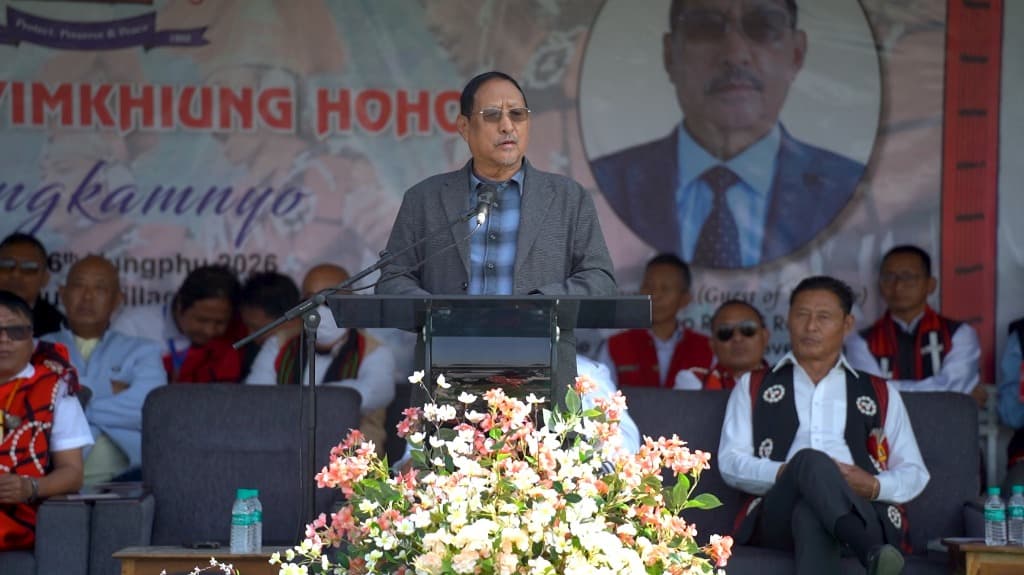
DIMAPUR — The Yimkhiung community celebrated its premier festival Tsüngkamnyo on Friday at Old Showuba Village public ground, Niuland, with Advisor for Urban Development and Municipal Affairs Zhaleo Rio as the guest of honour.
Tribal guests from the Western Sumi Hoho and Chakhroma Public Organisation attended the festival, organised by Western Yimkhiung Hoho (WYH). The event was celebrated with enthusiasm, with people wearing beautiful Yimkhiung traditional attire filling the ground.
Addressing the festive gathering, Advisor Zhaleo Rio said that the festival is a premier winter festival of the Yimkhiung community and noted similarities between it and the Angami Sekrenyi festival.
Also read: Western Sümi Hoho protests Assam Rifles' occupation of AAI land
He said that celebrating festivals of all Naga tribes throughout the year is a good tradition that should be observed with proper understanding of their meaning.
He noted that Naga festivals reflect the community’s rich culture, heritage, customary practices, traditional attire, indigenous games, feasting, and social bonding, adding that such observances ensure continuity and preservation of Naga traditions.
The advisor expressed concern that the dignity of labour and work culture are gradually eroding. He pointed out that despite Nagaland's high ratio of government employees compared to other states, employment opportunities remain limited, and society has become increasingly consumer-oriented rather than productive.
He said unemployment has grown largely due to the obsession with government or “white-collar” jobs, noting that recruitment today is based on merit and limited posts.
Zhaleo cautioned that if society focuses only on festivals, sports, conventions, and celebrations without meaningful work, the true spirit of the “Land of Festivals” would be lost.
He stressed that festivals should be celebrated after working and understanding their true significance, warning that neglecting work culture would ultimately affect families and future generations.
He said Naga festivals are closely linked to farming and agriculture, which remains the main livelihood for many families. Highlighting the values of hard work and self-reliance of the forefathers, he said they worked harder during shortages instead of seeking help.
Raising concern over unemployment, the advisor noted that many private-sector job opportunities exist in Dimapur, yet Naga participation remains low. He urged the youth to embrace the dignity of labour, acquire skills, and not limit themselves only to government jobs.
He added that livelihood development must begin at the family and village level with support from VDBs and agriculture-related departments, urging families and youth to take responsibility for sustainable living.
During the celebration short speeches were also delivered by the presidents of the Western Sumi Hoho, Western Sumi Kukami Hoho, and Chakhroma Public Organisation, along with SDO (Civil) Kuhuboto, Nuhuta Tunyi.
The significance of Tsüngkamnyo Munchi was highlighted by Western Yimkhiung Hoho (WYH) president H Akiumong.
Cultural presentations were performed by Angopong Cultural Club, Kohima, while the Rhythmic Fusion Band, Dimapur, presented a special song.