

Mhathung Yanthan launches books on Naga returnees and Lotha language, recalling COVID-19 challenges
Share


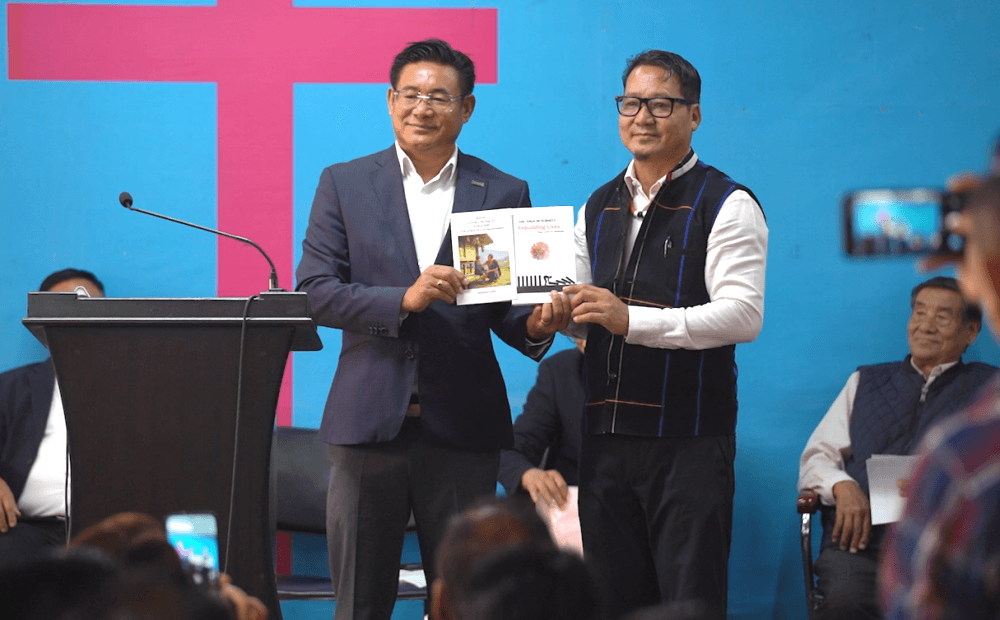
DIMAPUR — Advisor for Agriculture Mhathung Yanthan launched two books titled “The Naga returnees: Rebuilding lives post Covid-19” and “Basic Lotha (Kyong Yi) English Yilanglita (Conversation),” authored by Dr. Rev. Yanbemo Lotha and published by Heritage Publishing House, at Lotha Baptist Church, Dimapur, on Monday.
While unveiling the two books, the advisor emphasised the lasting relevance of traditional reading habits despite rapid technological advancements.
Yanthan noted that although many people now turn to the internet and social media for reading, the passion for physical books continues to thrive among dedicated readers.
He encouraged writers to keep contributing to literature, emphasising the importance of promoting one’s mother tongue through writing. He also urged authors to adhere to standardised guidelines established by literature committees.
Also read: Nagaland’s rural library network grows to 448
The advisor further remarked that reading not only expands knowledge but also sharpens the mind.
Referring to the newly released works, he described them as reflections of the challenges faced during the pandemic and as sources of inspiration to build resilience in the face of future crises.
WATCH MORE:
Principal Secretary, Environment Forest and Climate Change, Fisheries and Aquatic Resources and Parliamentary Affairs, Y Kikheto Sema, who also addressed the event, recalled the immense challenges of the COVID-19 pandemic, describing 2020 as a year of fear and uncertainty following the nationwide lockdown imposed in late March.
He said a special team was formed on April 2, 2020, with him as convener, to manage the lockdown in Dimapur and prepare for the return of nearly 20,000 Naga citizens, about 65% of whom were from Dimapur and nearby areas. Despite resistance, the team established 52 quarantine centres with around 4,000 beds.
He also stated that on May 12, 2020, he was given overall charge of returnees, and on May 22, 2020, the first special train, Chennai Express, brought back 2,469 people.
Nearly 50% later tested positive, leading to it being dubbed the “Corona Express.” Another train from Haryana on May 25 brought 1,345 returnees, intensifying fear among the public and even health workers.
Kikheto said one of the most painful moments was when some families refused to accept their own members or allow burials.
After four months, the situation stabilised, but a second wave struck after a ten-month pause.
He recalled that some were afraid to even approach the bodies of the deceased to offer prayers. He said he remembered criticising some who were only visible during the good times but disappeared during the crisis.
He added that eventually, many came forward to help, and it was heartening to see that spirit revived.
Associate Professor of Eastern Theological College, Jorhat, Dr. S Ekonthung Ezung, speaking on the books’ core genre, said that one preserves identity, specifically Naga English conversation, and the other restores dignity, that is the Naga returnees, and together they reflect both cultural rootedness and pastoral responsibility.
He mentioned that the author’s writing is not accidental; it is driven by discipline, conviction, and a desire to serve, and more importantly, his scholarship is not distant from life, and that is why this book is not merely academic; it is lived theology.