


Nagaland PwD commissioner urges inclusive accessibility policies, warning exclusionary digital systems deepen inequality and limit equal participation
Share


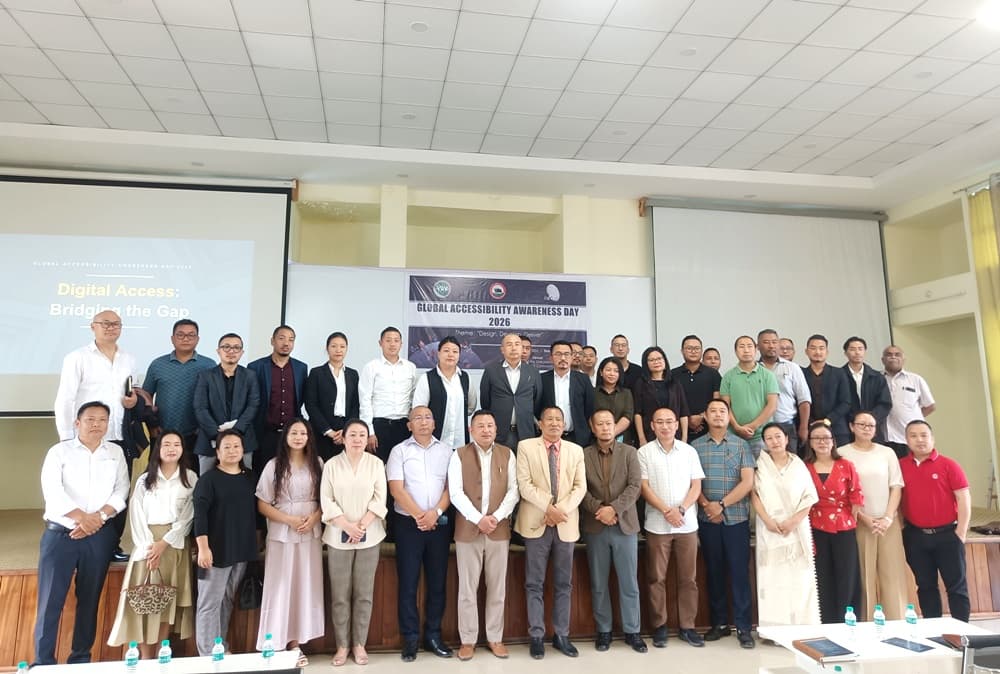
KOHIMA — State Commissioner for Persons with Disabilities (PwDs) Tongpang L Jamir on Thursday said that accessibility must be treated as a fundamental right and integrated from the beginning in policymaking, design and service delivery.
Addressing the observation of Global Accessibility Awareness Day 2026 in Kohima, Jamir said that inclusive development requires coordinated efforts from government institutions, educational bodies, businesses and faith-based organisations.
Observed on the theme ‘Design, Develop, Deliver’, the programme focused on improving digital and physical accessibility and promoting equal participation for PwDs.
Jamir said that while the state government has a responsibility to develop inclusive policies, churches also have an important role in promoting inclusion, dignity and equal participation.
He said that churches can contribute by creating accessible spaces, encouraging inclusive worship, promoting the use of digital tools and raising awareness against discrimination.
Also read: Nagaland urged to build 'legally airtight' child protection model rooted in Naga realities
“Inclusion is not an act of charity — it is a matter of fairness, equality, justice and human progress,” he said.
Calling accessibility a basic human right, he said that every individual deserves equal access to information, education, healthcare, employment and opportunities to participate fully in society.
“Accessibility is about dignity, equality and respect,” he said, adding that creating accessible environments enables both able-bodied persons and persons with disabilities to learn, work, communicate and live independently with confidence and freedom.
Jamir noted that as technology increasingly shapes banking, education, healthcare, transport, government services and communication, accessibility has become more critical than ever.
“Yet when digital systems are not designed inclusively, they can deepen inequality instead of eliminating it,” he said.
He stressed that accessibility should be considered from the outset in all decisions and planning processes.
“Accessibility should never be treated as an afterthought or an optional feature; it must become a fundamental part of everything we do,” he said.
He further said that schools and colleges must ensure equal learning opportunities, businesses should create products and services that are usable by everyone, and developers and designers should adopt universal design principles.
“When accessibility is prioritised, it benefits not only persons with disabilities but society as a whole,” he added.
Akumla Aier, Senior Programme Officer at IT&C Nagaland, delivered a presentation on ‘Digital Access: Bridging the Gap”, highlighting accessibility as a matter of human rights and independence. She also spoke on assistive technologies including screen readers, switch access and magnifiers, and discussed issues related to locomotor and physical access.
Read more: No seat left behind: Former disability commissioner pushes for accessible NST buses in Nagaland
Presenting on ‘What is Physical Accessibility, why is it important?’, Viketukho Nakhro, Programme Officer at the Office of the State Commissioner for PwDs, said that digital access and physical access are interconnected and essential for inclusion.
He cited Census 2011 data showing 29,631 persons with disabilities in Nagaland, accounting for 1.5% of the population, but said the figure is likely an underestimation and that future census exercises may provide a more accurate picture.
Nakhro said that accessibility challenges persist despite recent progress and argued that accessibility must extend beyond ramps and wheelchair access to include all disability categories and participation in social life.
He said improvements are needed across schools, workplaces, healthcare facilities, churches, markets, public transport systems and government offices.
Chairman of the Nagaland Staff Selection Board, Kevikha Kevin Zehol, and Director of Information Technology and Communication Nagaland, Sabou Yashu, also addressed the programme.