


Nagaland Director General of Police (DGP) Rupin Sharma on Saturday said police are continuing efforts to trace absconding accused Robert Kikon, who is wanted in connection with a POCSO case
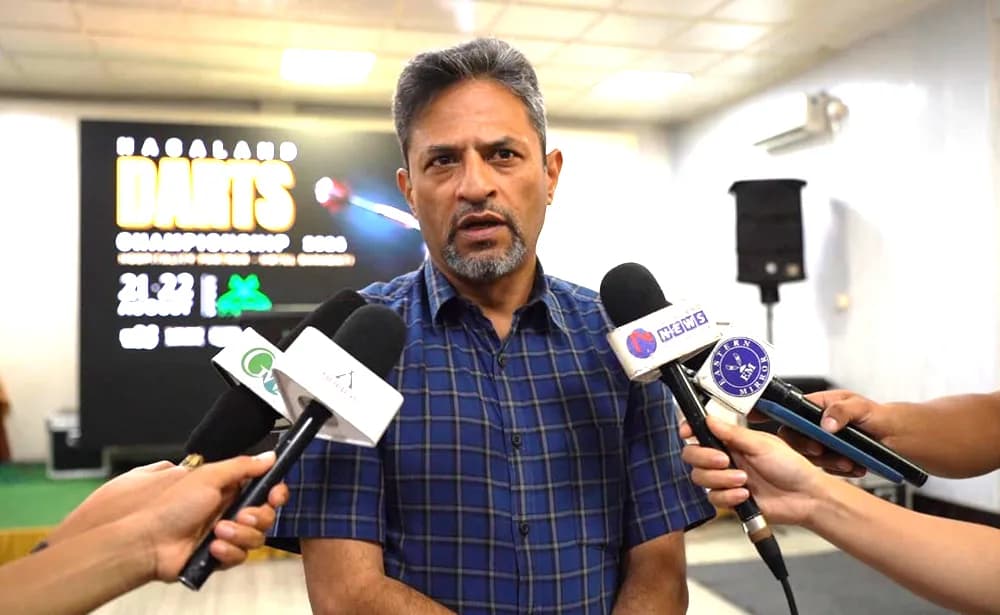
DIMAPUR — Nagaland Director General of Police (DGP) Rupin Sharma on Saturday said police are continuing efforts to trace absconding accused Robert Kikon, who is wanted in connection with a POCSO case and is believed to have travelled across several Southeast Asian countries.
Speaking to the media on the sidelines of an event in Dimapur, Sharma said the accused had initially fled to a Southeast Asian country and that Police were able to trace him to Cambodia and subsequently to Vietnam, where he allegedly entered using a different passport.
He was responding to queries about the whereabouts of Kikon, who went into hiding since October 2024 following revelations of alleged sexual misconduct involving minors.
The police have since received information suggesting that Kikon may have moved to another Southeast Asian country, and efforts are underway to establish his exact location, he said, expressing hope of locating him.
Also read: Dimapur POCSO court issues proclamation against absconding accused Robert Kikon
Nagaland DGP appeals for information on fugitive pastor Robert Kikon
“If he has committed an offence, it would be better for him to come back to India and face the law on his own rather than keep running around,” he said.
The DGP explained that if an accused is within India, police personnel of any State can arrest, but international legal procedures, including extradition, have to be followed if the person is outside the country.
He added that once the exact location is established, the legal process to bring him back can be initiated, noting that such procedures take time, particularly when the accused’s exact whereabouts are unknown.
1440 CCTVs for Dimapur and Kohima
When asked about the implementation of closed-circuit television (CCTV) surveillance in Dimapur, Sharma said the Ministry of Home Affairs, under the Police Modernisation Scheme, has sanctioned funds to the Nagaland government to establish an extensive CCTV surveillance network in Dimapur and Kohima.
WATCH MORE:
The proposed project envisages the installation of around 1,440 CCTV cameras across the two districts.
The DGP informed that the network will include conventional surveillance cameras as well as cameras equipped with facial recognition capabilities to help identify and track criminals.
The system is also expected to have additional functionalities to detect traffic violations, including riding two-wheelers without helmets, driving without seat belts, wrong parking and parking in prohibited areas. It may also assist in detecting people carrying weapons.
Sharma said the tender for the project had already been floated and the process was nearing completion, expressing hope that they should be able start installation of the cameras within two months.
Nagaland Police have already installed around 60 CCTV cameras at various locations through financial assistance from sponsors and well-wishers, he said, adding that they received funds through Corporate Social Responsibility (CSR) support from institutions, including Corporation Bank and Bank of Baroda, while the State Bank of India has also sanctioned financial assistance.
He informed that Chief Minister Neiphiu Rio and Deputy Chief Minister Y. Patton have contributed INR 5 lakh each, while Rajya Sabha MP S. Phangnon Konyak has also provided financial assistant towards the initiative.
The DGP pointed out that the expenditure involved in establishing an effective surveillance system goes beyond merely installing cameras, noting that the cost is not just the cameras but the major cost is on the software which detects and analyses things, as well as on the computer servers where the data is stored and processed.
He added that recurring expenditure is also required for internet connectivity and the transmission of data from the cameras to the central servers.
The existing network of around 60 cameras is currently being operated with the available resources, he said, adding that the proposed large-scale project would significantly improve the surveillance system.
On Chümoukedima IED blast probe
On the recent suspected IED blast at Chümoukedima village, Sharma said the state police have transferred all records, evidence and other materials collected during the initial investigation to the National Investigation Agency (NIA) after the case was handed over to the central agency.
The NIA, being an independent central investigating agency, does not normally share regular updates with the State Police, he said, adding that they will come to know only if they require their assistance in conducting searches, arrests or any other operation. He, however, expressed confidence that the central agency is pursuing the case in the right direction.