


Nearly 96% of Nagaland households are covered by health insurance schemes, says NHPS official Dr. Kikameren LKR.
KOHIMA — Nagaland government is keen to expand the coverage of the Chief Minister Health Insurance Scheme (CMHIS) to include a wider range of treatments, including outpatient (OPD) services, but budgetary constraints currently limit the scheme to inpatient care, Dr. Kikameren LKR, Joint CEO of Nagaland Health Protection Society (NHPS), said on Friday.
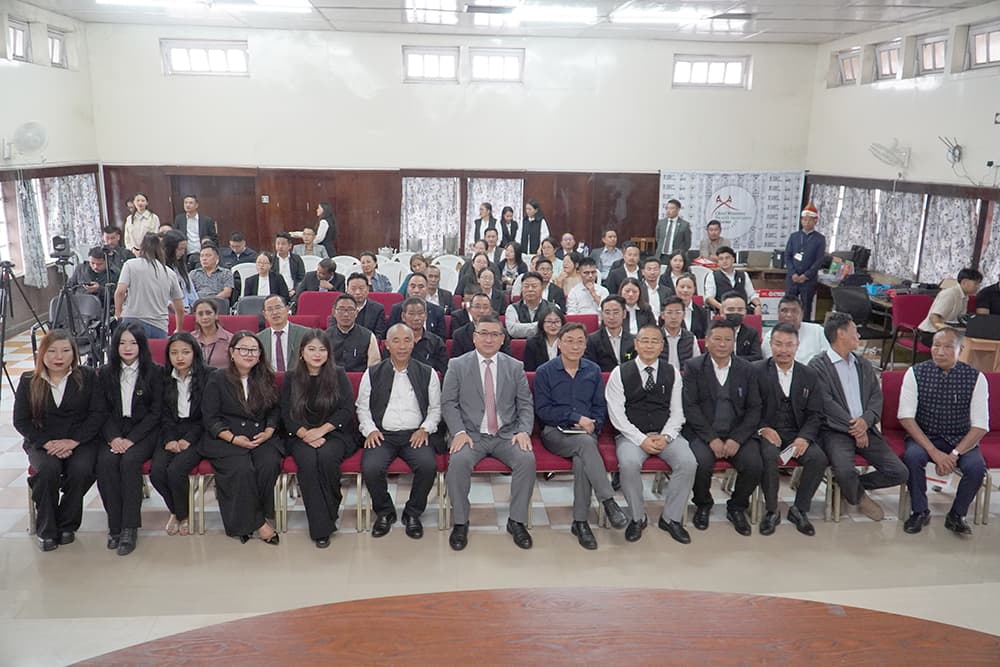
Dr. Kikameren was speaking at a seminar on CMHIS jointly organised by the High Court Bar Association and the Kohima Bench of Gauhati High Court in Kohima.
He explained that the CMHIS, launched in 2022, comprises two sub-schemes—one for government employees and pensioners, offering insurance coverage of up to INR 20 lakh per family per year, and another for the general category, popularly referred to as the "missing middle," covering those not included under other government health insurance programmes.
Highlighting the scheme's reach, he said that the Pradhan Mantri Jan Arogya Yojana (PM-JAY) covers around 2.59 lakh beneficiaries in Nagaland, while about 97,125 households of government employees and pensioners are enrolled under CMHIS.
Including the "missing middle" category, he estimated that nearly 96% of households in the state are covered under one of the health insurance schemes.
The doctor explained that government employees and pensioners contribute 50% of their monthly medical allowance towards the implementation of CMHIS.
The contribution collected amounts to nearly INR 60 crore annually, while the insurance premium payable comes to around INR 94 crore, with the state government bearing the remaining INR 34 crore.
Similarly, he informed that the state government contributes around INR 40 crore towards PM-JAY and another INR 10 crore for the CMHIS general category.
The NHPS has empanelled hospitals both within and outside Nagaland to ensure wider access to healthcare services, he said, adding that around 60 to 70 hospitals outside the state have been empanelled, particularly in locations frequently visited by patients from Nagaland.
He added that the scheme also provides a mechanism for beneficiaries to access treatment in non-empanelled hospitals under certain circumstances.
Also read: NSF renews opposition to Yoga Day observance, seeks voluntary participation clarification
Hospitals outside the state are required to be accredited by the National Accreditation Board for Hospitals and Healthcare Providers (NABH) to ensure quality healthcare services.
According to him, incentives offered under the scheme vary depending on the accreditation status of the hospital, whether it is a teaching institution, and the classification of the city where it is located.
The attractive package rates have encouraged several reputed hospitals to join the scheme, he said.
To avail of cashless treatment, beneficiaries are required to obtain a CMHIS card and present it at any empanelled hospital.
Dr. Kikameren also shared that NHPS has received complaints of hospitals charging patients over and above the approved package rates. To address such grievances, a 24x7 toll-free helpline has been established for beneficiaries to lodge complaints.
He said that hospitals found guilty of malpractice or fraudulent claims face stringent action, including suspension of empanelment.
Speaking on the occasion, Justice Nelson Sailo of Gauhati High Court lauded the state government for introducing provisions that enable patients to access treatment even in hospitals that are not empanelled under the scheme.
He described a robust healthcare system as the backbone of society.